

You get a text that says “nty” and wonder what it means. NTY means “no thank you.” People use it to decline an offer, an invite, or a suggestion in a quick and polite way.
This guide explains NTY meaning in text in simple words. You will learn where it came from, how to use it, and how to reply to it. You will also see real examples, tone tips, and when to avoid it in professional chats.
Meaning & Definition
What Does NTY Meaning in Text?
NTY is an acronym for “no thank you.” You will see it in text messages, social media comments, direct messages, and game chats. It works as a short, polite refusal. NTY means “no thank you” in text. Someone sends it to decline an offer, invitation, or suggestion without writing a long reply.
The abbreviation has three parts. N stands for “no.” T stands for “thank.” Y stands for “you.” People type it in capitals (“NTY”) or lowercase (“nty”). Both mean the same thing.
NTY sits close to other polite shorthand like “TY” (thank you) and “NP” (no problem). The difference is that NTY carries a refusal. The word “thank” keeps it softer than a plain “no.”
| Part | Stands For | Role in the Phrase |
| N | No | Signals refusal |
| T | Thank | Adds politeness |
| Y | You | Directs it to the other person |
Background / Origin
NTY grew out of early internet culture. Chat rooms, message boards, and IRC channels forced people to type fast and keep messages short. Shorthand like “TY” and “BRB” became normal, and NTY followed the same pattern.
One popular slang explainer notes that Urban Dictionary has a definition for NTY dating back to 2005. That suggests the abbreviation has been around for roughly two decades. Nobody can name one single inventor, and that is common with slang.
Instant messengers and mobile phones pushed it further. Typing on a small keypad took effort, so three letters beat three words. Later, social apps carried it into everyday chat.
Usage in Different Contexts
NTY changes feel depending on where you use it. A message to a close friend reads very differently from one sent to a manager. The next few sections break it down.
General Usage
In everyday chat, NTY declines something without drama. A friend offers snacks, a ride, or a plan. You answer “nty” and the matter is closed.
People use it in three main ways:
- To refuse an offer (“Want some cake?” “nty”)
- To turn down an invite (“Join us Friday?” “nty, I’m tired”)
- To reject a suggestion (“Let’s watch a horror movie” “nty”)
It works best when the other person already knows you. Close friends read it as relaxed. Strangers may read it as cold.
Adding a few extra words helps. “NTY, but thanks for asking” sounds warmer than the bare abbreviation.
Formal vs Informal Usage
NTY belongs to informal writing. It fits casual chat, group messages, and gaming lobbies. It does not fit contracts, official emails, or job applications.
Here is a simple comparison:
| Setting | Is NTY Okay? | Better Option |
| Chat with friends | Yes | NTY or “no thanks” |
| Family group chat | Usually | “No thank you” |
| Customer support message | Rarely | “No thank you, I’m all set” |
| Email to a boss or client | No | “Thank you, but I must decline” |
| Job interview follow up | No | A full polite sentence |
The rule is easy. When the relationship is casual, NTY works. When the relationship is formal, write the full phrase.
NTY Meaning on Social Media Platforms
NTY appears across most apps, and the meaning stays the same. Only the style changes slightly.
- WhatsApp and Messenger: People use NTY in one to one chats and groups to refuse plans or food offers. It is quick and common here.
- Snapchat and Instagram: NTY shows up in direct messages and story replies. Someone might answer a poll or invite with “nty.”
- TikTok and X (Twitter): Users drop NTY in comments to reject a trend, a product, or an opinion. Here it can sound dismissive or even playful.
- Gaming chats and Discord: Players use NTY when they decline a party invite, a trade, or a team request. The pace is fast, so short replies are normal. Nobody expects a paragraph during a match.
Other Meanings in Different Fields
For nearly all texting, NTY means “no thank you.” A few rare uses exist outside chat, and context makes them obvious.
- Aviation: NTY is an airport code linked to Pilanesberg International Airport in South Africa. You would see it on tickets or flight listings, not in casual chat.
- Typo for NYT: Some people mistype “NYT” (The New York Times) as “NTY.” Context usually reveals the mistake.
- Product listings: NTY is not a condition code. It should not be confused with “NWT,” which means “new with tags” in resale listings.
If a message has no offer, invite, or question, check for a typo before you assume it means “no thank you.”
Examples of NTY Meaning in Text in Sentences
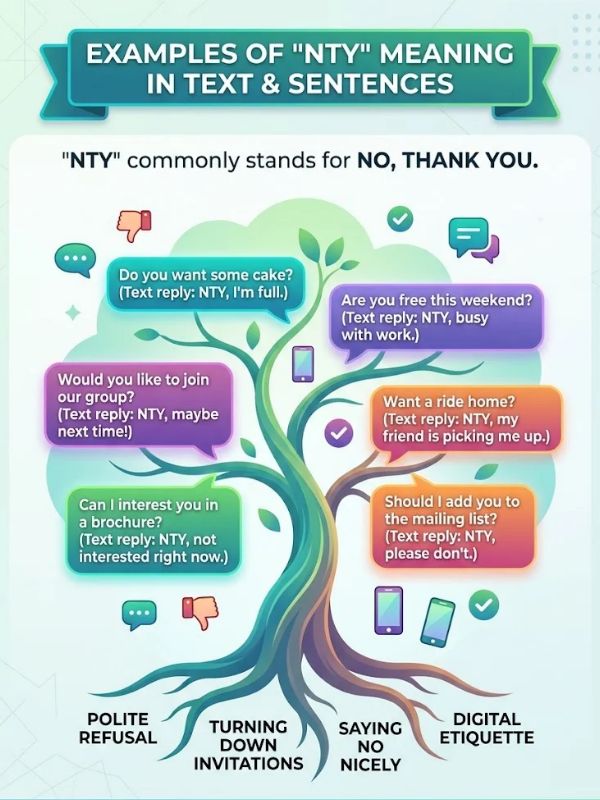
Examples make the abbreviation easier to spot. Below are real life style texts across different situations.
Declining food or drinks
- “Want a slice of pizza?” “NTY, I just ate.”
- “More tea?” “nty, I’m full.”
Declining plans
- “Movie tonight?” “nty, I have an early meeting.”
- “Come to the party on Saturday.” “NTY, but have fun!”
Declining help or advice
- “Need me to fix that for you?” “nty, I’ve got it.”
- “You should try this diet.” “nty, I’m happy with mine.”
Declining in gaming
- “Join our squad?” “nty, playing solo.”
- “Trade your sword for my shield?” “nty.”
Declining a sales message
- “Want to see our offer?” “NTY.”
Notice the pattern. The short replies stay polite when the sender adds a small reason. The bare “nty” can feel sharper.
Common Misconceptions
Many people misread NTY. These myths cause most of the confusion.
- Myth 1: NTY is always rude. It is not. The word “thank” is built into it. Tone depends on context and the relationship.
- Myth 2: NTY means “not today yet” or “not that yet.” It does not. These are guesses with no real support.
- Myth 3: NTY is the same as “no.” It is softer. A plain “no” ends the talk. “NTY” ends it with courtesy.
- Myth 4: NTY always means the person is angry. Most people use it because it is fast. Speed is the usual reason, not anger.
- Myth 5: Only young people use it. Teens use it a lot, but adults use it too in casual chats.
Similar Terms & Alternatives
Many abbreviations and phrases do a similar job. Pick the one that fits your tone.
Shorthand alternatives
- NT: Often means “nice try” or “no thanks,” depending on context
- NP: “No problem,” used after thanks
- NVM: “Never mind,” used to drop a topic
- TY: “Thank you”
- TYSM: “Thank you so much”
- IDK: “I don’t know,” sometimes used to dodge a request
Full phrase alternatives
- “No thanks”
- “Maybe next time”
- “I’ll pass, but thanks”
- “I appreciate it, but I’m good”
- “Not for me, thanks”
If you want to sound friendly, add a small warm line. “Maybe next time!” feels gentler than a bare refusal.
How to Respond to NTY Meaning in Text When Someone Uses It
When someone sends NTY, the best move is usually the simplest one. Accept the answer and move on.
Featured snippet answer: Reply to NTY with a short, friendly message like “No worries!” or “All good.” Do not push or ask them to explain.
Here are good replies for different situations:
| Situation | Good Reply |
| You offered food | “No problem, more for me!” |
| You invited them out | “No worries, maybe next time.” |
| You made a suggestion | “Got it, we’ll do something else.” |
| You sent a business offer | “Understood. Thanks for letting me know.” |
A few habits to avoid:
- Do not send a long message begging for a reason.
- Do not repeat the offer again and again.
- Do not guess that they are upset.
- Do not take it personally.
If you feel unsure about the tone, ask a light question later. “Everything okay?” works better than “Why are you being rude?”
Difference Between NTY Meaning in Text and Similar Terms
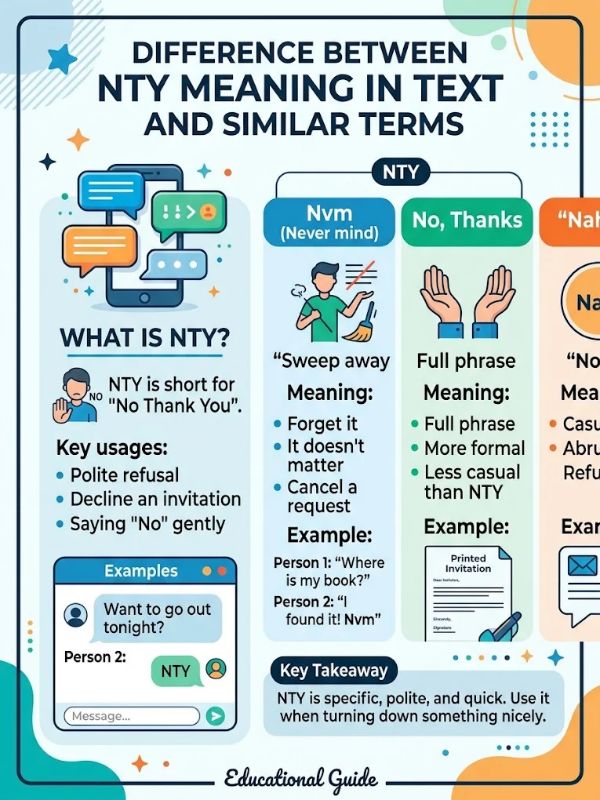
NTY is easy to mix up with other short replies. The table below shows how each one differs in meaning and tone.
| Term | Meaning | Tone | Used For |
| NTY | No thank you | Polite, brief | Declining an offer |
| NP | No problem | Friendly | Replying to thanks |
| NT | Nice try / no thanks | Playful or blunt | Teasing or declining |
| NVM | Never mind | Neutral | Dropping a topic |
| TY | Thank you | Warm | Showing thanks |
| NWT | New with tags | Neutral | Resale listings |
| NYT | New York Times | Neutral | News reference |
The main difference is intent. NTY refuses. NP and TY express gratitude or ease. NVM cancels a thought. NWT and NYT have nothing to do with chat manners at all.
One more detail helps. NTY and TY look similar, but they carry opposite energy. One declines. The other thanks. Read the full message before you decide.
Relevance in Online Conversations & Dating Apps
Online talk moves fast, and NTY fits that speed. It lets people set boundaries without writing a speech. That is why it appears often in group chats, comments, and messaging apps.
On dating apps, the abbreviation can carry more weight. Someone may answer a question, a date idea, or a request with “nty.” The reply usually signals that they are not interested in that specific thing. It does not always mean they dislike you.
Here is how to read it:
- NTY to a plan: They may want a different plan.
- NTY to a personal question: They may prefer not to share.
- NTY to a repeated invite: They are likely not interested.
If you get an NTY on a dating app, respect it. Do not push for a reason. A calm reply like “No problem, thanks for being honest” keeps things kind.
If you send NTY yourself, add a short note when you want to stay friendly. “NTY, but thanks for asking” feels softer. On the other hand, if you want a clean boundary, a clear “NTY” is fine.
Regional or Cultural Differences in Digital Slang
Slang changes by language and culture. NTY comes from English, yet people around the world borrow it.
In South Asia, many people mix English and local languages in chat. You may see “NTY yaar” or “nty, shukriya” in a casual conversation. Roman Urdu speakers might also write “nahi, shukriya” for the same idea.
In the Philippines, texting often blends English and Filipino. People might write “nty po” to stay respectful, or use “hindi na, salamat” in a fuller reply. The word “po” adds politeness, and that matters a lot in Filipino culture.
| Region or Group | Common Style | Tone Tip |
| English speaking users | “NTY” or “nty” | Add a short reason if needed |
| South Asian users | “NTY yaar”, “nahi, shukriya” | Mix is casual and friendly |
| Filipino users | “nty po”, “hindi na, salamat” | Add “po” for respect |
| Gaming communities worldwide | “nty” | Fast and accepted |
Suitability for Professional Communication
NTY is risky at work. It is short, and short can feel cold. In a professional setting, tone matters as much as content.
Avoid NTY in formal emails, client chats, and messages to senior colleagues. Use “no thank you” or a polite full sentence instead.
There are small exceptions. On a casual team chat with close coworkers, NTY may be fine. For example, a teammate might ask, “Want coffee?” and you reply “nty.”
Safer professional replacements:
- “Thank you, but I will pass.”
- “I appreciate the offer, but I must decline.”
- “Thanks for thinking of me. I am unable to take this on.”
- “No thank you, I’m all set.”
When in doubt, write the full phrase. It costs a few seconds and protects your image. Clear and kind writing always wins at work.
Summary of NTY Meaning and Best Practices
Here is the full picture in one place.
- NTY means “no thank you.”
- It started in early internet chat culture and spread through texting and social apps.
- It is polite, but very short, so it can feel blunt.
- It fits casual chat, gaming, and social media.
- It does not fit formal emails or professional messages.
- Replies should be calm and friendly.
- Context decides the tone.
Best practices:
- Add a short reason when you want to sound warm.
- Use the full phrase for formal settings.
- Reply to NTY with respect and do not push.
- Check context before you assume anger.
- Watch for typos like NYT.
Frequently Asked Questions
What does NTY mean in text?
NTY means “no thank you.” People use it to politely decline an offer or invite.
Is NTY rude?
Not by itself, but it can feel blunt without extra words. Adding a short reason makes it warmer.
How do you reply to NTY?
Send something simple like “No worries” or “All good.” Do not ask for a long explanation.
What does NTY mean on Snapchat or WhatsApp?
It means “no thank you” on both apps. People use it to refuse plans, food, or suggestions.
Can I use NTY in a professional email?
No, it is too casual. Write “no thank you” or a polite full sentence instead.
What is the difference between NTY and NP?
NTY declines something. NP means “no problem” and usually replies to thanks.
Does NTY mean anything else?
Rarely. It can be an airport code or a typo for NYT, but context makes this clear.
Final Thoughts
NTY is a small abbreviation with a clear job. It says “no thank you” in three letters, and it saves time in fast conversations. Once you understand the tone, the context, and the audience, you can use it with confidence.
Use it freely with friends and in gaming chats. Switch to full sentences for work and formal messages. When someone sends NTY to you, accept it gracefully and move on. Good digital manners are simple, and they start with reading the situation well.