

Ever seen “OFC” in a message and felt unsure what it means? You are not alone. This short slang term appears in text messages, group chats, gaming lobbies, and social media comments every day. People type it fast and move on, so the meaning can feel unclear.
OFC means “of course.” It is a casual way to say yes, to agree, or to show that something is obvious. In this guide, you will learn the OFC slang meaning in simple words. You will see real examples, tone tips, and quick answers for text, chat, and social media in 2026.
Ever Seen “OFC” in a Message and Wondered What It Means?
You open a chat. A friend replies with just three letters: “OFC.” You pause for a second. Is it a yes? Is it a joke? Is it a bit sassy? You are not alone. Millions of people see this short term every day.
It shows up in text messages, Instagram comments, TikTok replies, Snapchat chats, and gaming lobbies. The good news is that OFC is easy to understand once you see how it works.
This guide explains the OFC slang meaning in plain words. You will learn what it stands for, where people use it, how to reply, and when to skip it. You will also see real examples, handy tables, and quick answers you can use right away.
What Does OFC Slang Mean?
OFC is a texting abbreviation. It is short for “of course.” People type it to say yes, to agree, or to show that something is obvious.
Quick Definition
OFC means “of course.” It is a casual way to say “yes,” “sure,” “definitely,” or “naturally” in text, chat, and social media.
Simple Meaning of OFC (Easy Explanation)
Think of OFC as a fast “yes, obviously.” When someone asks a question and the answer is clearly yes, OFC fits well.
Here is a quick example:
- “Are you coming to the party?”
- “OFC!”
The reply means “Of course I am coming.” It sounds warm, quick, and confident.
Is the Abbreviation OFC Slang?
Yes. OFC is internet slang and a common texting shorthand. It belongs to the same family as LOL, BRB, IDK, and OMG. People use it in informal talk, not in formal writing. You will rarely see OFC in a legal letter or a job application.
You will see it all the time in friendly chats. That is where it feels natural. The slang has no hidden or secret meaning in everyday use. It simply replaces two words with three letters. That saves time and adds a relaxed tone.
Where Is OFC Used?
OFC works almost anywhere people type fast. Online talk moves quickly, so short replies win. Here are the most common places you will spot it.
Text Messages
Text messages are the top home of OFC. Friends and family use it to confirm plans, answer questions, and show support.
- “Can you pick me up at 6?” “OFC.”
- “Did you save me a seat?” “OFC I did.”
Social Media
OFC appears in comments, captions, and replies on Instagram, TikTok, X, Facebook, and Snapchat. Users type it to agree with a post or to joke about something obvious. A creator may post, “Pizza is the best food.” A follower may comment, “OFC.” That single word shows full agreement.
Group Chats
Group chats on WhatsApp, Telegram, Discord, and Messenger move fast. People use OFC to confirm plans without writing long replies. Someone asks, “Who is bringing snacks?” A friend answers, “OFC me.” The chat keeps flowing, and nobody wastes time.
Gaming Chats
Gamers type quickly during matches. OFC helps them answer teammates in one beat. A player may ask, “Will you cover me?” The reply “OFC” shows trust and teamwork.
Messaging Apps
Messaging apps like WhatsApp, iMessage, Signal, and Instagram DMs all support quick replies. OFC fits these apps well. It works in voice note captions, quick replies, and even in story responses.
What Does OFC Stand For?
OFC stands for “of course.” The three letters come from the first letters of each word. The “O” is for “of,” and the “F” and “C” come from “of course,” where the “F” sits in the word “of.”

This style of shortening is common online. People compress phrases to type less. For example, “by the way” became BTW, and “to be honest” became TBH. OFC followed the same path.
The phrase “of course” has been part of English for centuries. It means “naturally” or “as expected.” The texting version simply carries that old meaning into a modern format. Some people also write “ofc” in lowercase. Others write “OFC” in capitals for extra energy. Both forms mean the same thing.
OFC at a Glance
| Feature | Details |
| Full form | Of course |
| Type | Texting abbreviation, internet slang |
| Tone | Casual, friendly, confident |
| Best used in | Texts, DMs, group chats, comments |
| Avoid in | Formal emails, reports, job applications |
| Similar to | Sure, definitely, obviously, absolutely |
Examples of OFC Used in Sentences
Seeing the term in action makes it easy to learn. Here are simple sentences that show how people use OFC.
- “Do you want pizza tonight?” “OFC!”
- “Will you help me with my homework?” “OFC, send it over.”
- “Did you finish the project?” “OFC I did.”
- “Can I borrow your charger?” “OFC, take it.”
- “You are coming to my birthday, right?” “OFC, I would never miss it.”
- “Is this the best song ever?” “OFC it is.”
Notice the pattern. OFC usually comes first in the reply. Then people add a short extra line. That keeps the message clear and friendly. You can also use OFC alone. A single “OFC” is enough when the answer is obvious.
Why Do People Use OFC?
People use slang for a reason. OFC solves a few small problems in digital talk. Here are the main benefits.
1. Faster
OFC has three letters. “Of course” has eight, plus a space. That small gap adds up when you send many messages each day. Quick replies keep the chat moving.
2. Casual
OFC sounds relaxed. It removes the stiff feel that full words sometimes carry. When you text a friend, a short reply feels more natural than a formal one.
3. Friendly
OFC often feels warm. It tells the other person, “Yes, I am happy to do that.” A cheerful “OFC” can make someone feel welcome and supported.
4. Shows Confidence
OFC signals certainty. When you type it, you say you have no doubt. That confidence can reassure friends, teammates, and followers.
Quick Benefits Table
| Reason | What It Does | Example |
| Faster | Saves typing time | “OFC, see you at 8.” |
| Casual | Keeps the tone relaxed | “OFC, no worries.” |
| Friendly | Adds warmth | “OFC, happy to help.” |
| Confident | Shows certainty | “OFC we will win.” |
Real Life Examples of OFC Slang
Real chats show how flexible OFC can be. The same three letters can carry different feelings. Here are five common situations.
Example 1: Agreeing
Sam: “This movie was amazing, right?”
Lee: “OFC! Best one this year.”
Here OFC shows strong agreement. Lee does not just say yes. Lee shows excitement.
Example 2: Reassuring Someone
Mia: “Are you still mad at me?”
Zoe: “OFC not. We are good.”
In this case OFC backs up a reassuring message. It tells Mia that the answer is simple and clear. The tone is kind and calm.
Example 3: Being Playful
Ali: “Did you eat my fries?”
Hana: “OFC I did. You left them there.”
Now OFC feels teasing. Hana admits the deed with a cheeky tone. Friends often use OFC this way to joke around.
Example 4: Confirming Something Obvious
Ben: “Is water wet?”
Chris: “OFC.”
This is the classic use. The answer is clear, so OFC sums it up. The reply can also sound slightly funny because the question was easy.
Example 5: Offering Help
Nina: “Can you help me move this weekend?”
Omar: “OFC. Just tell me the time.”
Here OFC shows willingness. Omar says yes right away and offers to follow up. It feels supportive and dependable.
Different Tones OFC Can Have
Tone matters in text. You cannot hear a voice, so context does the work. OFC can sound very different based on the words around it and how you write it.
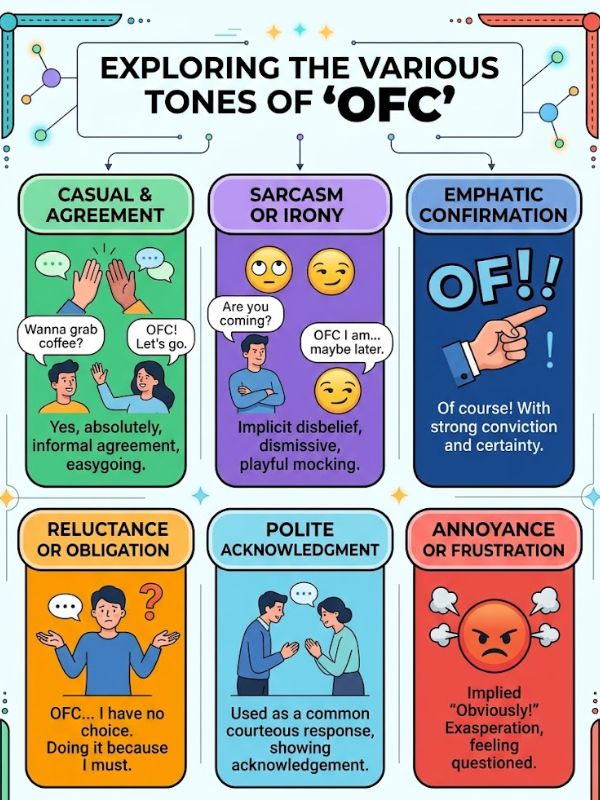
Here are the main tones:
- Friendly: “OFC! Come over anytime.”
- Excited: “OFC!!! I can’t wait.”
- Playful: “OFC I took the last slice.”
- Sarcastic: “Oh, OFC you forgot again.”
- Confident: “OFC we can do it.”
- Dismissive: “OFC.” (a flat reply with no extra words)
Capital letters, exclamation points, and emojis change the mood. A cheerful emoji makes OFC sound sweet. A period after a lone “ofc” can sound cold.
How Punctuation Changes OFC
| Style | Likely Feeling |
| OFC! | Excited and warm |
| OFC 🙂 | Friendly and soft |
| ofc | Relaxed and casual |
| OFC. | Flat or slightly annoyed |
| Oh, OFC… | Sarcastic or teasing |
When in doubt, add a friendly word or emoji. That small step avoids confusion.
OFC Slang vs Similar Terms
OFC has cousins in the slang world. Each one carries a slightly different feel. Here is how they compare.
| Term | Meaning | Tone | Example |
| OFC | Of course | Casual, confident | “OFC I will come.” |
| OBV | Obviously | Slightly sassy | “OBV it is true.” |
| FR | For real | Honest, emphatic | “FR, that was funny.” |
| DEF | Definitely | Strong, positive | “DEF coming.” |
| YEP | Yes | Simple, light | “Yep, done.” |
| SURE | Okay, yes | Neutral, flexible | “Sure, why not?” |
| ABSO | Absolutely | Enthusiastic | “Abso! Let’s go.” |
OFC sits in the middle. It sounds friendlier than OBV. It also sounds more confident than “sure.” Choose the term that matches your mood.
When Should You Use OFC?
OFC works best in relaxed settings. Use it when you know the person well or when the chat is casual.
Good moments include:
- Replying to a close friend
- Confirming plans in a group chat
- Agreeing with a social media post
- Reassuring a family member by text
- Chatting with teammates during a game
You can also use OFC to speed up a long chat. It keeps replies short and clear. People often appreciate that. If you are unsure, look at how the other person writes. If they use slang, you can join in. Matching their style helps the chat feel smooth.
When You Might Avoid OFC
Some situations call for full words. OFC can seem too casual or even careless there.
Avoid OFC in these cases:
- Emails to a boss, teacher, or client
- Job applications and cover letters
- Official notices and formal reports
- Messages to people who may not know slang
- Serious or sensitive conversations
Imagine a manager asks, “Will you submit the report today?” Replying “OFC” may feel too relaxed. A better reply is “Yes, of course. I will send it by noon.”
Older relatives may also miss the meaning. When you are not sure, write the full phrase. Clear communication always wins.
Is OFC Positive or Rude?
In most cases, OFC is positive. It shows agreement, willingness, and confidence. People use it to be friendly and quick.
Still, tone can change the feeling. A lone “OFC.” in a tense chat may sound impatient. It can also sound sarcastic if the question was silly. Context decides the mood.
Here is a simple guide:
| Situation | Does OFC Sound Rude? |
| Friendly chat with emoji | No, it sounds warm |
| Quick yes to a plan | No, it sounds helpful |
| Reply to an obvious question | Maybe, it can sound sassy |
| Reply during an argument | Yes, it can sound cold |
To stay safe, add a kind word. Try “OFC, happy to help” or “OFC, no problem.” Those small additions keep the tone clear.
Common Misunderstandings About OFC
Short slang can cause mix ups. Here are the most common ones and the truth behind them.
Misunderstanding #1: OFC Always Means Yes
Not always. Sometimes people use it in a sarcastic way. “Oh, OFC you forgot” does not mean “yes.” It shows mild frustration. Read the full message before you decide.
Misunderstanding #2: OFC Is Rude
Most of the time it is not. People use it to be friendly. Rudeness only appears when the tone is cold or sarcastic. Look at punctuation and context.
Misunderstanding #3: OFC Is the Same as OBV
They are close, but they differ. OBV means “obviously,” and it can sound a little more sassy. OFC feels softer and more agreeable.
Misunderstanding #4: OFC Has Only One Meaning
In texting, OFC almost always means “of course.” Outside chat, the letters can stand for other things. For example, some groups use OFC for an official fan club. In sports, OFC can also point to a football confederation. The setting usually makes the meaning clear.
Pro Tips for Using OFC Naturally
Good slang use feels easy and honest. These tips help you sound natural.
Keep the Audience in Mind
Think about who will read your message. Friends may love slang. A teacher or boss may prefer full words. Pick the style that fits the reader.
Match the Tone
Match the mood of the chat. If the other person is excited, reply with energy. If they feel upset, add a gentle word. OFC works well when the tone fits.
Don’t Overuse Slang
Too much slang can feel messy. Use OFC when it adds value. Mix it with full sentences so your message stays clear.
Read Context First
Before you reply, read the whole message. Check for hints like sarcasm, jokes, or serious topics. Context tells you if OFC is a good choice.
Here is a quick checklist:
- Do I know this person well?
- Is the chat casual?
- Is the topic light or friendly?
- Will my tone be clear?
If you answer yes to most, go ahead and use OFC.
Popular Variations People Also Use
Slang changes shape as people use it. Here are common forms of OFC that you may see.
| Variation | Meaning | Feel |
| ofc | Of course (lowercase) | Relaxed |
| OFC! | Of course, with excitement | Cheerful |
| ofc ofc | Of course, repeated | Playful or eager |
| OFC not | Of course not | Reassuring |
| ofc lol | Of course, with a laugh | Light and funny |
| ofc tho | Of course, though | Casual, conversational |
| ofcccc | Of course, stretched | Extra friendly or dramatic |
| OFC ❤️ | Of course, with love | Warm and caring |
Stretched spellings like “ofcccc” add emotion. Extra letters can show excitement or a joking mood. Emojis do the same job.
Related phrases include “for sure,” “100 percent,” “absolutely,” “naturally,” and “no doubt.” Each one expresses the same idea in a slightly different style.
Is OFC Still Popular in 2026?
Yes. OFC remains a common texting shortcut in 2026. It has stayed steady because it is simple and useful. People of many ages understand it. Social media keeps it alive. Short replies on TikTok, Instagram, and Snapchat favor quick words.
OFC fits that style perfectly. Gaming and group chats also keep it in daily use. New slang appears all the time. Some terms fade after a few months. OFC has lasted because it describes a basic idea. People always need a quick way to say “of course.”
Experts who study online language note that short agreement words tend to survive. They are practical. They also work across cultures and age groups. That is a strong reason to expect OFC to stay around.
Frequently Asked Questions
What does OFC mean in text?
OFC means “of course” in text. People use it to say yes or to show something is obvious.
Is OFC slang or a real word?
OFC is slang. It is a texting abbreviation for the phrase “of course.”
How do you reply to OFC?
Reply with something friendly, like “Great!” or “Thanks!” You can also continue the topic with a follow up question.
Is OFC rude to say?
Usually not. It sounds friendly, but a flat “OFC.” can seem cold in a tense chat.
Can I use OFC at work?
Avoid it in formal emails. It is fine in casual chats with close coworkers.
What is the difference between OFC and OBV?
OFC means “of course” and sounds friendly. OBV means “obviously” and can sound a bit sassy.
Is OFC still used in 2026?
Yes. OFC is still popular in texts, DMs, group chats, and gaming chats.
Final Thoughts
OFC is a small term with a clear job. It means “of course,” and it helps people reply fast, show confidence, and keep chats friendly. You now know where it appears, how it sounds, and how to use it with care.
Use OFC when the mood is casual and the reader knows slang. Switch to full words when the setting is formal. With good context and a kind tone, OFC makes your messages quick, clear, and easy to enjoy.