

A poison tree tattoo carries deep meaning. It speaks about anger, betrayal, and hidden emotions. This design comes from William Blake’s famous poem. It shows how silence can grow into something harmful.
This guide covers the full meaning behind the poison tree tattoo. You will learn its origins, symbolism, and spiritual ties. We also share design ideas, colors, and placement tips for 2026.
What Is a Poison Tree Tattoo?
A poison tree tattoo is a body art design that features a tree linked to poison, decay, or forbidden fruit. The tree often looks twisted or split. Some versions show healthy branches on one side and dead, cracked branches on the other.
Others include a snake wrapped around the trunk or fruit hanging from the limbs. The design does not always mean something evil. Many people use it to represent inner conflict. It can show the fight between good and bad feelings inside a person.
It can also stand for a toxic relationship, a betrayal, or anger that grew because it was never spoken out loud. This tattoo style sits inside a bigger category of nature tattoos, but it stands apart because of its emotional weight.
A regular tree tattoo often means life, strength, or family roots. A poison tree tattoo means something sharper. It points to pain that grew quietly, often without anyone noticing until it was too late.
The Origins: William Blake’s “A Poison Tree” (1794)
The poison tree tattoo traces back to a short poem by William Blake called “A Poison Tree.” Blake wrote it in 1794 as part of his collection Songs of Experience. The poem tells the story of a person who feels angry at a friend.
He speaks about his anger, and it fades away. But he feels angry at a foe and stays silent. That silent anger grows inside him like a tree. In the poem, the speaker waters this anger with fear and tends it with false smiles.
- Blake wrote the poem in 1794 as part of his collection Songs of Experience.
- The poem opens with the speaker feeling angry at a friend, and that anger fades once he speaks about it.
- The speaker then feels angry at a foe, but he stays silent instead of talking it out.
- His silent anger does not disappear. It grows inside him like a tree.
- He waters this tree with fear and tends it daily with false smiles and quiet deceit.
- The tree grows a shiny, tempting apple, a symbol of the danger hidden inside bottled up rage.
- His enemy sees the fruit, sneaks into the garden at night, and steals it.
- The poem ends with the foe lying dead beneath the tree, and the speaker feels glad to see him there.
- The poem shows how unspoken anger turns into something that can harm both the person holding it and the people around them.
Poison Tree Tattoo Meaning: Core Symbolism
The poison tree tattoo carries several layers of meaning. Most people connect it to one or more of the ideas below.
Featured snippet answer: A poison tree tattoo mainly symbolizes suppressed anger, hidden emotions, toxic relationships, and the idea that unspoken feelings grow into something harmful over time.
Here is a closer look at the core symbolism:
- Bottled up anger. The tattoo often stands for feelings a person never expressed. Just like in Blake’s poem, silence lets anger grow bigger.
- Toxic relationships or people. Many wearers use the tattoo to mark a painful chapter involving a friend, partner, or family member who caused harm.
- Duality of human nature. The tree can show both life and death, good and bad, at the same time. This reflects the mixed nature of every person.
- Forbidden knowledge or temptation. The fruit on the tree can echo the biblical story of Eden, tying the design to themes of temptation and consequence.
- Growth through pain. Some people get this tattoo after healing from a hard period. The tree becomes proof that they survived something poisonous and came out stronger.
- A warning to others. A few wearers see the tattoo as a personal reminder to speak up instead of staying silent, so anger never turns into poison.
This mix of meanings makes the poison tree tattoo flexible. Two people can have almost the same design but tell completely different stories about their lives.
Poison tree tattoo meaning for girl
For many women, a poison tree tattoo speaks about strength through hardship. It often marks the end of a toxic friendship, a painful breakup, or a period of self doubt. The tree becomes a symbol of standing tall even after roots were tangled in pain.
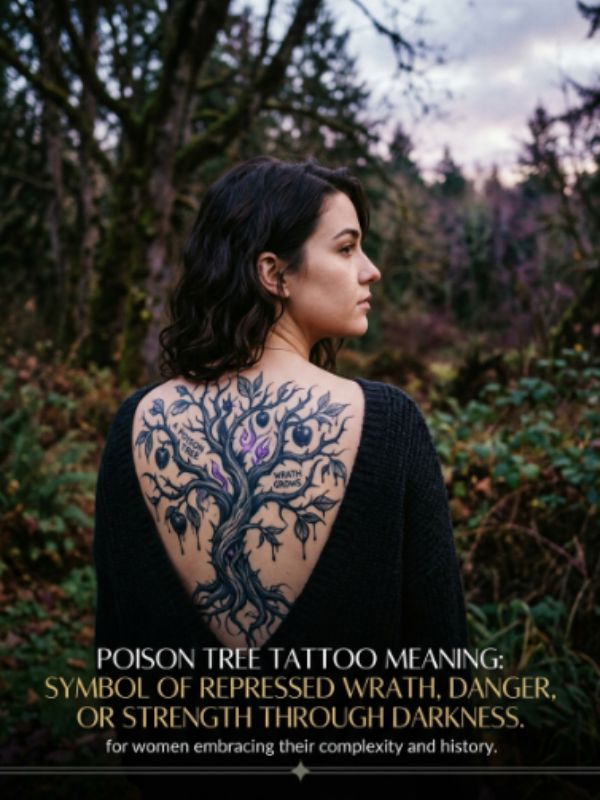
Some women choose softer artistic touches for this design. They may add flowers, small birds, or curling vines to soften the dark theme. This blends the toxic symbolism with a message of rebirth and grace. The result feels less about danger and more about quiet resilience.
Other women pick this tattoo purely for its literary meaning. They love Blake’s poem and want a piece of art that reflects their appreciation for classic poetry mixed with personal emotion.
Poison tree tattoo meaning men
Men often lean toward bolder, darker versions of the poison tree tattoo. Thick black lines, gothic shading, and sharp branches are common choices. For many men, this design channels controlled anger, discipline, and the idea of mastering inner darkness instead of letting it control them.
| Aspect | Meaning for Men |
| Style preference | Bold black lines, gothic shading, sharp branches |
| Core emotion | Controlled anger, discipline over inner darkness |
| Common trigger | Betrayal by a friend, partner, or business associate |
| Symbolic message | Mastering rage instead of letting it control you |
| Growth angle | Standing strong after surviving hardship |
| Popular placement | Forearm, back, or shoulder for bold detail |
| Color choice | Mostly black and grey, sometimes one red accent |
Some men connect the tattoo to personal battles with betrayal, whether from a friend, business partner, or family member. The tree becomes a permanent reminder to stay guarded and to choose honesty over silent resentment.
Poison Tree tattoo Meaning Bible
The poison tree design often connects to biblical themes, even though it comes from a secular poem. The Bible speaks about a tree of knowledge of good and evil in the Garden of Eden. Eating its fruit brought consequences that changed human history.
People who read the tattoo through this lens see it as a symbol of temptation, sin, and the weight of choices. The forbidden fruit becomes a warning about actions that look appealing on the surface but carry hidden danger underneath.
Matthew 7:17 in the Bible also states that a good tree cannot bear bad fruit, and a bad tree cannot bear good fruit. Some wearers use the poison tree tattoo to reflect this idea, showing that character and actions come from the same root.
Poison tree tattoo meaning mental health
Many people connect this tattoo to their mental health journey. Anxiety, depression, and unresolved trauma often grow quietly, much like the tree in Blake’s poem. A person may hide their pain behind a smile while it builds up inside.
The tattoo can act as a personal marker of this struggle. Some wearers get it during recovery to represent the moment they chose to face their pain instead of burying it. Others use it as a reminder that hiding emotions leads to harm, and that healthy expression matters.
A few therapists and support groups have noted that clients who choose nature based tattoos, including poison trees, often describe the process as a way to externalize an internal struggle. Turning pain into art gives it a shape that feels easier to carry.
Poison tree tattoo meaning romana
In a romantic context, sometimes written as “romana,” the poison tree tattoo can symbolize a relationship that looked beautiful on the outside but caused harm underneath. It marks lessons learned from love that turned unhealthy or one sided.
Some people get this tattoo after leaving a relationship filled with manipulation or emotional harm. The tree becomes proof of surviving something that once looked like love but acted like poison.
| Aspect | Romantic Meaning |
| Core theme | A love or relationship that looked beautiful but caused harm |
| Common trigger | Manipulation, one sided love, or emotional betrayal |
| Symbolic message | Beauty on the surface, poison underneath |
| Fruit symbolism | Often shown as a heart shaped fruit instead of an apple |
| Growth angle | Proof of surviving a painful love story and moving forward |
| Popular placement | Ribcage, thigh, or wrist for a more private reminder |
| Color choice | Red accents for passion and betrayal, or soft watercolor for healing |
Others use it in a more hopeful way, showing that even a painful love story can lead to personal growth and a stronger sense of self worth.
Poison tree tattoo On hand
Hand placements have grown popular for smaller, simplified poison tree designs. A tattoo on the hand stays visible every day, which many wearers like because it keeps the meaning close and personal.
Common hand placements include the side of the hand, the space between the thumb and index finger, or across the back of the hand in a thin line style. These spots work best with minimalist versions of the design since hand skin has less space and more movement.
People who choose this placement often want a constant, visible reminder of the lesson their tattoo represents, whether that lesson involves speaking up, healing, or letting go of toxic ties.
Who Gets a Poison Tree Tattoo — and Why
People from many backgrounds choose this tattoo, but a few groups stand out.
| Group | Common Reason |
| Literature lovers | Deep appreciation for William Blake’s poetry |
| Survivors of toxic relationships | Marking the end of a painful chapter |
| Mental health advocates | Representing hidden struggles and healing |
| Gothic and dark art fans | Love for the visual style and symbolism |
| People in recovery | Symbol of growth after a hard period |
Most people who choose this tattoo share one thing in common. They want a design that means something. A poison tree tattoo rarely gets picked just because it looks nice. It usually connects to a real story or a strong belief.
Popular Design Variations
Artists offer many styles for the poison tree tattoo. Each style changes the tone of the piece, even though the core symbolism stays the same.
Black and Grey Gothic Style
This version uses heavy shading, sharp branches, and a dark, moody feel. It often includes cracked bark, twisted roots, and a stormy background. This style suits people who want their tattoo to feel intense and dramatic.
Blake Inspired Illustration
Some tattoo lovers want a design that pulls directly from old illustrated editions of Songs of Experience. These versions often include vintage line work, small text from the poem, or an old book style border around the tree.
Half Dead Half Living Tree
This design splits the tree down the middle. One side looks full of leaves and life. The other side looks bare, cracked, and dead. This visual works well to show internal struggle, duality, or a turning point in someone’s life.
Serpent and Fruit Motif
A snake wrapped around the trunk, paired with hanging fruit, brings in strong biblical and mythological weight. This version leans heavily into themes of temptation, danger, and forbidden knowledge.
Heartfruit Design
Some artists replace the apple with a heart shaped fruit. This shift turns the tattoo toward themes of love, heartbreak, and emotional poison rather than general anger. It works well for people marking the end of a toxic romance.
Minimalist Line Art
This style strips the design down to simple, clean lines. It suits smaller placements like the wrist, hand, or ankle. Minimalist versions still carry the full meaning, just in a quieter visual form.
Watercolor Style
Watercolor poison tree tattoos add soft color splashes behind black line work. This style softens the dark theme and gives the tattoo a dreamy, artistic feel, which many people prefer for larger back or thigh pieces.
Color Meanings in Poison Tree Tattoos
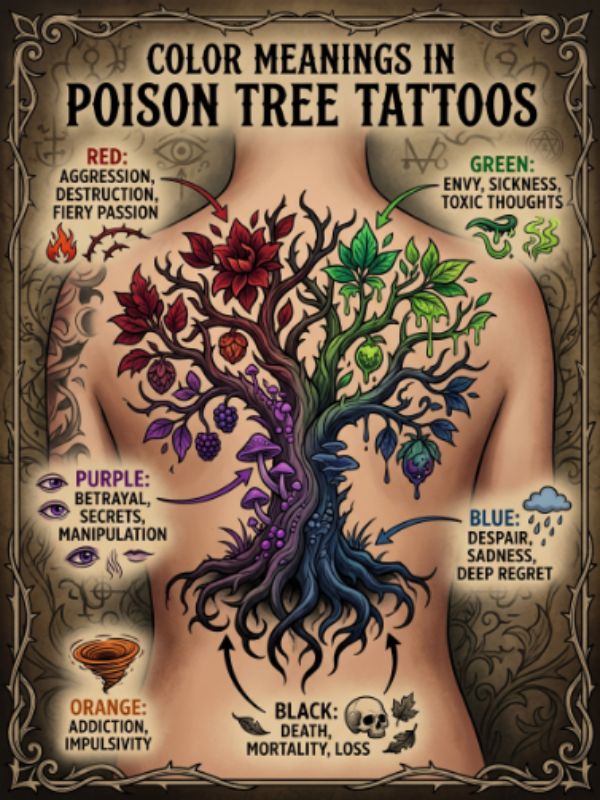
Color choice changes the emotional tone of a poison tree tattoo. Here is a quick breakdown.
| Color | Meaning in Poison Tree Tattoos |
| Black | Grief, anger, mystery, hidden emotion |
| Red | Passion, danger, betrayal, intense feeling |
| Green | Growth, healing, renewal after pain |
| Purple | Spiritual reflection, transformation |
| Gray | Balance between good and bad, emotional complexity |
| Gold | Hope, hidden strength, valuable lessons learned |
Many people mix black and grey shading with one bold accent color, often red or green, to highlight the fruit or a single branch. This draws the eye toward the most symbolic part of the design.
Best Placement Options for a Poison Tree Tattoo
Placement matters just as much as design when it comes to a tattoo with deep personal meaning.
- Forearm: Great for detailed designs since it offers a long, flat canvas.
- Back: Best for large, full scene tattoos with a tree, roots, and fruit all shown together.
- Ribcage: Popular for people who want a more private, personal placement.
- Thigh: Offers plenty of space for shading and color work.
- Hand or wrist: Best for small, simplified line art versions.
- Shoulder: Works well for medium sized designs that wrap slightly around the arm.
People who want their tattoo to stay private often choose the ribcage or thigh. Those who want the design to feel like a daily reminder often pick the forearm or hand.
Psychological Dimension: Why This Symbol Resonates So Deeply
The poison tree tattoo taps into something almost every person understands. Everyone has felt anger they never expressed. Everyone has held onto a feeling that grew heavier the longer it stayed silent.
This shared experience explains why Blake’s poem still connects with readers over two hundred years after he wrote it. Psychologists often point out that suppressed emotions do not vanish. They shift shape. Anger can turn into anxiety.
Sadness can turn into resentment. The poison tree becomes a visual metaphor for this process, showing how something small can grow into something dangerous if left unchecked. Choosing this tattoo often marks a turning point.
Frequently Asked Questions
What does a poison tree tattoo mean?
A poison tree tattoo mainly represents suppressed anger, hidden emotions, and the idea that unspoken feelings grow into something harmful over time.
Where does the poison tree tattoo design come from?
The design comes from William Blake’s 1794 poem “A Poison Tree,” which describes how bottled up anger grows like a tree and produces poisoned fruit.
Is the poison tree tattoo a bad omen?
No, it is not a bad omen. Most wearers use it as a symbol of personal growth, healing, or a lesson learned rather than a curse or warning.
What does a half dead half living tree tattoo mean?
A half dead half living tree tattoo shows the balance between good and bad within a person, often reflecting inner conflict or a major turning point in life.
Can a poison tree tattoo represent healing?
Yes, many people get this tattoo after recovering from a toxic relationship or mental health struggle to mark their growth and survival.
Does the poison tree tattoo connect to the Bible?
Yes, some people link it to the tree of knowledge of good and evil from the Garden of Eden, tying the design to temptation and consequence.
What is the best placement for a poison tree tattoo?
The forearm and back work well for detailed designs, while the wrist and hand suit smaller, simplified versions.
Conclusion
A poison tree tattoo holds far more meaning than its dark, quiet image suggests. It carries the weight of a two hundred year old poem, biblical themes, and deeply personal stories about anger, betrayal, and healing.
Whether someone chooses this design for its literary roots, its spiritual meaning, or its connection to mental health, the tattoo speaks to something almost everyone understands. Silence can grow into something harmful, but facing that truth can also lead to real growth.