

You may have seen “habibti” in a text, a song, or a comment on social media. Maybe a friend used it and you wondered what it meant. Habibti is an Arabic word that means “my love,” “my dear,” or “my darling.” People say it to a female. It can sound romantic, sweet, or simply friendly.
This guide explains the habibti meaning in Arabic, text, and chat in plain words. You will learn how to say it, how people use it in real life, and how it differs from “habibi.” You will also see how to reply and which mistakes to avoid. Let’s start.
What Does Habibti Mean?
Habibti (حبيبتي) is an Arabic word that means “my love,” “my dear,” or “my darling.” People say it to a female. It can show romantic love, family warmth, or close friendship.
The word is warm and personal. The ending “ti” means “my.” The base word “habib” means beloved or loved one. Put them together and you get “my beloved” said to a woman or girl.
Here are the most common English translations:
- My love
- My dear
- My darling
- My beloved
- My sweetheart
- Dear friend (in casual talk)
The meaning changes with the situation. A husband may say it to his wife with deep love. A mother may say it to her daughter with tenderness. A friend may say it to another friend as a warm hello.
| Situation | Who Speaks | Likely Meaning |
| Couple | Husband to wife | My love, my darling |
| Family | Mother to daughter | My dear girl |
| Friends | Girl to girl | My dear friend |
| Shop or street | Seller to customer | Friendly, polite address |
| Online chat | Any close contact | Sweet, casual affection |
Habibti vs Habibi: What Is the Difference?
Habibti is for a female. Habibi is for a male. Both mean “my beloved.” Arabic changes words based on the gender of the person you talk to. So the ending changes too. Habibi ends with “i” for a man. Habibti ends with “ti” for a woman.
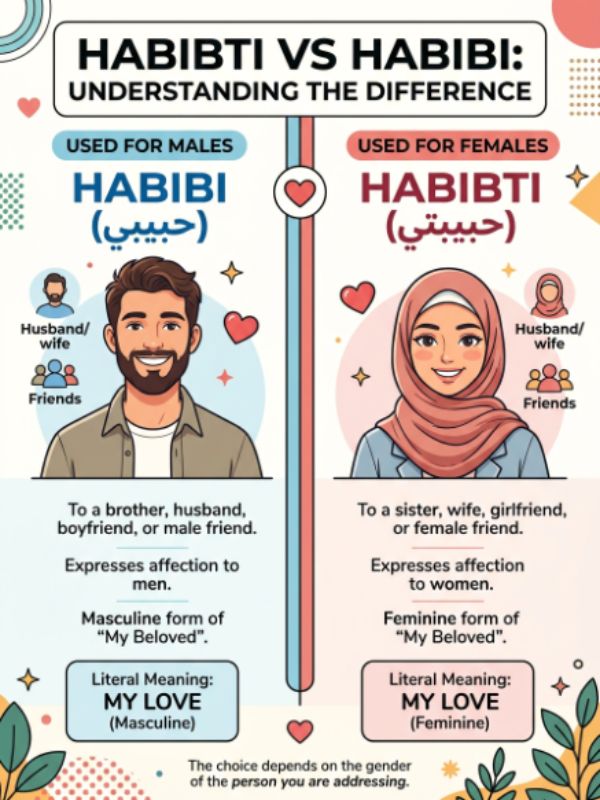
In real life, though, many people use “habibi” for everyone. It has become a general term of affection. You will hear men and women call both men and women “habibi.” Habibti is more precise and often feels more personal.
Quick Comparison Table
| Feature | Habibti | Habibi |
| Arabic script | حبيبتي | حبيبي |
| Said to | Female | Male (often used for anyone) |
| Meaning | My beloved (female) | My beloved (male) |
| Tone | Warm, personal | Warm, common, casual |
| Grammar | Feminine form | Masculine form |
Why People Mix Them Up
Pop songs and social media made “habibi” famous around the world. Many learners hear it first and assume it works for everyone. That is partly true in casual speech. Still, speaking to a woman with “habibti” shows you know the language. It also feels kinder and more respectful to native speakers.
The Linguistic Root of Habibti
Arabic words grow from roots, usually made of three letters. The root behind habibti is ح ب ب (Ha, Ba, Ba). This root carries the idea of love and affection.
Many well known Arabic words come from this same root:
- Hubb means love
- Habib means beloved (male)
- Habiba means beloved (female)
- Mahabba means affection or deep love
- Muhibb means a person who loves
- Ahabba means he loved
Habibti is built like this: habiba (beloved, female) plus the “i” sound that means “my.” This pattern shows how Arabic joins meaning and grammar in one short word.
Habibti Meaning in Arabic
In Arabic, habibti means “my beloved” or “my darling.” It is the feminine possessive form of habiba. The word is common in every Arabic speaking region, from Morocco to Iraq. Arabic speakers do not treat it as a rare or formal word. They use it daily, like English speakers use “dear” or “sweetheart.” It sits in the heart of everyday speech.
Habibti Pronunciation
Say it as ha-BEE-bti. The stress falls on the middle syllable. Break it into small parts:
- Ha sounds like a soft, breathy “h” from the throat
- Bee sounds like the word “bee”
- Bti sounds like “bti,” said quickly
The first letter (ح) is not the same as the English “h.” Native speakers make it from deeper in the throat. Do not worry if you cannot do it perfectly. A clear “h” is enough for friendly talk.
Regional accents change the sound a little. In Moroccan and Algerian Arabic, people often shorten it to “hbibti.” In Egyptian and Levantine Arabic, you will hear the full “habibti.”
Habibti in Text and Chat
Arabic speakers who type in English letters use a system called Arabizi. In this system, the number 7 stands for the letter ح. So habibti can appear as:
- Habibti
- Habibty
- 7abibti
- 7abibty
- Hbibti
All of these mean the same thing. You will see them in WhatsApp, Instagram, and Snapchat. Pair them with a heart emoji and the message feels extra sweet.
How Habibti Is Used in Real Life
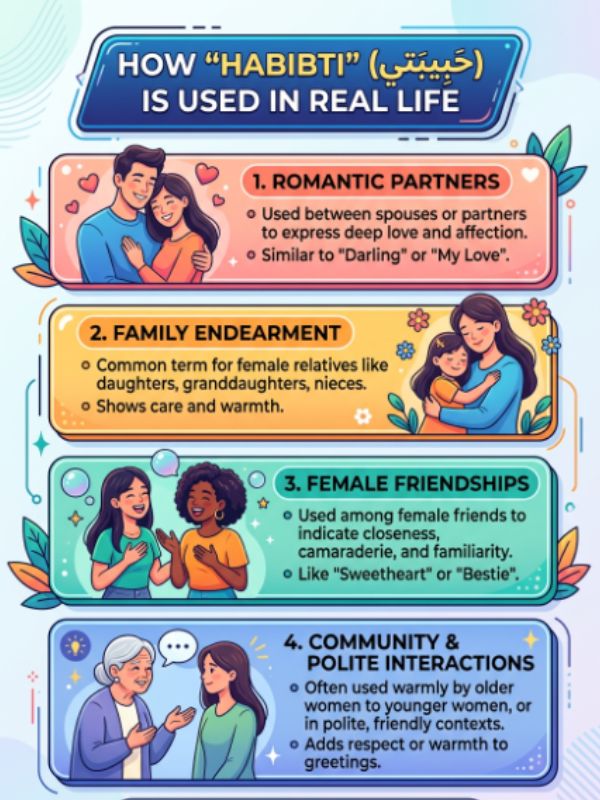
Habibti is flexible. The same word can be romantic, motherly, or friendly. Tone, place, and relationship give it its meaning. Think of it as a warm label. It tells the listener that you feel kindness toward her. Most of the time, it is a positive and safe word.
Romantic Use
Couples use habibti as a pet name. A husband may say “Ya habibti” to his wife at home. A boyfriend may use it in a love message. The word “ya” before it adds emotion and works like “oh” in English.
Common romantic examples include:
- “Sabah el kheir, habibti” means “Good morning, my love”
- “Ana bahebbek, habibti” means “I love you, my darling”
- “Wahashteeni, habibti” means “I miss you, my love”
In romance, the word feels soft and close. Partners often combine it with other love words like “hayati” (my life) or “albi” (my heart).
Family Use
Family members say habibti all the time. Mothers, fathers, grandparents, and siblings use it with girls and women in the family. Here the word does not show romance. It shows care and protection. A mother may say, “Yalla, habibti, eat your food.” A grandmother may say, “Come here, habibti.”
An older brother may say, “Don’t worry, habibti, I am here.” Family use makes children feel loved and safe. Many Arabic speakers grow up hearing this word from their earliest years. That is why it carries a strong feeling of home.
Friendly Use
Between friends, habibti is like “girl,” “dear,” or “babe” in English. Women often greet each other with “Ahlan habibti” (Hello, dear). It shows closeness without any romantic meaning.
You may also hear it in casual places. A friendly shopkeeper may say it to a female customer. A neighbor may say it while chatting. In these cases, it works as a polite and warm way to speak.
Here are a few friendly examples:
- “Shukran habibti” means “Thank you, dear”
- “Kifik, habibti?” means “How are you, dear?”
- “Tfaddali, habibti” means “Please come in, dear”
Cultural Significance of Habibti
Arabic culture values warmth in speech. People show respect and care by using kind words with each other. Habibti is one of the simplest ways to do this. The word also shows how open Arabic speakers are with affection. Saying “my beloved” to a friend or relative is normal. It does not feel strange or too personal in most settings.
Habibti Meaning Friend
Habibti does not literally mean “friend.” The Arabic word for a female friend is “sadiqa” (صديقة). But people often use habibti in place of it, and that is why many search for “habibti meaning friend.”
When a girl says “habibti” to her close friend, it works as “my dear friend.” The friendship feels deeper because the word carries love. So the meaning “friend” is real in everyday use, even if it is not the dictionary meaning. Use this simple rule. If the speaker and listener are close friends, “habibti” means “dear friend.” If they are a couple, it means “my love.”
Habibti in Islamic and Quranic Context
Many people ask if habibti has a religious meaning. The short answer is no. It is a common word of love in Arabic, used by people of all faiths, including Muslims, Christians, and others.
Because Arabic is the language of the Quran, people often connect Arabic words with religion. But habibti is an everyday word, not a religious term.
Habibti Meaning in Islam
In Islam, habibti has no special religious rule. It is a normal, kind expression. Muslims use it with wives, daughters, mothers, sisters, and female friends. Islam values kind speech. The Prophet Muhammad (peace be upon him) taught people to speak gently and to show love to family.
| Question | Answer |
| Is habibti a religious word? | No. It is a common Arabic word of love. |
| What does it mean? | My love, my dear, my beloved (to a female) |
| Is it allowed in Islam? | Yes. It is a kind and normal expression. |
| Who can say it? | Husbands, parents, siblings, and close friends |
| Is it in the Quran? | No. Only the root ح ب ب (love) appears. |
| Any limits? | Some communities prefer men avoid it with unrelated women. |
Saying a warm word like habibti to a spouse or relative fits these values. Some conservative communities prefer that men avoid loving nicknames with unrelated women. This is a matter of manners, not a religious ban on the word itself. Context always matters.
Habibti Meaning in Quran
The exact word “habibti” does not appear in the Quran. However, the root ح ب ب (love) appears many times. The Quran uses forms like “hubb” (love) and “yuhibbu” (he loves). For example, the Quran speaks about the love of believers for Allah. It also says that Allah loves those who do good.
These verses show that love is an important idea in the Quran, even though the word habibti is not there. So you can say this clearly: habibti is not a Quranic word, but its root is deeply connected to the Quranic idea of love.
Habibti in Music, Film, and Social Media
Arabic pop culture loves love words. Habibi and habibti appear in countless songs, lyrics, and movie lines. Singers use them to add feeling and warmth. One famous example is Amr Diab’s hit song “Nour El Ain,” also known as “Habibi Ya Nour El Ain.” The song made “habibi” known to listeners around the world.
Since then, many artists in Egypt, Lebanon, and the Gulf have used these words in their music. In classic Egyptian films, characters use habibti in romantic scenes and family moments. In modern Arabic series, you will hear it in everyday talk between friends and relatives.
Social media has spread the word even further. People use it in:
- Instagram captions and comments
- TikTok videos and voice clips
- Snapchat chats with close friends
- WhatsApp messages and status updates
- Birthday wishes and Mother’s Day posts
Non Arabic speakers now use it too. Many people hear it in songs or videos and start using it as a cute nickname. This shows how far the word has travelled.
How to Respond When Someone Calls You Habibti
If someone calls you habibti, they are showing warmth. Your reply depends on who they are and how you feel. A simple smile and a kind word usually work well.
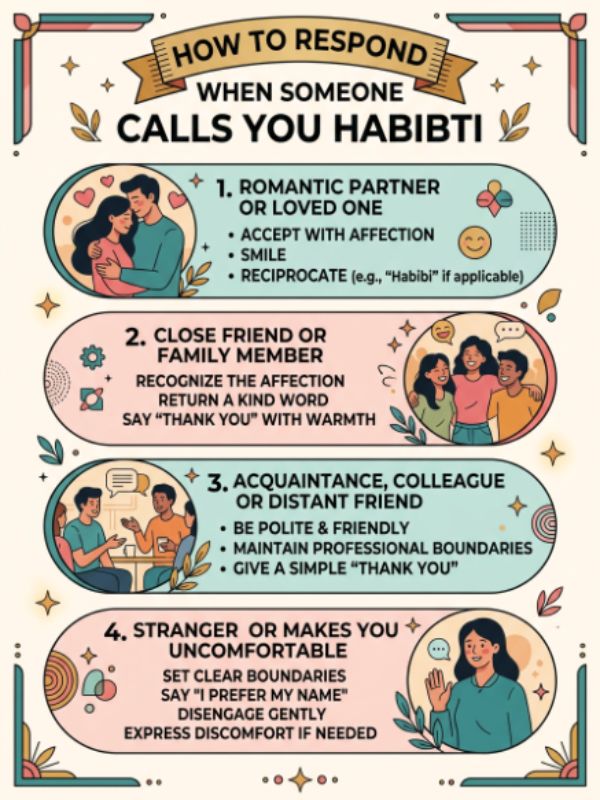
Here are easy replies for different situations:
| Who Says It | Good Reply | Meaning |
| Close friend | “Ya habibti!” | Oh, my dear! |
| Male friend | “Ya habibi!” | Oh, my dear! |
| Family member | “Wa inti habibti” | And you are my dear |
| Partner | “Ana kaman bahebbek” | I love you too |
| Shopkeeper | “Shukran” | Thank you |
If a woman says it to you, reply with “habibti” or “wa inti habibti.” If a man says it to you, reply with “habibi” or “wa inta habibi.”
If you feel uncomfortable, you can stay polite and neutral. A simple “shukran” (thank you) is enough. You do not need to use the word back. In friendly settings, though, returning the kindness is common and welcome.
Sample Chat Replies
- “Habibti, kifik?” You can reply: “Kwayyesa, shukran! W inti?”
- “Miss you, habibti!” You can reply: “Miss you more, habibti!”
- “Thank you, habibti.” You can reply: “Ahlan, habibti, always.”
Common Mistakes to Avoid
Learners often make small errors with this word. Most are easy to fix. Read the list below before you use it.
- Using habibti for a man. Habibti is feminine. Use habibi for a man.
- Overusing it with strangers. In formal or new situations, keep your tone polite and simple.
- Assuming it is always romantic. Many people say it in a friendly or family way.
- Ignoring cultural limits. In conservative settings, a man using it with an unrelated woman may seem too personal.
- Mispronouncing the first sound. Try a soft breathy “h,” not a hard “k” or a silent sound.
- Mixing gender in replies. Match your reply to the listener, not to yourself.
A final tip is to listen first. Notice how local speakers use the word around you. Then copy the same tone and style.
Related Arabic Terms of Endearment
Arabic has many sweet words for loved ones. If you enjoy habibti, you may like these too. Each one has its own feeling.
| Arabic Term | Meaning | Said To |
| Habibi | My love, my dear | Male (or anyone) |
| Hayati | My life | Anyone |
| Albi | My heart | Anyone |
| Rouhi | My soul | Anyone |
| Azizti | My dear, my precious | Female |
| Aziz albi | Dear to my heart | Male |
| Ya amar | Oh, my moon | Male or female |
| Ya oyouni | Oh, my eyes | Anyone |
| Ghalia | Precious, dear | Female |
| Ya omri | Oh, my lifetime | Anyone |
You can combine these words. For example, “Habibti ya albi” means “My love, my heart.” Another example is “Ya hayati” which means “Oh, my life.” These blends sound rich and loving.
Each region also has its own favorites. Egyptians often use “ya amar.” People in the Levant like “ya albi.” Gulf speakers often say “ya rouhi.” Learning a few of these helps you sound natural.
Frequently Asked Questions
What does habibti mean in English?
Habibti means “my love,” “my dear,” or “my darling.” It is said to a female.
Is habibti romantic?
Not always. It can be romantic, but people also use it for family members and close friends.
How do you say habibti correctly?
Say “ha-BEE-bti,” with stress on the middle sound. The first “h” is soft and breathy.
Can I call a man habibti?
No. Use “habibi” for a man. Habibti is the feminine form.
Is habibti in the Quran?
No. The word itself is not in the Quran, but its root meaning “love” appears many times.
Is habibti a polite word?
Yes, in most settings it is polite and warm. Just use it with care around people you do not know well.
What is the difference between habibi and habibti?
Habibi is masculine, and habibti is feminine. Both mean “my beloved.”
Final Thoughts
Habibti is a small word with a big heart. It means “my love” or “my dear,” and it fits many moments in life. It can express romance, family care, or simple friendship. Its Arabic root, which means love, gives it real depth.
Use it with kindness and respect. Learn the pronunciation, match the gender, and read the situation. When you do, this warm word can help you connect with Arabic speakers in a natural and sincere way.