

Discernment Meaning: What Does Discernment Mean? Definition, Examples & How to Use It (2026)

Discernment means the ability to see clearly and judge wisely. It helps you tell what is true from what is false, and what is wise from what is risky. People use this word in daily life, in faith, in work, and in relationships. In 2026, with so much online noise, this skill matters more than ever.
This guide explains the discernment meaning in simple words. You will learn the definition, the origin, and real examples. You will also see how discernment works in the Bible, in relationships, and in daily choices. By the end, you will know how to use the word in a sentence and how to build this skill step by step.
What Does Discernment Mean?
Discernment means the ability to see the difference between things and to judge them wisely. It is a skill of careful thinking. A person with discernment looks beyond the surface. They notice details, weigh facts, and choose well.
Think of a jeweler who can tell a real diamond from a fake one. The two stones may look the same to most people. The jeweler sees the small signs that reveal the truth. That is discernment in action.
Discernment works in three steps:
- Notice: You observe the facts, the people, and the situation.
- Weigh: You compare what you see with what you know.
- Decide: You choose the wisest path.
The word often appears with related terms like good judgment, insight, sound reasoning, and clear perception. It is a quiet strength. It does not shout. It simply sees clearly.
Discernment Origin and Etymology
The word comes from the Latin verb discernere. This verb joins two parts: dis, meaning “apart,” and cernere, meaning “to separate or sift.” So the root idea is to separate one thing from another.
The word entered English through Old French in the Middle Ages. Early writers used it for both physical sight and mental sight. Over time, it came to mean the wise ability to tell right from wrong, true from false, and good from bad.
Here is a quick look at the word’s journey:
| Stage | Form | Meaning |
| Latin | discernere | To separate, to distinguish |
| Old French | discernement | Act of distinguishing |
| Middle English | discernement | Insight, power to judge |
| Modern English | discernment | Wise judgment and clear perception |
Discernment Meaning in Different Contexts
The word shifts a little depending on where you use it. The core idea stays the same. You separate what matters from what does not.
- In daily life: It means making smart choices about people, money, and time.
- In business: It means spotting good opportunities and avoiding bad deals.
- In faith: It means seeking God’s guidance to know what is right.
- In art and taste: It means a trained eye for quality, such as in wine, music, or design.
- In media: It means telling reliable news from false claims.
What Is the Meaning of Discernment? (Definition and Origin)
The meaning of discernment is the skill of understanding something clearly and judging it with wisdom. Dictionaries describe it as keen insight or good judgment. The origin goes back to the Latin idea of sifting one thing from another, as a farmer sifts grain from chaff.
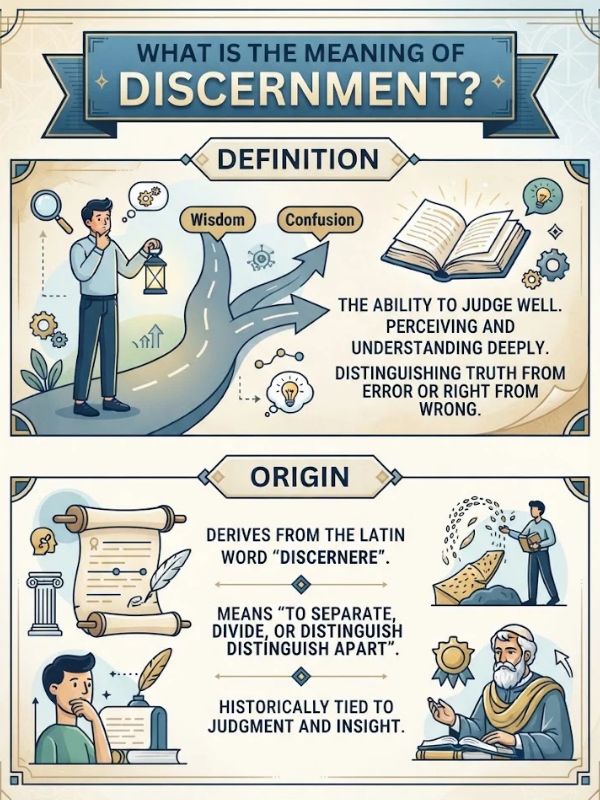
That image helps. A good farmer shakes the grain until the useless husks fall away. What remains is the good part. Discernment does the same with ideas, choices, and information.
Examples of Discernment in Everyday Life
Real examples make the idea easy to grasp. You use discernment more often than you think.
Discernment at Home and Work
- A parent senses that a child is upset, even though the child says “I’m fine.”
- A manager reads a resume and sees that the candidate’s skills fit the team, not just the job title.
- A shopper reads reviews and spots the fake ones that sound too perfect.
- A student picks a reliable source for a research paper instead of the first search result.
Discernment Online
The internet is full of noise. Discernment helps you stay safe and informed.
- You check who wrote an article before you trust it.
- You pause before you share a shocking headline.
- You notice when an offer sounds too good to be true.
- You compare several sources before you form an opinion.
Discernment Meaning in the Bible
The Bible treats discernment as a gift of wisdom. It teaches that real understanding starts with respect for God and a humble heart. Many verses connect discernment with wisdom, knowledge, and right living.
Biblical writers use the idea in two main ways. First, it means telling good from evil. Second, it means understanding God’s will in a given moment. Both ideas shape how Christians think about the word today.
What Does God Say About Discernment?
Scripture speaks about discernment in many places. Here are some key passages, described in simple terms:
- Proverbs 2:3 to 6 teaches that God gives wisdom, and that people who seek understanding like hidden treasure will find it.
- 1 Kings 3:9 records Solomon asking God for an understanding heart so he could judge his people well.
- Hebrews 5:14 says that mature believers train their senses to tell good from evil.
- Philippians 1:9 to 10 shows Paul praying that love will grow along with knowledge and insight.
- 1 John 4:1 urges believers to test every spirit to see whether it comes from God.
The message is steady. God invites people to ask for wisdom, and he promises to answer. James 1:5 says that anyone who lacks wisdom should ask God, who gives freely.
Spiritual Discernment Meaning
Spiritual discernment means the ability to understand spiritual truth and to tell what comes from God from what does not. It goes deeper than common sense. It relies on prayer, Scripture, and the guidance of the Holy Spirit.
First Corinthians 2:14 explains that spiritual things are understood in a spiritual way. A person may be very smart and still miss spiritual truth. Spiritual discernment fills that gap. It helps a believer see the heart of a matter.
Discernment Meaning in Christianity
In Christianity, discernment is a way of seeking God’s direction in life. Christians use it to test teachings, make big choices, and avoid deception. It is both a spiritual habit and a daily practice.
Many churches teach that discernment grows through:
- Regular prayer
- Reading and studying the Bible
- Wise counsel from mature believers
- Quiet reflection and patience
- Obedience to what God has already shown
Some traditions, such as Catholic and Jesuit teaching, have formal methods for this. They use quiet reflection to notice inner movements of peace or unrest. These help a person see where God may be leading.
Gift of Discernment Meaning
The gift of discernment is a special ability, given by the Holy Spirit, to recognize truth and spot error. First Corinthians 12:10 lists it among the spiritual gifts as “distinguishing between spirits.”
People with this gift often sense when a teaching is off or when a situation hides danger. They may see motives that others miss. Christians believe this gift exists to protect and serve the church, not to show off or to judge others harshly.
Spirit of Discernment Meaning
The phrase “spirit of discernment” describes an attitude of clear, wise, and prayerful seeing. It does not always point to a special gift. It can describe a way of living where a person stays alert, humble, and open to truth.
In Christian writing, it also links to the Holy Spirit as the source of wisdom. A person with this spirit tends to be calm, patient, and slow to react. They look for God’s truth before they act.
Spiritual Discernment Meaning in the Bible and Christian Life
In the Bible, spiritual discernment appears in stories of prophets, kings, and apostles. Solomon asked for it. Paul taught it. Jesus showed it when he saw through the tricks of religious leaders.
In Christian life today, it shows up in simple moments:
- Choosing a church community
- Testing a sermon against Scripture
- Deciding on a job, a move, or a marriage
- Knowing when to speak and when to stay quiet
Praying for Discernment Meaning
Praying for discernment means asking God for wisdom to see clearly and choose well. It is a humble request. The person admits they do not have all the answers and asks for guidance. A simple prayer might sound like this: “Lord, give me wisdom to see what is true. Show me the right path. Help me listen, and give me courage to follow.”
God’s Discernment Meaning
God’s discernment refers to his perfect knowledge and flawless judgment. The Bible teaches that God sees the heart, knows all things, and judges with fairness. Hebrews 4:12 says his word can judge the thoughts and attitudes of the heart. Humans have limited sight. God’s sight has no limit. Believers trust that he sees what they cannot, and that is why they ask for his guidance.
How to Develop Discernment: Practical Steps
Discernment is a skill. You can grow it with practice. Here are steps that work for most people.
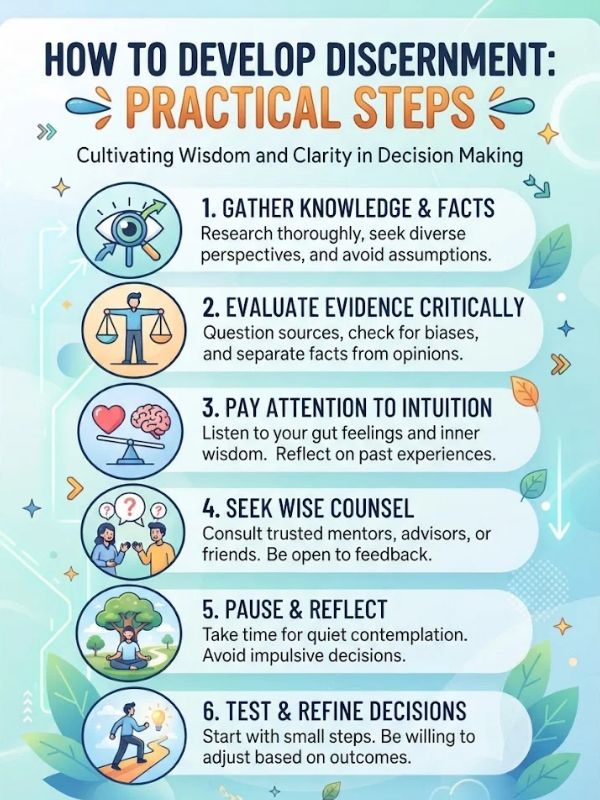
Step by Step Guide
- Slow down. Quick choices often lead to regret. Take time to think.
- Ask good questions. Who benefits? What is missing? What is the source?
- Gather facts. Look at more than one view before you decide.
- Listen to your gut, then test it. Intuition gives a signal. Facts confirm it.
- Seek wise counsel. Talk to people who have more experience.
- Reflect on past choices. Learn from what worked and what did not.
- Pray or meditate. For many people, quiet time brings clarity.
- Stay humble. Admit when you are wrong and change course.
Daily Habits That Build Discernment
- Read widely and from different sources
- Keep a journal of decisions and results
- Practice active listening in conversations
- Limit noise from social media
- Spend time in silence each day
Discernment Meaning in a Relationship
In a relationship, discernment means seeing a person clearly and honestly. It helps you notice character, not just charm. You look at actions, not only words. A discerning person asks simple questions. Does this person respect me? Do they keep promises? Do their values match mine? Do I feel safe and heard?
Signs of Discernment in Relationships
- You notice patterns, not just single moments.
- You trust actions more than promises.
- You spot red flags early.
- You also see green flags, like kindness and honesty.
- You set healthy boundaries.
Discernment is not about being cold or picky. It protects your heart. It also helps you build trust with people who deserve it.
What Is Good Discernment?
Good discernment is clear, calm, and wise judgment based on facts, values, and honest reflection. It does not rush. It does not rely on pride or fear. It looks at the whole picture.
Someone with good discernment usually shows these traits:
- They think before they act.
- They ask questions instead of assuming.
- They accept advice from others.
- They notice small details.
- They stay fair and open minded.
Lack of Discernment Meaning
Lack of discernment means poor judgment, where a person fails to see the truth or the risks in a situation. It often leads to bad choices, wasted money, and hurt feelings. People may lack discernment because of haste, pride, strong emotion, or little experience. Everyone has moments like this. The good news is that you can improve.
Good Discernment vs. Lack of Discernment
| Area | Good Discernment | Lack of Discernment |
| Decisions | Careful and thoughtful | Rushed and impulsive |
| Information | Checks sources | Believes the first claim |
| People | Reads character well | Trusts too quickly |
| Advice | Welcomes wise counsel | Ignores warnings |
| Emotions | Stays balanced | Acts on strong feelings |
| Results | Fewer regrets | Repeated mistakes |
Discernment vs. Judgment, Wisdom, and Intuition
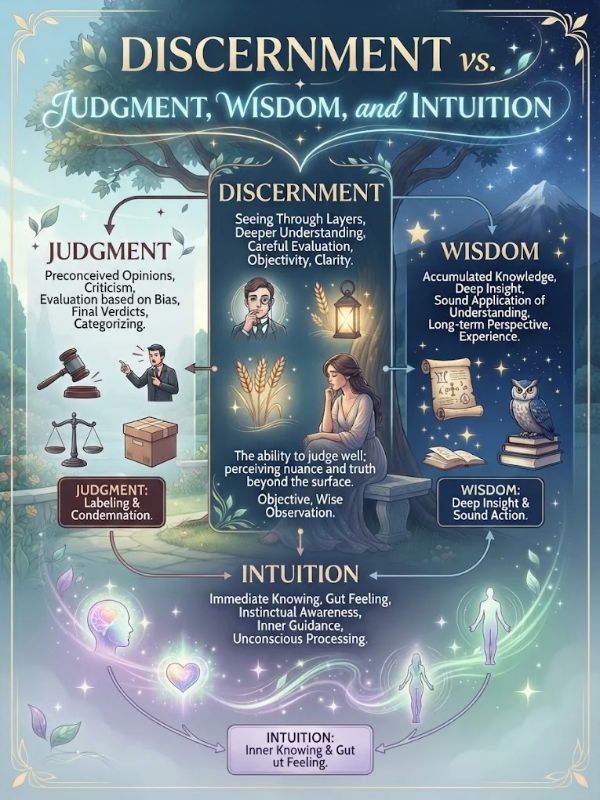
These words are close, but they are not the same. Knowing the difference makes your understanding sharper.
Discernment vs. Judgment
Judgment is the final decision or opinion. Discernment is the seeing that comes before it. Discernment gathers the clues. Judgment draws the conclusion. In faith settings, judgment can also carry a harsh tone, while discernment stays gentle and careful.
Discernment vs. Wisdom
Wisdom is deep understanding built over time. Discernment is how wisdom shows up in a moment. You use discernment to apply wisdom to a real situation.
Discernment vs. Intuition
Intuition is a quick gut feeling. Discernment tests that feeling with facts and values. Intuition may start the process. Discernment finishes it.
| Term | Simple Meaning | Speed | Based On |
| Discernment | Wise seeing and sorting | Medium | Facts, values, reflection |
| Judgment | A decision or opinion | Varies | Conclusion from evidence |
| Wisdom | Deep, lasting understanding | Slow | Experience and truth |
| Intuition | Instant gut sense | Fast | Feeling and pattern |
What Is Another Word for Discernment?
Common synonyms for discernment include insight, judgment, wisdom, perception, acuity, sagacity, and discrimination in the positive sense. The best choice depends on the sentence.
- Insight: deep understanding
- Perception: the ability to notice
- Acumen: sharp, practical judgment
- Sagacity: wise and sound thinking
- Astuteness: quick and clever awareness
- Prudence: careful, sensible choice
Opposites include naivety, carelessness, foolishness, and poor judgment.
How to Use Discernment in a Sentence
Seeing the word in context helps you remember it. Here are simple sentences:
- She showed great discernment when she chose her business partner.
- Good discernment helps you avoid online scams.
- He prayed for discernment before he accepted the new job.
- The critic’s discernment made her reviews trusted by readers.
- With careful discernment, the team picked the best plan.
- A lack of discernment led him to trust the wrong person.
Having Discernment: What Does It Look Like?
Having discernment looks calm and steady from the outside. The person does not panic. They listen first. They ask a few smart questions. They take their time. Inside, they weigh motives, facts, and long term results.
They care about truth more than being right. They also admit what they do not know. You can often spot a discerning person by how they handle pressure. They do not give in to hype. They do not chase every trend. They stay grounded.
Power of Discernment Meaning
The power of discernment is its ability to protect you and guide you. It saves you from scams, bad deals, and unhealthy people. It also opens doors to good opportunities that others miss. Over a lifetime, this power adds up. Small wise choices build a strong career, healthy relationships, and peace of mind. Many people say discernment is one of the most useful life skills to learn.
Discernment Meaning in Farsi, Chinese, and Polish

The idea of discernment exists in every language. Here are common translations:
| Language | Word | Pronunciation | Meaning |
| Farsi | تشخیص | tashkhis | Recognition, diagnosis, discernment |
| Chinese | 辨别力 | biànbié lì | Power to tell things apart |
| Polish | rozeznanie | roh-zeh-ZNA-nyeh | Discernment, insight, awareness |
In Farsi, the word tashkhis also appears in medical settings for diagnosis. In Chinese, biànbié means to tell apart, which fits the Latin root well. In Polish, rozeznanie is often used in religious and everyday contexts.
Discernment Meaning in AI
In AI, discernment describes a system’s ability to tell reliable information from unreliable information. It also covers choosing the right response for the right situation. A discerning AI checks facts, notes uncertainty, and avoids confident guesses.
Humans still need discernment when using AI. AI tools can sound sure and still be wrong. You should check important claims, compare sources, and use your own judgment. Good use of AI blends machine speed with human wisdom.
Common Mistakes About Discernment
Many people misunderstand this word. Here are the five most common errors.
1. Discernment Does Not Mean Indecision
Taking time to think is not the same as being stuck. Discernment aims to reach a clear decision. It simply makes sure the decision is wise. If you delay forever, you lose the benefit.
2. Discernment Is Not the Same as Intelligence
A very smart person can still lack discernment. Intelligence is about processing information. Discernment is about using it well. Plenty of brilliant people make poor choices about trust, money, or people.
3. Discernment Is Not Only Spiritual
Faith gives the word a rich meaning, but it is not only religious. Doctors, judges, teachers, and parents all use discernment. Anyone can grow it, whatever their beliefs.
4. Discernment Is Not the Same as Suspicion
Being suspicious means doubting everything. Being discerning means testing things fairly. A discerning person can trust when trust is earned and doubt when doubt is wise.
5. Discernment Is Not Perfect Certainty
Even wise people cannot know everything. Discernment helps you make the best choice with the facts you have. You may still be wrong sometimes. What matters is that you act with honesty and learn from the result.
Frequently Asked Questions
What does discernment mean in simple words?
Discernment means the ability to see clearly and judge wisely. It helps you tell what is true, right, or wise from what is not.
What is the spiritual meaning of discernment?
Spiritual discernment is the ability to understand God’s truth and tell what comes from him. It grows through prayer, Scripture, and the guidance of the Holy Spirit.
What is the gift of discernment?
The gift of discernment is a spiritual ability to recognize truth and detect error. The Bible lists it as “distinguishing between spirits” in 1 Corinthians 12:10.
What is another word for discernment?
Good synonyms include insight, wisdom, perception, judgment, and acumen. The best word depends on your sentence.
How can I develop discernment?
Slow down, ask good questions, check your sources, and seek wise advice. Reflect on past choices and stay humble. Prayer or quiet reflection also helps.
What is the difference between discernment and judgment?
Discernment is the careful seeing that comes first. Judgment is the final decision or opinion that follows.
What does lack of discernment mean?
It means poor judgment, where someone misses the truth or the risks in a situation. It often leads to hasty choices and regret.
Final Thoughts
Discernment is the skill of seeing clearly and choosing wisely. It comes from the Latin idea of sifting one thing from another. It matters in daily life, in the Bible, in relationships, at work, and even in how we use AI.
You can grow this skill with simple habits. Slow down, ask questions, check facts, and seek good counsel. Over time, your choices become clearer and your confidence grows.