
Classroom games make learning fun for kids. They help students focus, think, and enjoy every lesson. Whether you teach young learners or older students, the right game can turn a dull day into an exciting one.
This guide shares 50+ easy and educational classroom games for students in 2026. You will find cognitive, physical, social, and creative games for every grade. Each idea is simple to set up and works with little or no prep, so you can start playing today.
Why Classroom Games Are Important for Kids
Classroom games help kids learn faster because they make learning active, social, and fun. Children remember what they experience. A game gives them a reason to listen, think, and take part. Games also lower stress. A shy student may never raise a hand during a lecture. That same student often joins a team game with ease.
Here are the main reasons teachers use classroom games:
- They boost focus and attention span.
- They improve memory and recall.
- They build teamwork and communication skills.
- They teach kids to win and lose with respect.
- They give kids a healthy break from desk work.
- They make review sessions feel less boring.
Research on game based learning keeps pointing the same way. Active play strengthens motivation and helps ideas stick. A five minute game can do more than a ten minute worksheet.
Real Life Example
Think of a spelling lesson. A teacher reads a list of words, and kids copy them. Half the class drifts away. Now picture the same words in a team race on the board. Every child stays alert. The class cheers, laughs, and remembers the words the next day.
Types of Classroom Games for Kids
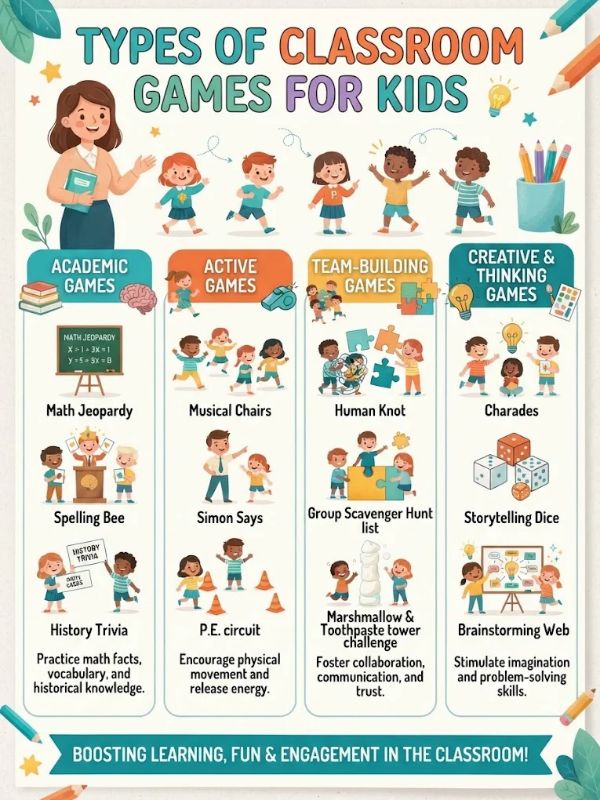
Classroom games fall into four main groups. Each group trains a different skill. A strong teacher mixes all four during the week.
| Game Type | Main Skill Built | Best Time to Use |
| Cognitive | Memory, logic, problem solving | Review time, lesson starters |
| Physical | Energy release, coordination | Mid day breaks, after long lessons |
| Social and Teamwork | Communication, trust, empathy | Start of term, group projects |
| Creative | Imagination, expression | Art time, end of week fun |
Cognitive Games
Cognitive games make the brain work. They train memory, logic, vocabulary, and quick thinking. These games fit well with math, reading, science, and language lessons.
Physical Games
Physical games get kids out of their seats. They burn extra energy and wake up tired minds. Many of them also teach counting, rhythm, and listening.
Social and Teamwork Games
Social games teach kids how to work together. Students share ideas, solve problems as a group, and learn to listen. These games build a kind and supportive classroom culture.
Creative Games
Creative games invite kids to imagine, draw, act, and speak. There is often no single right answer. That freedom helps quiet students shine.
How to Choose the Right Classroom Game
The right classroom game matches your learning goal, your students’ age, your time, and your space. Start with the goal. Ask yourself what you want kids to learn or practice. Next, think about age. Young kids need short rules and quick rounds. Older kids enjoy strategy, competition, and bigger challenges.
Use this simple checklist before you pick a game:
- Does the game support today’s lesson?
- Can kids understand the rules in under two minutes?
- Do you have enough space and materials?
- Will every child get a turn to take part?
- Does the game fit your time slot?
Always keep a backup game ready. Some days the mood in the room changes fast. A flexible teacher adapts without stress.
Best Classroom Games for Kids
Below you will find 20 top classroom games sorted by type. Each one includes the goal, the setup, and a quick way to play. After this list, you will find even more games for specific needs.
Top 5 Cognitive Games
Matching Memory Cards
Memory cards train short term memory and focus. Make pairs of cards with matching pictures, words, or math facts. Lay them face down in a grid. Kids flip two cards at a time. If the cards match, the player keeps them. If not, the cards go back face down. The player with the most pairs wins.
- Best for: Kindergarten to Grade 3.
- Time: 10 minutes.
Word Definition Competition
This game builds vocabulary fast. Split the class into two teams. Read a word aloud and ask each team to write a clear meaning. Teams earn a point for each correct definition. Give a bonus point for using the word in a sentence. Pick words from your current reading unit.
- Best for: Grades 3 to 8.
- Time: 15 minutes.
Chess
Chess teaches planning, patience, and logic. Kids learn to think ahead and weigh choices. Many schools run chess clubs for this reason. Start with the basic moves of each piece. Let kids play short games in pairs. Teach one new idea each week, such as a simple opening or a trick to protect the king.
- Best for: Grades 2 and up.
- Time: 20 to 30 minutes.
Kahoot
Kahoot is a free online quiz platform. Teachers build a quiz, and students answer on tablets or phones. A live leaderboard keeps excitement high. Use Kahoot to review any subject. Keep each quiz to 10 questions. Short quizzes hold attention better than long ones.
- Best for: Grades 2 and up.
- Time: 10 to 15 minutes.
Top 5 Physical Games
All Hands on Deck
This is a fast team game. Place several small objects on a table, such as markers or erasers. Call out a number, and teams race to put exactly that many hands on the objects. It builds counting skills and quick listening. Change the rule each round to keep it fresh. For example, ask for only left hands.
- Best for: Pre K to Grade 3.
- Time: 10 minutes.
Freeze Dance
Play music and let kids dance. Stop the music without warning. Everyone must freeze like a statue. Anyone who moves sits out for one round. Add a learning twist. Call out a math problem during each freeze, and kids show the answer with their fingers.
- Best for: Pre K to Grade 4.
- Time: 10 minutes.
Fitness Dice
Make two large dice. On the first die, write six exercises such as jumping jacks, squats, and toe touches. On the second die, write six numbers. Roll both dice. The class does that exercise that many times. It works well as a brain break after a long lesson.
- Best for: Grades 1 to 6.
- Time: 5 to 10 minutes.
Walk Like an Animal!
Kids move around the room like different animals. Call out “bear,” “frog,” or “crab,” and everyone copies the movement. Silly walks bring plenty of laughs. Link it to science. Ask kids to move like animals from your current unit, such as ocean life or rainforest creatures.
- Best for: Pre K to Grade 2.
- Time: 5 to 10 minutes.
Speed Stacking Challenge
Give each team a set of plastic cups. Kids stack them in a pyramid and then take them apart as fast as they can. Use a timer to track the best time. This game trains hand and eye coordination. It also teaches kids to improve through practice. Let them beat their own record each round.
- Best for: Grades 2 to 6.
- Time: 15 minutes.
- Top 5 Social Games
Classroom Jeopardy
Build a game board with categories and point values. Teams pick a category and answer the question for points. The team with the highest score wins. Use categories from your unit, such as “Fractions,” “Animals,” or “Famous Places.” Free online templates save prep time.
- Best for: Grades 3 to 8.
- Time: 20 to 30 minutes.
Save the Egg
This is a classic problem solving challenge. Each team gets simple supplies like paper, tape, straws, and cotton balls. Their job is to build a case that keeps a raw egg safe from a drop. Teams plan, build, test, and improve. The activity teaches teamwork, patience, and basic science ideas such as force and impact.
- Best for: Grades 3 to 8.
- Time: 30 to 40 minutes.
Shrinking Classroom
Place a rope or tape circle on the floor. Ask the whole class to stand inside it. After each round, make the circle smaller. Students must work together to fit. They learn to share space, give ideas, and care for one another. Keep the game safe and gentle at all times.
- Best for: Grades 1 to 6.
- Time: 10 minutes.
Finding the Common Thread
Kids sit in small groups and look for things they all share. These can be hobbies, favorite foods, or pets. Each group must find three surprising things in common. The game helps new classmates bond. It works well in the first week of school. It also shows kids that they have more in common than they think.
- Best for: Grades 2 to 8.
- Time: 10 to 15 minutes.
Escape Room
A classroom escape room turns lessons into a mystery. Teams solve a series of puzzles to unlock a locked box. Each puzzle uses skills from your unit, such as math or reading clues. Start with three puzzles for younger kids. Older kids can handle five or six. Add a story, such as “Find the missing treasure,” to boost excitement.
- Best for: Grades 3 and up.
- Time: 30 to 45 minutes.
Top 5 Creative Games
Classroom Bingo
Give each student a bingo card with words, numbers, or pictures. Call out clues, and kids mark the matching squares. The first child with a full row shouts “Bingo!” You can adapt this game to any subject. Try sight words, shapes, math answers, or science terms.
- Best for: Pre K to Grade 6.
- Time: 15 minutes.
Tic Tac Toe
This simple game works as a quick review. Draw a three by three grid on the board. Split the class into two teams, X and O. A team earns a square by answering a question correctly. The first team to make three in a row wins. It is easy to run in just five minutes.
- Best for: Pre K to Grade 5.
- Time: 5 to 10 minutes.
Classroom Pictionary
One student draws a word or idea, and the team guesses. No talking and no letters are allowed. The drawing must tell the story. Choose words from your lessons, such as “volcano,” “fraction,” or “community helper.” The game builds vocabulary and visual thinking.
- Best for: Grades 1 to 8.
- Time: 15 to 20 minutes.
All About Me Activity
Each child makes a poster or a short page about themselves. They can add drawings, favorite things, and goals. Then they share it with the class. This activity builds confidence and speaking skills. It also helps teachers learn about each student. Many teachers use it in the first weeks of school.
- Best for: Pre K to Grade 6.
- Time: 30 minutes.
Charades for the Classroom
Kids act out a word or phrase without speaking. Their team must guess the answer in a set time. Use story characters, jobs, or science words. Charades helps shy kids express ideas through movement. It also teaches body language and focus. Everyone laughs, and everyone learns.
- Best for: Grades 1 to 8.
- Time: 15 minutes.
Tips for Implementing Classroom Games Effectively
To run a classroom game well, explain the rules clearly, keep rounds short, and make sure every child gets a turn. Good planning prevents most problems.
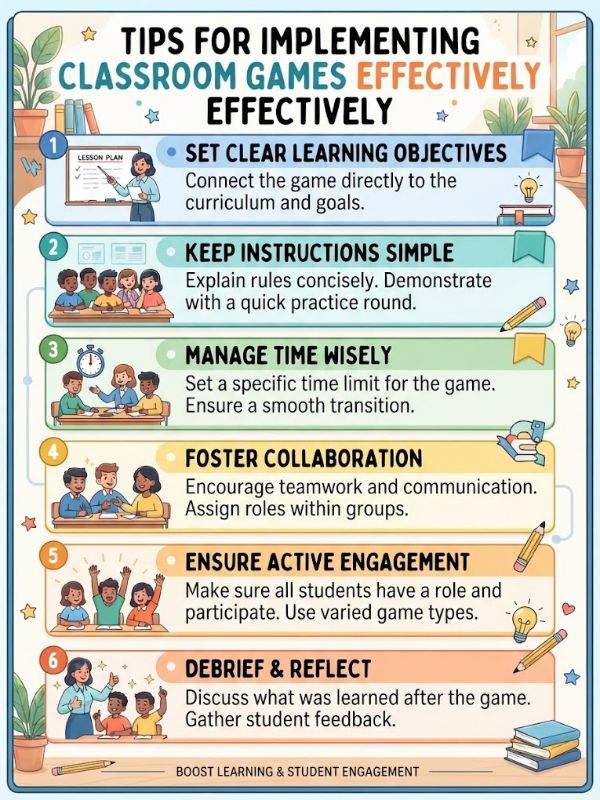
Follow these simple steps:
- Test the game yourself before class.
- Show one quick example round.
- Set a clear time limit.
- Praise effort, not only winning.
- Mix teams often so kids work with different classmates.
- End with a short talk about what students learned.
Keep the mood positive. Avoid public scoreboards that make weaker players feel bad. Team points and class goals often work better than individual rankings. Finally, watch for kids who feel left out. Offer them a special role, such as scorekeeper or timer. Every student should feel valued.
Boost Kids’ Learning and Have Fun with Great Classroom Games
Games and learning work best together. A fun lesson feels light, but the skills kids build are real. When students enjoy class, they ask more questions and try harder tasks.
Teachers also benefit. Games show you what kids know in a quick and natural way. You can spot gaps in understanding while students play. The next sections share even more ideas. They cover benefits, brain games, team builders, and games by grade level.
Top Benefits of Elementary Classroom Games
Elementary students gain a lot from structured play. Young minds grow through movement, talk, and hands on tasks. Games give them all three at once.
| Benefit | How Games Help |
| Better memory | Repeated play helps facts stick |
| Stronger focus | Short rounds keep attention high |
| Social skills | Kids learn to share, wait, and cheer others |
| Confidence | Small wins build a positive attitude |
| Language growth | Games encourage speaking and listening |
| Healthy movement | Active play improves mood and energy |
Games also support emotional growth. Kids learn to handle frustration when they lose. They learn to celebrate kindly when they win. These lessons matter far beyond the classroom.
“Brain” Classroom Games for Elementary Students
Brain games sharpen thinking skills. They need very little prep and work in any subject. Try these eight quick ideas.
- Mystery Number: Think of a number. Students ask yes or no questions to guess it.
- Word Chain: Each student says a word that starts with the last letter of the previous word.
- Odd One Out: Show four items. Kids pick the one that does not belong and explain why.
- Twenty Questions: Students guess a secret object by asking up to twenty questions.
- Rhyme Time: Say a word, and students race to name rhyming words.
- Math Relay: Teams solve one problem each, then pass the marker to the next teammate.
- Spelling Bee: Students spell words aloud, and the last child standing wins.
- Riddle of the Day: Post one riddle each morning. Kids guess by the end of the day.
These games take five to ten minutes. They work as warm ups, time fillers, or end of day treats.
Are You Enjoying This Content?
If these ideas help your classroom, keep exploring. Many teachers share new game ideas every week. Try one new game each Friday and note which ones your students love most. Save your favorites in a simple notebook or digital folder. Over time, you will build a personal game bank. That bank saves hours of planning.
Who’s Missing?
This is a gentle memory and observation game. Students sit in a circle. One child closes their eyes while the teacher quietly taps another child to hide behind a desk or screen.
The first child opens their eyes and guesses who is missing. Everyone cheers when the answer is right. Then a new round begins. The game sharpens visual memory and builds a warm class bond. It works best for Pre K to Grade 3 and takes about 10 minutes.
Team Building Games
Team building games help students trust each other. They work best at the start of the year or before group projects. Here are seven easy options.
- Human Knot: Students stand in a circle and hold random hands. They must untangle themselves without letting go.
- Marshmallow Tower: Teams build the tallest tower using spaghetti sticks and marshmallows.
- Blindfold Maze: One student guides a blindfolded partner through an obstacle path using only words.
- Group Story: Each child adds one sentence to build a class story.
- Paper Chain Challenge: Teams make the longest paper chain in five minutes.
- Silent Line Up: Students line up by birthday month without speaking.
- Compliment Circle: Each child shares one kind word about the student next to them.
After each game, hold a short talk. Ask what worked, what was hard, and how the team can improve. These reflection moments turn play into real learning.
Fun Classroom Games by Grade Level
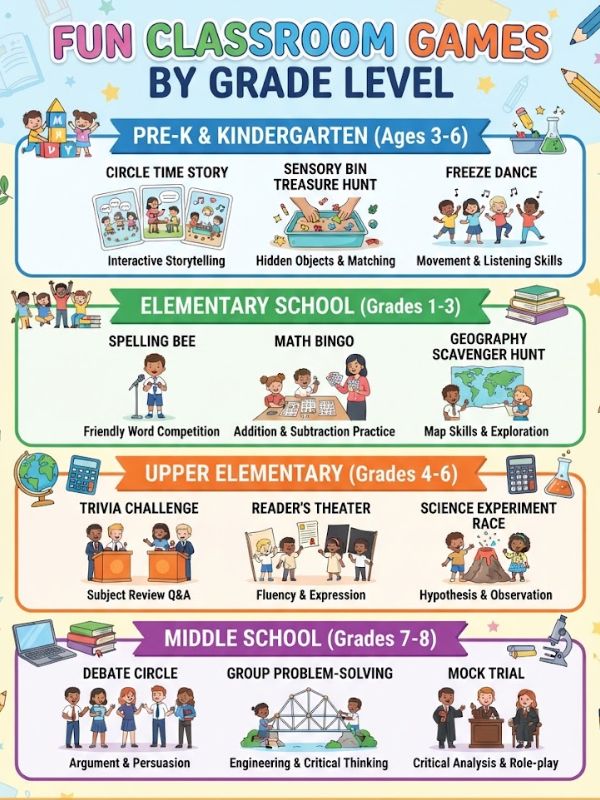
Different ages need different games. Younger kids love movement and simple rules. Older kids enjoy strategy, debate, and bigger challenges. Use this guide to match games to your class.
| Grade Level | Best Game Style | Example Games |
| Pre K and Kindergarten | Movement, songs, simple rules | Simon Says, Color Hunt, Animal Sounds, Bean Bag Toss |
| Grades 1 and 2 | Short, active, sound based | Sight Word Hop, Number Line Jump, Sound Bingo, Shape Scavenger Hunt |
| Grades 3 and 4 | Team contests, light strategy | Math Bowling, Story Dice, Vocabulary Charades, Map Race |
| Grades 5 and 6 | Debate, puzzles, deeper thinking | Mini Debate, Code Breaker, Trivia Showdown, Science Mystery Box |
Games for Pre K and Kindergarten
Keep games short, under ten minutes. Use bright colors and songs. Simon Says builds listening skills. Color Hunt sends kids to find objects of a named color. Animal Sounds teaches letters and science together. Bean Bag Toss practices counting and aim.
Games for Grades 1 and 2
Early readers love action mixed with words. In Sight Word Hop, kids jump onto word cards as you call them. Number Line Jump uses a floor number line for addition and subtraction. Sound Bingo has kids match letter sounds. Shape Scavenger Hunt sends them to find shapes around the room.
Games for Grades 3 and 4
Kids at this age love friendly competition. Math Bowling uses plastic pins, and each knocked pin earns a math question. Story Dice gives each child a roll to guide a short story. Vocabulary Charades acts out new words. Map Race has teams find places on a map the fastest.
Games for Grades 5 and 6
Older students enjoy thinking challenges. Mini Debate lets them argue fun topics such as “Cats are better than dogs.” Code Breaker uses simple ciphers to hide messages. Trivia Showdown covers current lessons. Science Mystery Box asks kids to guess hidden objects from clues.
Sign Up to Receive Your FREE Classbook Publishing Kit
Many teachers love to turn student work into a real book. A class book celebrates writing, art, and teamwork. It makes a great keepsake for families. Look for a free publishing kit from a trusted school book program.
A good kit includes templates, tips, and a simple guide. Check what the kit offers before you sign up. Start small. Collect drawings and short stories from your game days. Combine them into a class book at the end of the term. Students feel proud to see their work in print.
Frequently Asked Questions
What are the best classroom games for kids?
Top picks include Kahoot, Classroom Bingo, Pictionary, Freeze Dance, and Escape Room. They are easy to set up and work for many subjects.
How long should a classroom game last?
Most games work best at 5 to 20 minutes. Younger kids need shorter rounds, while older kids can handle longer games.
Are classroom games good for learning?
Yes. Games boost memory, focus, and motivation. Kids remember lessons better when they play and think at the same time.
What are easy classroom games with no supplies?
Try Simon Says, Word Chain, Twenty Questions, Charades, and Who’s Missing. They need no materials and take no prep.
How do I stop a classroom game from getting too noisy?
Set clear rules before you start. Use a signal like a clap or raised hand to bring the class back to calm.
Can classroom games work for shy students?
Yes. Team games and role based games help shy kids take part safely. Give them jobs like timer or scorekeeper to build confidence.
How often should teachers use games in class?
Use a short game two or three times a week. Daily five minute brain breaks also work well for most grades.
Final Thoughts
Classroom games make school brighter for everyone. They teach skills, build friendships, and help kids love learning. With more than 50 ideas in this guide, you can find the right game for any lesson, any age, and any mood.
Start with one or two games that fit your class. Watch how students respond, then adjust. Over time, you will build a powerful toolkit that keeps your lessons lively all year long.