

Have you ever seen “CYA” in a text and wondered what it really means. This short abbreviation shows up everywhere in 2026, from casual chats to work emails. Most of the time, it simply means “See Ya,” a fun and easy way to say goodbye. Friends use it to end conversations, sign off on social media, or wrap up a group chat with a light, friendly touch.
But CYA does not always mean the same thing. In offices, emails, and business chats, CYA often stands for “Cover Your Ass,” a phrase used to describe protecting yourself from blame. This guide breaks down every meaning of CYA in simple terms. You will learn how to use it, when to use it, and how to avoid mixing up its casual and professional meanings.
TL;DR
CYA has two very different meanings, and context decides which one you need.
- In casual texting and social media, CYA means “See Ya”. It is a fun, informal way to say goodbye.
- In business, legal, and workplace settings, CYA means “Cover Your Ass” (or the politer version, “Cover Your Assets”). It refers to actions taken to protect yourself from blame.
Both meanings are common in 2026. This guide breaks down every context so you never send the wrong message again.
What Does CYA Mean in Text?
CYA is a short text abbreviation with two possible meanings depending on where you see it.
The friendly meaning is “See Ya”. People use it to say goodbye at the end of a chat, call, or hangout. It sounds casual and warm, almost like waving to a friend through your phone screen.
The second meaning is “Cover Your Ass”. This version shows up in emails, meetings, and office chats. It means someone is protecting themselves from blame, criticism, or legal trouble.
Here is a quick snapshot:
| Meaning | Full Form | Common Setting | Tone |
| Goodbye | See Ya | Texting, social media, casual chat | Friendly, light |
| Self protection | Cover Your Ass(ets) | Workplace, business, legal talk | Serious, cautious |
Most of the time, if a friend texts “CYA” at the end of a conversation, they mean “See ya later.” If a coworker says “Send that email just to CYA,” they mean covering themselves from blame.
What Does CYA Mean in Different Contexts?
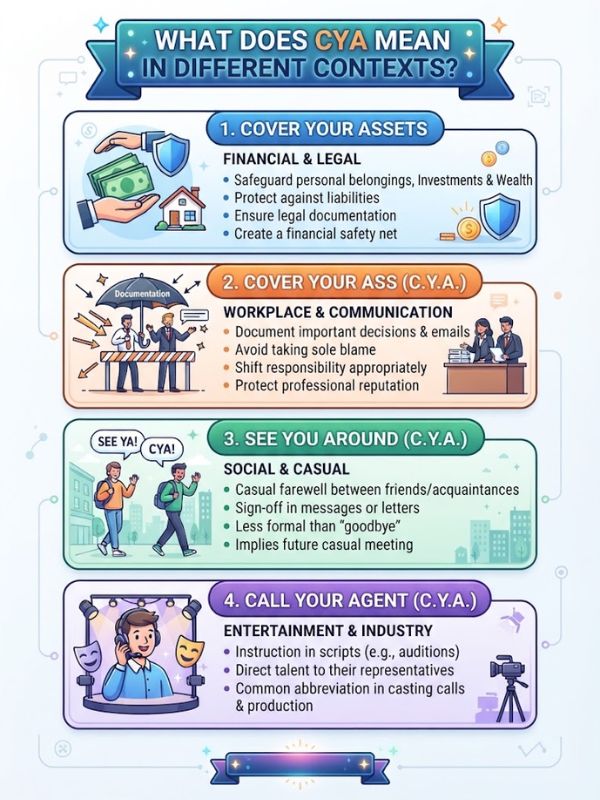
Context changes everything with CYA. The same three letters can mean something sweet or something strategic.
On Social Media
On platforms like Instagram, TikTok, and Snapchat, CYA almost always means “See Ya.” People use it in comments, captions, and direct messages. It is a quick, breezy sign off.
Example: “Had such a good time today! CYA this weekend 🥰”
In Group Chats
In friend group chats, CYA usually signals someone is leaving the conversation or heading out for the day. It keeps things light and short.
Example: “Gotta go pick up my sister, CYA guys!”
In Work Emails and Meetings
In professional settings, CYA shifts meaning almost completely. It becomes shorthand for protecting yourself from blame or liability.
Example: “I’m CCing my manager on this just to CYA.”
In Gaming Chats
Gamers often use CYA to say goodbye after a match or session. It fits the fast typing style used during online play.
Example: “GG everyone, CYA next round!”
How Is CYA Used in Text Messages?
CYA works best as a closing line. People rarely start a conversation with it. Instead, they drop it in right before ending the chat.
Here are common ways people use CYA in texts:
- As a simple goodbye: “Okay, talk later. CYA!”
- With emojis for warmth: “CYA soon 😊👋”
- Paired with plans: “CYA at the game tonight”
- In a rush: “Running late, CYA in 10”
- As a casual sign off in group chats: “Alright team, CYA tomorrow”
CYA feels less formal than “goodbye” and less intense than “talk to you later.” It sits right in the middle, perfect for quick, friendly exchanges.
Real Life Text Examples
Here is how a natural conversation might flow:
Person A: “This was fun, we should do it again soon”
Person B: “Definitely! CYA next week 😄”
Person A: “Heading to bed now, night!”
Person B: “Night, CYA tomorrow”
These examples show how CYA fits naturally into everyday texting without sounding forced.
Why Does CYA Mean “See You”?
CYA works as a phonetic shortcut. When you say the letters “C,” “Y,” and “A” out loud, they sound close to “see ya.”
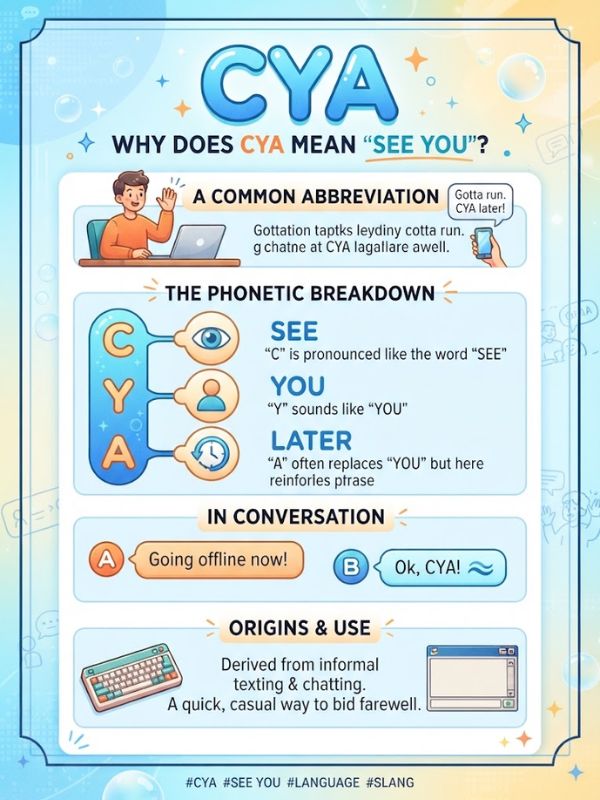
- C sounds like “see”
- Y sounds like “ya” (a casual version of “you”)
- A adds emphasis, similar to how “ya” already ends in that sound
This type of abbreviation is called a phonetic acronym. Other examples include “CU” (see you) and “IC” (I see). Texting culture loves these shortcuts because they save time and keystrokes while keeping a friendly, spoken tone.
CYA became popular in early internet chatrooms and instant messaging platforms in the late 1990s and early 2000s. Back then, typing speed mattered, and short abbreviations spread fast among casual users.
Is CYA Friendly or Rude?
CYA is friendly in almost every situation. It is not rude, sarcastic, or dismissive on its own. People use it to end conversations on a warm, casual note.
However, tone always depends on context. If someone types “cya” with no punctuation, no emoji, and ends a heated conversation abruptly, it might feel cold or dismissive. Add a smiley face or an exclamation mark, and it instantly feels warmer.
Here is a simple table to show how tone shifts:
| Style | Feels Like |
| “CYA!” | Cheerful, friendly |
| “cya 😊” | Warm, casual |
| “cya.” | Neutral, maybe rushed |
| “cya” (after an argument) | Could feel cold or curt |
In general, CYA carries a light, positive tone. The formatting around it (capitalization, punctuation, emojis) shapes how the receiver interprets it.
CYA Meaning in Banking
In banking and finance conversations, CYA takes on its serious meaning: Cover Your Ass or Cover Your Assets.
Banking professionals use CYA to describe actions taken to protect themselves from legal or financial responsibility. This often includes:
- Documenting every client interaction
- Getting written approval before making changes
- Keeping detailed records of transactions
- Following compliance steps exactly as written
Example: “Make sure you get the client’s signature first, that’s basic CYA.”
Banks operate in a heavily regulated space. One missed step can lead to lawsuits or compliance violations. CYA culture exists to protect both the employee and the institution.
CYA Meaning in Finance
The finance world uses CYA the same way banking does. It refers to protecting yourself, your team, or your company from blame, risk, or legal trouble.
Common CYA practices in finance include:
- Sending confirmation emails after verbal agreements
- Saving screenshots of approvals
- Keeping audit trails for every transaction
- Double checking numbers before submitting reports
Example: “I always email a summary after client calls, pure CYA.”
This habit is not about dishonesty. It is about accountability. Financial professionals face audits, regulations, and legal scrutiny, so proper documentation protects everyone involved.
CYA Meaning From a Girl
When a girl texts “CYA,” she almost always means “See Ya.” It is a casual, friendly way to end a conversation and does not usually carry hidden meaning.

Context matters here too. Consider these examples:
- After a fun hangout: “Had a great time! CYA soon 😊” — This signals she enjoyed herself and wants to see you again.
- Quick and short: “cya” — This might just mean she is busy or in a rush, not that she is upset.
- With extra warmth: “cya later cutie 💕” — This adds a flirty, affectionate tone.
Do not overanalyze a plain “cya.” Most of the time, it simply means she is wrapping up the conversation naturally. If you want a clearer read on interest, look at the full conversation, not just the sign off.
How Do You Respond to CYA?
Responding to CYA is simple. Match the tone and keep it short.
Good ways to respond:
- “Cya!”
- “See ya soon!”
- “Later!”
- “Bye! Talk soon 😊”
- “Cya tomorrow!”
If someone used CYA to close a conversation, there is no need to write a long reply. A short, friendly response keeps the exchange natural and easy.
If CYA was used in the workplace sense (Cover Your Ass), respond based on the actual topic, not the abbreviation itself. For example, if a coworker says “I emailed the client just to CYA,” you might reply, “Good call, always safer that way.”
CYA vs. Similar Texting Abbreviations
CYA is part of a bigger family of goodbye abbreviations. Here is how it compares:
| Abbreviation | Meaning | Typical Use |
| CYA | See Ya | Casual goodbye |
| CU | See You | Casual goodbye, slightly shorter |
| TTYL | Talk To You Later | Ending a chat but planning to reconnect |
| BRB | Be Right Back | Temporary pause, not a full goodbye |
| GTG | Got To Go | Leaving quickly, often mid conversation |
| L8R | Later | Very casual goodbye |
CYA stands out because it sounds warm and personal, almost like saying it out loud. TTYL feels slightly more formal, while GTG feels rushed. Choosing between them depends on the vibe you want to set.
What Does CYA Mean at Work?
At work, CYA almost always means Cover Your Ass or Cover Your Assets. It describes protective behavior meant to avoid blame, criticism, or liability.
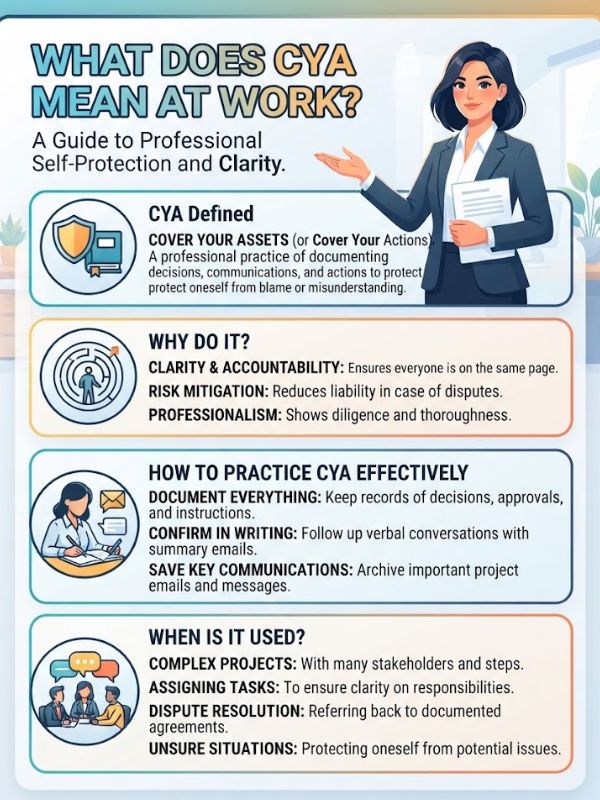
Common CYA behaviors at work include:
- Sending a follow up email after a verbal instruction
- CCing a manager on sensitive conversations
- Saving copies of important documents
- Asking for written approval before big decisions
- Documenting meeting notes and action items
Example: “Always get client approval in writing, that’s just CYA.”
This behavior is common in industries with high accountability, such as healthcare, law, finance, and corporate management. Employees use CYA tactics to protect their reputation and avoid being blamed for mistakes they did not cause.
Is CYA a Bad Thing at Work?
Not at all. CYA is often seen as smart, responsible behavior. It shows professionalism and attention to detail. Problems only arise when CYA behavior becomes excessive, such as over documenting every tiny task out of fear rather than necessity.
Is CYA Appropriate in Professional Communication?
Yes, but only with its workplace meaning. Using CYA in the “Cover Your Ass” sense is common and acceptable, especially in internal conversations with coworkers you know well.
However, avoid using the raw phrase “Cover Your Ass” in formal documents, client emails, or official reports. Instead, use professional alternatives:
- “For documentation purposes”
- “To ensure clarity and accountability”
- “As a precaution”
- “For record keeping”
Also avoid using CYA in its casual “See Ya” sense during formal business communication. Saying “CYA” to a client in a formal email feels too casual and unprofessional. Stick to “Best regards” or “Thank you” in those situations.
Where Did CYA Come From?
CYA as “See Ya” traces back to early texting and internet chat culture. As mobile phones adopted SMS in the late 1990s, character limits and slow typing speeds pushed people to invent shortcuts. CYA became one of many phonetic abbreviations, alongside terms like BRB and TTYL.
CYA as “Cover Your Ass” has a different history. This phrase grew popular in American workplace culture during the mid 20th century, especially in government, military, and corporate settings. It described the habit of creating paper trails to avoid blame during audits or investigations. Over time, it became common slang across many industries.
Today, both meanings coexist. Younger generations mostly use the casual “See Ya” version in texting and social media, while professionals across all age groups use the “Cover Your Ass” meaning in office settings.
Frequently Asked Questions
What does CYA mean in a text from a friend?
It almost always means “See Ya,” a casual way to say goodbye or end the conversation.
Does CYA mean the same thing on every platform?
No, the meaning depends on context. Casual chats and social media use “See Ya,” while workplace conversations often use “Cover Your Ass.”
Is CYA a flirty text?
Not by itself. It becomes flirty only when paired with extra words, emojis, or a warm tone.
Can I use CYA in a work email?
Only casually with coworkers you know well. Avoid it in formal emails or client communication.
What is a polite way to say Cover Your Ass at work?
Say “for documentation purposes” or “as a precaution” instead of the slang phrase.
How do I reply if someone texts me CYA?
Reply with something short and friendly, like “Cya!” or “See ya soon!”
Is CYA rude if someone sends it after an argument?
It can feel cold without punctuation or emojis, but it is not inherently rude. Tone depends on the full context of the conversation.
Final Thoughts
CYA proves how much meaning can hide inside just three letters. In friendly texts and social media, it brings warmth and simplicity to a quick goodbye. In professional settings, it shifts into a completely different role, representing caution, documentation, and self protection.
Understanding both meanings helps you read messages correctly and respond with the right tone. Whether a friend is saying “CYA later” after a fun day out or a coworker mentions CYA before sending an important email, context always tells you exactly what they mean.