
On Twitter, ATP means “at this point.” People use it to show they have reached a limit, a conclusion, or a moment of acceptance. You will see it in posts like “ATP I just need a nap.” It is short, fast, and easy to type.
This guide explains what ATP means in text, chat, and social media. You will learn its full form, tone, origin, and real examples. You will also learn when to use it, when to avoid it, and how to reply with confidence in 2026.
What Does ATP Mean in Text?
In text, ATP means “at this point.” It sits at the start or end of a sentence to show that someone has reached a conclusion, a breaking point, or a moment of surrender. People type ATP to save time. Texting rewards speed, so long phrases shrink into short codes. “
At this point” has three words and ten letters. ATP has three letters. That is a big saving for a quick message. The meaning of ATP depends on the sentence around it. It can sound tired, funny, angry, or calm. The words next to it tell you which one.
Here are a few quick examples:
- “ATP I don’t even care anymore.”
- “I’ll walk home ATP.”
- “ATP he should just apologize.”
In each line, you can swap ATP for “at this point” and the sentence still makes sense. That is the easiest test for the slang.
ATP Full Form
The full form of ATP in slang is At This Point. Each letter stands for one word.
| Letter | Stands For |
| A | At |
| T | This |
| P | Point |
The phrase “at this point” refers to the current moment in a story or situation. It often suggests that things have changed over time. Something has built up, and now the speaker reacts to it.
Outside slang, ATP has other full forms. Scientists know it as adenosine triphosphate, the molecule that carries energy in cells. Sports fans know it as the Association of Tennis Professionals. On Twitter, though, the slang meaning wins almost every time.
What Does ATP Stand For on Twitter?
On Twitter, ATP stands for “at this point.” Users post it in replies, quote tweets, jokes, rants, and reaction posts. It fits the platform well because tweets have a limited length, so every character counts. Twitter culture also loves dramatic, relatable one liners. ATP fits that style perfectly. A user can sum up a whole mood in a few letters.
You will see ATP in posts like these:
- “ATP my phone battery has more drama than my love life.”
- “ATP just give me the weekend.”
- “ATP I trust no one on this timeline.”
The tone usually feels casual and expressive. Most users write in lowercase, which adds to the relaxed feel. Capital letters may signal stronger emotion.
ATP Meaning in Different Contexts
ATP changes shape depending on where you use it. The core meaning stays the same, but the mood shifts. Let’s look at the main settings.
Casual Conversations
In everyday chats, ATP often shows a relaxed decision or mild surrender. A friend might text, “ATP let’s just order pizza.” That means, “We have waited long enough, so let’s pick the easy option.”
The tone here is light. No one feels angry. The speaker just wants to move forward. You can also use ATP to show a shared feeling. “ATP it’s just too hot outside” invites your friend to agree.
Arguments
During arguments, ATP takes a sharper edge. It can signal that someone has lost patience. “ATP I’m done explaining” tells the other person that the speaker has reached their limit.
In heated threads, ATP may sound cold or dismissive. The reader may feel shut out. Use caution if you want to keep the peace. Some users also pair ATP with strong opinions. “ATP you’re just trolling” shows that the speaker no longer takes the other person seriously.
Funny Tweets
Humor is where ATP shines. Comedians and meme accounts use it to exaggerate small problems. The joke grows because the reaction is bigger than the cause.
Examples include:
- “ATP my cat runs this house.”
- “ATP I’m 90 percent coffee.”
- “ATP the group chat needs a manager.”
The charm comes from honest, over the top exaggeration. Readers laugh because they feel the same way.
Relationship Posts
In relationship talk, ATP often marks a turning point. “ATP I just want someone who texts back” shows frustration and hope in one line. It can also show affection.
“ATP you’re my favorite person” says that after everything, this person stands out. Because love brings strong feelings, ATP can sound sad, sweet, or playful. Context is everything.
School or Work
At school or work, ATP often expresses fatigue or deadline stress. A student might write, “ATP I need a nap more than a grade.” A coworker might joke, “ATP the printer wins.” In casual team chats, this is fine. In formal emails or reports, avoid it. Professional writing needs full words and a clear tone.
Is ATP Rude, Offensive, or Neutral?
ATP is not rude or offensive on its own. It is a plain phrase shortened into letters. Its tone depends on the words and mood around it. Think of ATP as a tool. You can use it kindly or harshly. The abbreviation itself carries no insult.
Neutral
Most of the time, ATP sounds neutral. It simply points to the current moment. “ATP we have five minutes left” is just a time check. Neutral use is common in planning, updates, and simple comments. No emotion hides behind it.
Frustrated
Frustration is the most common hidden tone. When someone is tired of a situation, ATP often appears. “ATP I give up” carries clear stress. Watch for clues like short sentences, strong verbs, or sighs written as words. These signs show that the writer feels worn down.
Sarcastic
ATP also works well for sarcasm. “ATP I should just move to the moon” is a joke, not a plan. The exaggeration gives it away. Sarcastic ATP posts often get likes and replies. Readers enjoy the playful drama. Still, sarcasm can fail in text, so be careful with new people.
Where Is ATP Commonly Used?
ATP appears across many platforms. Social media is its home, but it has spread well beyond Twitter.
| Platform | How ATP Appears |
| Twitter (X) | Jokes, rants, reactions |
| Captions and comments | |
| TikTok | Comment sections and video text |
| Snapchat | Quick chats between friends |
| WhatsApp and Messenger | Everyday texting |
| Forum replies and threads | |
| Discord | Gaming and community chat |
Younger users lead the trend, but adults use it too. Anyone who texts a lot may pick it up. You may also hear ATP in spoken form among friends who text often. Some people say “at this point” in a voice that mirrors how they type.
Emotional and Psychological Meaning
ATP often reflects a feeling of acceptance or exhaustion. Many users reach for it when emotions build up. It lets them express a big feeling in a small way. Psychologically, the phrase “at this point” marks a mental line.
The speaker has weighed what happened and made a call. That can feel freeing, even if the mood is sad or angry. ATP also creates a sense of shared experience. When readers see it, they often think, “Me too.” This connection explains why ATP posts spread so fast.
Here are some common emotions behind ATP:
- Tiredness and burnout
- Mild frustration
- Dark humor
- Relief and acceptance
- Playful exaggeration
Notice that not every one of these feelings is negative. ATP can mark relief as easily as stress. “ATP I’m just grateful it’s Friday” is a happy line.
Origin and Background of ATP Slang
ATP grew out of texting culture. Early mobile phones limited message length, and typing on small keys took time. People created short forms like LOL, BRB, and IDK to speed things up. The phrase “at this point” was already common in spoken English. It was only a matter of time before someone shortened it.
As social platforms grew, the short form spread through posts and replies. No single person invented ATP. Like most slang, it grew from many users copying each other. Twitter, with its tight space and fast pace, helped it spread widely.
Why People Use ATP
People use ATP for several simple reasons. Speed comes first. Typing three letters beats typing three words. Style is another reason. ATP sounds casual and modern. It signals that the writer belongs to an online community.
Emotion also matters. ATP lets users show a mood without a long explanation. A short line can say, “I am done,” “I am tired,” or “I am joking.”
Here are the top reasons:
- Speed: It saves time while typing.
- Space: It fits within short post limits.
- Tone: It adds a relaxed, honest feel.
- Humor: It boosts jokes and exaggeration.
- Connection: It helps users bond with peers.
Real Life Conversation Examples
Examples make slang easier to learn. Here are short chats that show ATP in action across different moods.

Friendly
Mia: Are you coming to the party?
Sara: ATP I’m already on my way!
Here, ATP shows excitement. Sara has decided, and she is moving.
Casual
Ali: What should we eat?
Zain: ATP anything works. I’m starving.
Zain uses ATP to show he has stopped being picky. The tone is easy and relaxed.
Argumentative
User A: I told you three times already.
User B: ATP I don’t even want to argue.
User B sounds tired and a bit cold. ATP signals the end of patience.
Funny
Post: ATP my alarm clock is just a suggestion.
This tweet exaggerates for laughs. Readers understand the joke at once.
Work
Colleague 1: The report is still not ready.
Colleague 2: ATP let’s ask for a deadline extension.
This use is practical. ATP points to the current state of the project and suggests a next step. It works in a casual team chat, not a formal email.
Common Misunderstandings
Many people misread ATP, especially when they first see it. A few common mistakes appear again and again.
- Mistake 1: Thinking ATP means the science term. Adenosine triphosphate is a real thing, but it rarely appears in slang posts. Look at the topic. A joke about being tired is not about cell energy.
- Mistake 2: Reading ATP as always angry. Many users read it as harsh. In truth, ATP can be playful, calm, or kind. Always check the full sentence.
- Mistake 3: Mixing it up with the tennis tour. Sports pages use ATP for the Association of Tennis Professionals. Slang use is unrelated.
- Mistake 4: Believing it must start a sentence. ATP can appear at the beginning, middle, or end. “I’m done ATP” is just as correct as “ATP I’m done.”
When in doubt, replace ATP with “at this point.” If the sentence reads well, you have the right meaning.
Variations and Similar Slang
ATP has a few cousins in online language. Some share its meaning, while others express similar moods in different ways.
Common variations include:
- atp: The lowercase version, used in casual posts.
- At this point: The full phrase, often used when clarity matters.
- ATM: Means “at the moment,” which points to now rather than a turning point.
- IDC: Means “I don’t care,” which is stronger than ATP.
- SMH: Means “shaking my head,” used to show disbelief.
- TBH: Means “to be honest,” used to share a frank opinion.
Notice that ATP carries a sense of buildup. ATM, in contrast, simply names the present time. That small difference matters.
ATP vs Similar Slang
Comparing slang terms helps you choose the right one. Here is a simple table.
| Slang | Full Form | Main Use | Tone |
| ATP | At this point | Shows a limit or conclusion | Tired, funny, calm |
| ATM | At the moment | Describes the current time | Neutral |
| IDC | I don’t care | Shows lack of concern | Cold or blunt |
| SMH | Shaking my head | Shows disbelief | Disappointed |
| TBH | To be honest | Introduces a frank opinion | Honest |
| IMO | In my opinion | Shares a personal view | Mild |
Use ATP when something has built up over time. Use ATM when you only talk about right now. Use IDC when you truly do not care. Each term has its own job.
When to Use ATP
ATP works best in relaxed, informal settings. If you feel comfortable using slang, ATP is a fine choice.
Use ATP in these situations:
- Texting friends and family
- Posting jokes on social media
- Replying to a funny or relatable tweet
- Chatting in gaming or community groups
- Sharing a mood in a quick comment
You can also use ATP when you want to sound honest without writing much. A short line often feels more real than a long one. Remember to match the tone to your audience. Friends will get the joke. Strangers may need more context.
When to Avoid Using ATP
Some places call for full words. Avoid ATP when clarity and respect matter most.
Skip ATP in these cases:
- Formal emails and business reports
- Job applications and cover letters
- Academic essays and official papers
- Messages to older readers who may not know the slang
- Serious conversations that need care and detail
Slang can confuse people who do not know it. It may also seem careless in professional settings. When the stakes are high, choose clear and complete language. Also avoid ATP in tense arguments if you want to calm things down. It may sound dismissive and add fuel to the fire.
Polite Alternatives
Sometimes you want the same meaning without slang. Plenty of polite options exist.
Here are some easy replacements:
- “At this point” (the full phrase)
- “By now”
- “Given where we are”
- “As things stand”
- “Right now, it seems best to”
For example, instead of “ATP let’s reschedule,” you can write, “Given where we are, let’s reschedule.” The message stays the same, but the tone becomes more formal and warm.
These alternatives work well in emails, meetings, and professional chats. They keep your writing clear and friendly.
How to Respond When Someone Uses ATP
Your reply depends on the mood behind the message. Read the context first, then choose your tone.If the tone is funny, join the joke. Reply with a playful line or a matching post. A little humor builds connection.
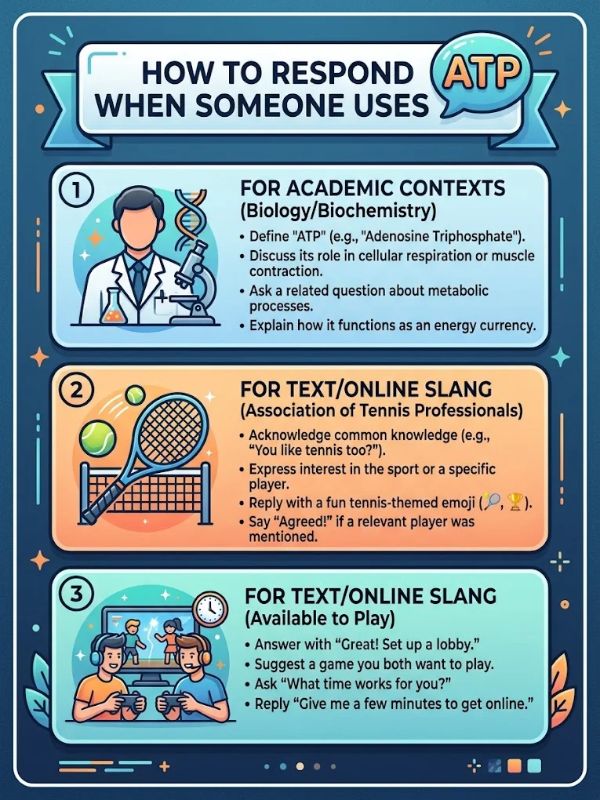
If the tone is tired or sad, respond with care. A short, kind message goes a long way. For example, you can say, “That sounds rough. Want to talk about it?” If the tone is angry, stay calm. Avoid fighting fire with fire.
A calm reply like “I hear you. Let’s take a break” can cool things down. If you feel confused, simply ask. A quick “Do you mean ‘at this point’?” clears up any doubt. Most people will happily explain.
Regional and Cultural Usage
ATP is understood across many English speaking regions. Users in the United States, the United Kingdom, Canada, Australia, and the Philippines all use it online. South Asian users, including many in Pakistan and India, also use it in English texts and posts.
Culture shapes tone. In some communities, direct language feels normal. In others, people prefer softer wording. ATP can sound blunt in a polite setting, so choose it with care.
Many multilingual users mix ATP into messages written in other languages. A chat may blend English slang with Urdu or Hindi words. This mix shows how global online language has become.
Is ATP Safe for Social Media?
Yes, ATP is safe for social media. It contains no offensive words, no hidden insults, and no harmful meaning. Platforms do not flag it. The only risk is tone. A harsh sentence with ATP may still hurt someone. The abbreviation is safe, but the message around it needs thought.
Brands and creators can use ATP too. It works well in casual captions and replies. Just keep the voice friendly and on topic. If you manage a professional account, think about your audience. A relaxed brand may use ATP freely. A formal brand may prefer full phrases.
Impact of Using Slang in Communication
Slang shapes how we connect online. It speeds up chats, builds friendships, and adds personality. ATP is one small example of that bigger trend. Slang also has limits. It can confuse new readers, blur meaning, and weaken formal writing.
Overuse may make your message hard to follow. Good communicators balance both sides. They use slang with friends and clear language in formal settings. This habit keeps messages friendly and understood.
Here is a quick view of the pros and cons:
| Benefit | Risk |
| Faster typing | May confuse some readers |
| Friendly, modern tone | Can seem unprofessional |
| Builds community | May hide emotion or detail |
| Adds humor | Can be misread as rude |
Use slang as a seasoning, not the whole meal. A little goes a long way.
Frequently Asked Questions
What does ATP mean in text?
ATP means “at this point.” People use it to show a limit, a conclusion, or a mood shift.
What does ATP stand for on Twitter?
On Twitter, ATP stands for “at this point.” Users post it in jokes, rants, and reactions.
Is ATP rude or offensive?
No, ATP is not rude on its own. The tone depends on the words around it.
Is ATP the same as ATM?
No. ATP shows a turning point, while ATM means “at the moment” and names the present time.
Can I use ATP in a work email?
It is best to avoid it in formal emails. Use “at this point” in full instead.
Where did ATP slang come from?
ATP grew from texting culture, where short forms save time. No single person created it.
How do I reply to an ATP message?
Read the tone first. Match humor with humor, and answer tired messages with kindness.
Final Thoughts
ATP is a simple slang term with a clear meaning: “at this point.” It saves time, adds personality, and helps people share moods in just a few letters. You now know its origin, tone, examples, and best uses.
Remember to check the context before you judge the message. ATP can sound tired, funny, calm, or sharp. Use it with friends, skip it in formal writing, and choose polite alternatives when needed.