Bop Girl Meaning: What Is a Bop Girl? Definition, Meaning & Usage in Text and Social Media (2026)

Have you seen “bop girl” in a comment or a group chat and wondered what it means? You are not alone. Many people search for this phrase because it can sound friendly in one place and hurtful in another. A “bop girl” is slang for a girl labeled as promiscuous, and most people use it as an insult.
This guide gives you the bop girl meaning in simple words. You will learn the definition, the origin, and how people use it in text and on social media. You will also see why the term can harm, how it differs from calling a song a “bop,” and what better words you can use instead.
What Does ‘Bop’ Mean?
The word “bop” has several meanings. The right one depends on who is talking and where. Understanding all of them helps you read the context correctly.
Quick Definition of “Bop”
“Bop” is a flexible slang word. It can describe a great song, a light hit, a dance move, or, in a negative sense, a person. When it describes a girl, it often carries a sexual and judgmental tone. The key point is simple. A “bop” song is praised. A “bop” girl is usually shamed.
The Main Meanings of “Bop” Today
Here is a quick look at how the word works in daily use.
| Meaning | Plain Explanation | Example Sentence | Tone |
| A great song | A catchy track you replay often | “That new single is a total bop.” | Positive |
| To hit lightly | A gentle tap | “She bopped him on the head with a pillow.” | Playful |
| To dance | Move to the beat | “We bopped around the kitchen.” | Positive |
| A “bop” girl | A girl labeled as promiscuous | “Don’t call her a bop. That is rude.” | Negative |
| To go somewhere | Casual movement | “I’ll bop over to the store.” | Neutral |
Notice how one word swings from happy to harmful. Tone, context, and the speaker’s intent decide everything.
How to Tell Which Meaning Is Being Used
Look at the words around “bop.” If a person talks about music, playlists, or dancing, the meaning is positive. If the word points at a girl and mentions dating, rumors, or her body, it is likely an insult.
Also check the group. In some friend circles, people use the word as a joke. In public comments, it is more often used to shame. When in doubt, treat it as a risky word.
Why Teens Use ‘Bop Girls’ and What It Means for Them
Teens use slang to belong. New words signal that you are part of the group and that you understand the culture. “Bop girl” spread fast because it is short, catchy, and easy to type.
For many teens, the term works like a label. It can be a way to gossip, to tease, or to push someone out of a group. Some teens use it without thinking about the weight behind it. They may have picked it up from a video or a group chat.
Common Reasons Teens Use the Term
Several forces push this slang forward. Here are the most common ones.
- Peer pressure: Teens repeat words they hear from friends so they do not feel left out.
- Social media trends: Short videos and memes spread slang within hours.
- Humor and shock value: Some teens use harsh words to get a reaction.
- Gossip and rivalry: The label is sometimes used as a weapon in arguments or breakups.
- Pop culture: Songs, influencers, and comment sections make the word feel normal.
What It Can Mean for Teens Who Are Labeled
Being called a “bop girl” can feel awful. The label judges a girl before anyone knows her story. It can lower her self esteem and make her feel watched at school and online. Some girls also start to fear that any normal choice, like talking to a boy or posting a photo, will bring a rumor. This fear can lead to stress, anxiety, and withdrawal from friends.
Why the Term ‘Bop’ Can Be Harmful
The word may look small, but its effects can be big. It puts a negative sexual label on a person, often a girl, and often without proof. That is a form of shaming. Slang like this also carries a double standard. Boys who date many people rarely get a label this harsh. Girls often do. That unfair gap is one reason experts and educators call the term harmful.
Emotional and Social Impact
Name calling online spreads fast and stays visible. A single comment can be screenshotted and shared in group chats. The target may feel exposed and alone.
Possible effects include:
- Lower confidence and self worth
- Anxiety about school or social events
- Fear of posting or speaking online
- Strained friendships and trust issues
- Withdrawal from activities she once enjoyed
Link to Cyberbullying and Harassment
When a group uses “bop” to target one person, it becomes bullying. Repeated labels, rumors, or edited images can cross into harassment. In serious cases, schools and platforms treat this as a policy violation.
If someone shares private or intimate images alongside this label, the situation can become a legal matter. Families should save evidence and report it right away.
Why It Hurts Boys and Others Too
The word can also pressure boys. Some feel they must act tough or collect attention to look “cool.” Others become targets when they refuse to join in. A culture that rates people by their dating life hurts everyone.
“Bop” Meaning, Origin and Usage
Words rarely appear from nowhere. “Bop” has a long history, and its modern meaning grew from several roots. The exact path is debated, so treat any single story with caution.
Where the Word “Bop” Came From
The word first appeared in English as a verb for hitting lightly. Later, in the 1940s, “bop” became linked to bebop jazz, a fast and energetic music style. Over time, “bop” came to describe any song with a strong beat.
The “bop girl” meaning is newer. Many slang observers connect it to online communities, especially Black social media circles, where it spread through tweets and videos in the late 2010s and early 2020s. From there, it moved into mainstream teen language.
How People Use “Bop” in Text and Social Media
On apps like TikTok, Instagram, X, Snapchat, and Discord, people drop “bop” into captions and comments. Some use it to describe music. Others use it to describe people. Here are real life style examples.
| Platform | Example Use | Likely Meaning |
| TikTok comment | “This song is such a bop 🔥” | Great song |
| Group chat | “Stop calling her a bop. You don’t know her.” | Insult, with pushback |
| Instagram caption | “Bop season is here” | Playlist or party mood |
| Gaming chat | “I’ll bop him with the hammer” | Hit lightly |
| Discord server | “Don’t use that word here. It is a slur for girls.” | Rule enforcement |
Reading Tone and Context
Tone matters most. A friend joking about a song is not the same as a stranger attacking someone’s name. Ask three quick questions: Who said it? Who is it about? What is the goal?
If the goal is to shame, embarrass, or exclude, the word is harmful. If the goal is to praise a track, it is fine. Many schools and online communities now ask users to avoid the “girl” version altogether.
Related Terms to “Bop”
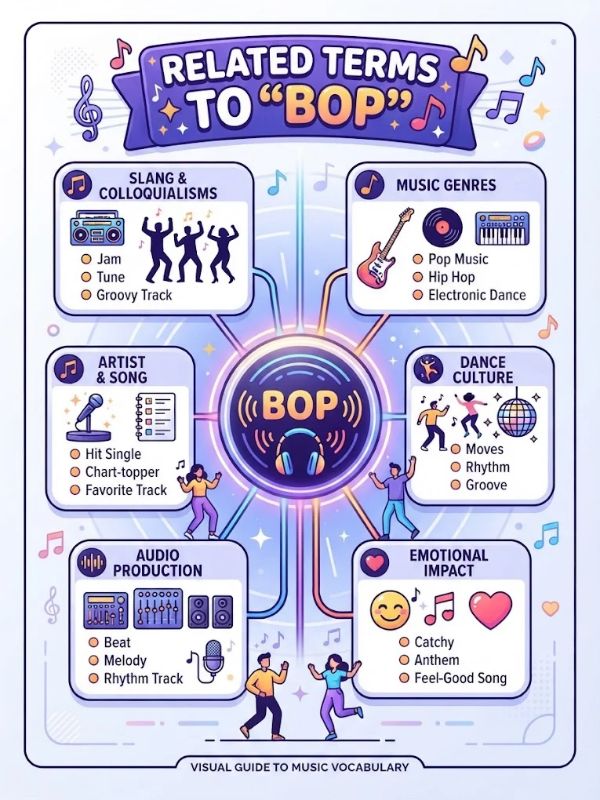
“Bop girl” belongs to a family of slang terms that judge people by their dating life. Knowing these terms helps parents and teens spot patterns. Some are mild. Others are clearly offensive.
Common Slang Related to “Bop”
| Term | Meaning | Is It Harmful? |
| Bop (song) | A catchy, replayable track | No |
| Bop girl | A girl labeled as promiscuous | Yes |
| Thot | A derogatory label for a girl, short for a rude phrase | Yes |
| Hoe | A derogatory label for a woman | Yes |
| Pick me | A person seen as seeking approval from others | Mildly negative |
| Baddie | A confident, stylish person | Usually positive |
| Slay | To do something exceptionally well | Positive |
| Simp | Someone seen as overly devoted | Mildly negative |
Positive Alternatives to Use Instead
Language can build people up. If you want to compliment someone, try words that focus on skill, kindness, or style.
- “She is confident.”
- “That outfit is fire.”
- “She is a great friend.”
- “That song is a banger.”
- “He has real talent.”
Swapping one word can change the whole mood of a chat.
Why Slang Keeps Changing
Slang evolves quickly. A word can shift from friendly to hurtful in a few months. New terms also replace old ones as soon as adults learn them. That is why parents benefit from staying curious rather than trying to memorize every word.
How Parents Can Support Their Children
Parents do not need to be tech experts. They only need to stay open and calm. A teen who feels safe talking at home is more likely to ask for help when something goes wrong. Start with curiosity, not punishment. If you hear the word, ask what it means to them. Listen first. Teens often share more when they do not feel judged.
Simple Conversation Starters
Try short, friendly questions. These can open the door without pressure.
- “I saw a word online and wanted to understand it. Have you heard of ‘bop girl’?”
- “How do people at school use that term?”
- “Has anyone ever used it about you or a friend?”
- “How did that make you feel?”
- “What would you like me to do if it happens?”
Teach Respect and Empathy
Explain that words shape how people see themselves. Share that labeling someone by their dating life is unfair. Encourage your child to speak up kindly when friends use hurtful words. Model the behavior you want. Avoid rating people by their looks or relationships in front of your kids. Children copy what they hear at home.
Know When to Step In
Watch for warning signs. These include sudden sadness, avoiding school, deleting accounts, or sleeping poorly. Any of these can point to bullying. If you see these signs, stay calm. Save screenshots, talk to the school, and report the content on the platform. Seek help from a counselor or doctor if your child seems overwhelmed.
Tools to Support Healthy Digital Engagement
Good habits and the right tools work together. No app can replace conversation, but tools can add a safety net. Choose options that fit your child’s age and your family’s values.
Helpful Settings and Features
Most platforms offer built in controls. Take a few minutes to explore them with your teen so it feels like teamwork.
| Tool or Feature | What It Does | Best For |
| Comment filters | Hides selected words and phrases | Instagram, TikTok, YouTube |
| Restricted or private accounts | Limits who can view and message | All social apps |
| Block and report buttons | Removes bullies and flags content | Every platform |
| Screen time dashboards | Tracks daily app use | Phones and tablets |
| Family pairing and linked accounts | Lets parents adjust safety settings | TikTok, Snapchat, Instagram |
| Content warning tools | Blurs sensitive images or text | Messaging apps |
Build Healthy Daily Habits
Tools work best with routines. Set clear screen time limits and device free hours, such as during dinner and before bed. Encourage offline hobbies like sports, art, music, or volunteering. Teach your teen to pause before posting. A simple rule helps: “Would I say this to their face?” If the answer is no, do not post it.
Use Trusted Resources
Schools, counselors, and nonprofit groups offer guides on cyberbullying and media literacy. Many provide free lessons and conversation scripts. Ask your child’s school which programs they use. If your child feels distressed, a mental health professional can help. Getting support early often prevents bigger problems later.
The Dangers of ‘Bop’—and How to Counter Them
Slang that shames can lead to real harm. The risks reach beyond hurt feelings. Understanding them helps families respond early and wisely.
Key Dangers to Know
- Emotional harm: Shame, anxiety, and low mood
- Cyberbullying: Group attacks, rumors, and exclusion
- Privacy risks: Pressure to share photos or personal details
- Reputation damage: Screenshots can spread and last for years
- Normalizing disrespect: Repeated use makes unfair judgment seem normal
How to Counter Them
Countering harm starts with small, steady actions. Here is a simple plan teens and families can follow.
- Pause and think. Do not repeat the word as a joke.
- Speak up kindly. Say, “That is not cool. Let’s not use that word.”
- Support the target. Send a private message of kindness.
- Report and block. Use platform tools right away.
- Tell a trusted adult. Share what happened and show screenshots.
Build a Kinder Online Culture
Schools and communities can help by setting clear rules. Group chat admins can ban harmful terms. Teachers can add short lessons on respectful language. Teens also hold real power. When a few people refuse to join in, the trend loses strength. One kind comment can shift the whole conversation.
Frequently Asked Questions
What does “bop girl” mean?
A “bop girl” is slang for a girl labeled as promiscuous. Most people use it as an insult, so it is best avoided.
Is “bop” always an insult?
No. Calling a song a “bop” is a compliment. The word turns negative when it targets a person.
Where did the term “bop girl” come from?
The meaning grew from online slang, mostly on social media in the late 2010s and early 2020s. The word itself is much older and links to jazz and light hitting.
Is it okay to call my friend a “bop” as a joke?
It is risky. Even a joke can hurt, and others may read it differently. Choose a kinder word instead.
What should I do if someone calls me a “bop girl”?
Do not reply in anger. Save the message, block the person, report it, and tell a trusted adult.
How can parents talk to teens about the word “bop”?
Stay calm and curious. Ask open questions, listen first, and explain why labels like this can harm people.
What is a better word to use instead of “bop girl”?
Use words that praise real qualities, such as “confident,” “talented,” or “kind.” If you mean a great song, say “banger” or “hit.”
Final Thoughts
Language shapes how we see each other. A single phrase can lift someone up or push them down. Knowing the real meaning of “bop girl” gives you the power to choose with care. Keep the conversation going. Stay curious about the slang your teens use, and listen without judgment. Small choices, like swapping one word or speaking up once, can build a kinder digital world.