
Branded Title Meaning: What Does Branded Title Mean? Definition, Pros, Cons & Examples (2026)

You find a car at a great price. Then you see “branded title” on the paperwork. What does it mean? A branded title is an official mark on a car’s record. It warns buyers about major past damage, such as a crash, flood, fire, or total loss. The brand stays with the car for life.
This guide explains the branded title meaning in simple words. You will learn the definition, the main types, the pros and cons, and real examples. You will also see how a brand affects value, insurance, and financing in 2026. Read on to buy smart and avoid costly mistakes.
What Does Branded Title Mean?
A branded title is an official mark on a vehicle’s title that shows the car has a serious problem in its past. The state adds this mark, called a “brand,” to the permanent record. The brand warns every future buyer about major damage, a total loss, or another important event.
Think of it like a label on a food package. The label does not say the food is bad. It tells you something you need to know before you eat. A brand works the same way. It gives you facts so you can decide with open eyes.
Most brands come from big events. A car may suffer a major crash. A flood may soak the interior. A fire may burn the engine bay. An insurance company may decide the repair cost is too high and call the car a total loss. In each case, the state records the event on the title.
What Is a Branded Title on a Car?
A branded title on a car is a title document that carries a permanent warning label about the vehicle’s history. The label may say salvage, rebuilt, flood, fire, junk, or something similar. The exact word depends on the state and the reason for the brand.
Every car in the United States has a title. The title proves who owns the car. It also lists the vehicle identification number, also called the VIN. A clean title has no warning label. A branded title does.
Here is a simple way to see it:
- A clean title says no major brand has been recorded.
- A branded title says a major event has been recorded.
- A brand is the specific word the state uses, such as “Rebuilt” or “Flood.”
You may also hear the phrases “title brand,” “branded vehicle,” and “branded car.” They all point to the same idea. The car has an official history flag that buyers must see.
Branded Title vs. Salvage Title
A salvage title is one type of branded title. A branded title is the bigger category that includes salvage and many others. Every salvage title is branded. Not every branded title is salvage.

People mix these terms up all the time. Sellers sometimes use them as if they mean the same thing. They do not. The easiest way to remember is this: “branded” is the umbrella, and “salvage” is one item under it.
A car usually receives a salvage title when an insurer declares it a total loss. This happens when the repair cost reaches a set share of the car’s value. That share changes by state. Many states set it somewhere between 60 and 100 percent.
Here is a quick comparison:
| Feature | Branded Title | Salvage Title |
| What it is | Broad category of title warnings | One specific type of brand |
| Examples | Salvage, rebuilt, flood, fire, junk, buyback | Total loss, not yet repaired |
| Can the car be driven? | Depends on the brand | Usually not, until repaired and inspected |
| Is it permanent? | Yes, in most cases | Changes to “rebuilt” after repair and inspection |
So when a seller says “branded title,” ask one more question. Ask exactly which brand the title carries. The answer changes everything.
Types of Branded Titles
States use different words, but most brands fall into a few groups. Learn these six, and you will understand almost any title you see.
1. Salvage Title
A salvage title means an insurer or the state declared the car a total loss. The repair cost was too high compared with the car’s value. It also covers many stolen cars that insurers paid out and later recovered. A salvage car usually cannot be registered or driven on public roads.
The owner must repair it first. Then the car must pass a state inspection. After that, the state may issue a new title. Many buyers of salvage cars are repair shops, hobby builders, and parts sellers. Regular drivers should be careful. A salvage car that has not been fixed is not ready for daily use.
2. Rebuilt Title
A rebuilt title means a former salvage car was repaired and passed a state inspection. Some states call it “reconstructed” or “rebuilt salvage.” The idea is the same. The car was once a total loss and is now legal to drive again. The inspection checks basics. Officers may look at the VIN, the receipts for parts, and the safety equipment.
In many states, this inspection does not test the full quality of the repair. That point matters a lot. A rebuilt car can be a good deal if the repair was done well. It can also be a headache if the work was poor. The brand tells you the car needs extra checking.
3. Flood or Water Damage Brand
A flood brand means water seriously damaged the vehicle. Floods, hurricanes, and heavy storms create most of these cases. Water can reach the engine, the wiring, the seats, and the electronic modules. Water damage often causes slow problems. Rust may appear months later.
Mold can grow inside the carpet. Sensors may fail without warning. Airbags and safety systems can also suffer. Many experts see flood cars as higher risk than a car with simple body damage. Water gets into places you cannot see. Be extra careful with this brand.
4. Fire Damage Brand
A fire brand means the vehicle burned or suffered serious heat damage. The fire may have started in the engine, inside the cabin, or in a garage. Even a small fire can melt wires and weaken plastic parts. Heat can harm the frame and suspension as well.
Smoke can also leave a strong smell that never fully leaves. Some fire cars look fine on the outside but hide damage under the dash. Not every state uses a separate fire brand. Some fold fire damage into the salvage brand. Always read the full title and the history report.
5. Manufacturer Buyback or Lemon Law Brand
A buyback brand means the maker bought the car back from the owner because of repeated defects. Many states have lemon laws. These laws protect buyers who get a car with a serious problem that the maker cannot fix.
After a buyback, the maker may repair the car and resell it. Many states require a brand on the title. Some also require a written notice to the next buyer. This brand does not always mean heavy crash damage. The problem may be an engine fault, a faulty transmission, or an electronic issue. Ask what was wrong and what the maker fixed.
6. Junk or Nonrepairable Brand
A junk or nonrepairable brand means the car cannot legally return to the road. The state treats it as scrap or a parts source. The damage is so severe that repair is not allowed.
This is the strictest brand. In most states, a nonrepairable car cannot be registered again. Buyers use it only for parts or metal recycling. If a seller offers you a nonrepairable car as a daily driver, walk away. The title itself says the car should not be on the road.
Here is a summary of all six brands:
| Brand | Simple Meaning | Can It Be Driven? | Risk Level |
| Salvage | Declared a total loss | Not until repaired and inspected | High |
| Rebuilt | Repaired after total loss | Yes, after inspection | Medium to high |
| Flood | Major water damage | Depends on state and repair | High |
| Fire | Fire or heat damage | Depends on state and repair | High |
| Buyback | Maker repurchased a defective car | Yes | Low to medium |
| Junk or nonrepairable | Scrap only | No | Very high |
Why Does a Car Get a Branded Title?
A car gets a branded title when an official event shows serious damage, repeated defects, or a legal problem. Insurers, states, and manufacturers all play a role. They report the event, and the state adds the brand.
The most common reasons include:
- A major crash that leads to a total loss
- Flood, hurricane, or storm damage
- Fire damage
- Hail damage that costs too much to fix
- Theft and later recovery with damage
- A manufacturer buyback under lemon law
- A car sold as junk or for parts
- Odometer problems, such as a rollback or “not actual mileage” notes
Insurance rules drive many brands. An insurer compares the repair estimate with the market value of the car. If repair costs too much, the insurer pays the owner and takes the car. The insurer then reports the total loss. The state issues a salvage title.
Real life example: A family owns a five year old sedan. A tree falls on it during a storm. The repair estimate is $11,000. The car is worth $13,000. In a state with a 75 percent threshold, the insurer declares a total loss. The car receives a salvage title. Later, a repair shop buys it, fixes it, and passes inspection. The car now has a rebuilt title.
Does a Branded Title Mean the Car Is Unsafe?
No. A branded title does not automatically mean a car is unsafe, but it does mean the car needs a careful check. The brand tells you about the past. It does not tell you the quality of the repair.
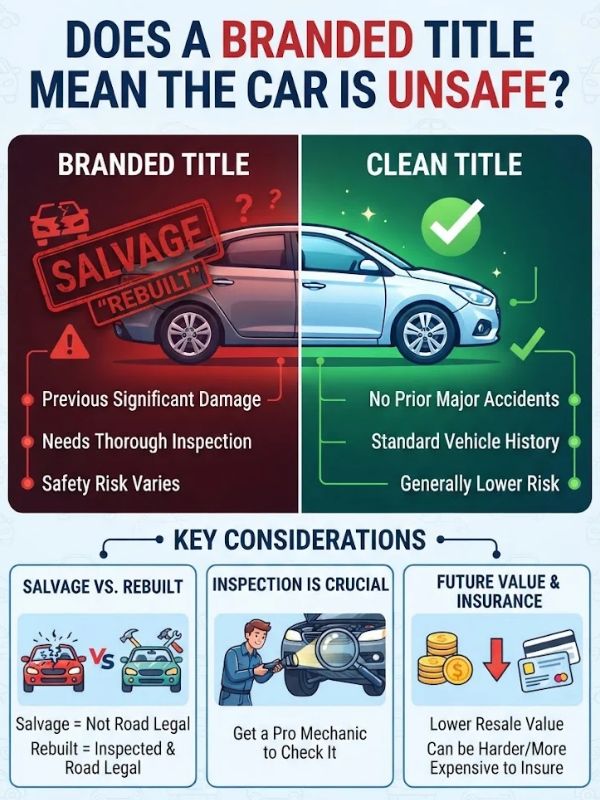
Some branded cars are repaired by skilled technicians with good parts. These cars may drive well for years. Other branded cars are fixed with cheap parts and poor welding. These cars can be dangerous in a crash.
The risk depends on three things:
- The type of damage
- The quality of the repair
- The proof the seller can show
Frame damage is a serious worry. A bent frame can change how the car handles. It can also change how the car protects you in a crash. Airbags are another concern. Some repair shops have installed fake or used airbags that fail. The smart move is simple. Treat the brand as a warning light. Do not panic, but do not ignore it. Pay a trusted mechanic to inspect the car before you buy.
How Much Does a Branded Title Affect Value?
A branded title usually lowers a car’s value by a large amount, often 20 to 40 percent compared with a similar car with a clean title. The drop can be bigger for flood or fire brands. It can be smaller for some buyback cars.
Why does value fall so much? Buyers worry about hidden damage. Lenders and insurers often limit their service. Resale becomes harder. Fewer buyers means a lower price.
Here is a rough guide. Real numbers vary by car, region, and market:
| Title Type | Typical Value Compared With Clean Title |
| Clean | 100 percent |
| Buyback or lemon law | Often 10 to 30 percent lower |
| Rebuilt | Often 20 to 40 percent lower |
| Flood or fire | Often 30 to 50 percent lower |
| Salvage (not repaired) | Often 50 percent lower or more |
Remember that this price drop works both ways. You save money when you buy. You lose money when you sell. Many owners find that a rebuilt car sits on the market for a long time. Keep every repair receipt and photo. Good records can help you sell later and may support a better price.
Is It Bad to Buy a Branded Title Car?
Buying a branded title car is not always bad, but it carries more risk than buying a clean title car. It can work for careful buyers who inspect the car, check the paperwork, and accept the lower resale value. Some people buy branded cars on purpose. A skilled mechanic may enjoy the project.
A buyer on a tight budget may want a newer model at a lower price. A parts seller may want the car for components. For most everyday drivers, the risks often outweigh the savings. Insurance can be harder. Loans can be harder. Resale can be harder. Hidden problems can cost more than you saved.
Here are the pros and cons side by side:
| Pros | Cons |
| Lower purchase price | Lower resale value |
| Access to newer or better models | Possible hidden damage |
| Good option for skilled DIY owners | Harder to insure fully |
| Useful for parts and projects | Harder to finance |
| Some repairs are high quality | Some buyers refuse to consider it |
Ask yourself three honest questions before you buy:
- Do I have proof of quality repairs?
- Can I get insurance and financing?
- Am I fine with a harder resale later?
If you answer no to any of these, think again.
Does a Branded Title Affect Insurance?
Yes. A branded title often makes insurance harder to get, and it can raise the cost or limit the coverage. Each insurer sets its own rules. Some companies refuse full coverage on branded cars. Others offer only liability coverage.
A few will insure a rebuilt car after an inspection. Some charge higher prices because they see more risk. Claim payouts also change. If a branded car is totaled later, the insurer pays based on the lower branded value, not the clean title value. This is a key point many owners miss.
Before you buy, call your insurance company. Give them the VIN and the brand. Ask three things:
- Will you offer full coverage?
- Will you require an inspection?
- How will you set the car’s value after a claim?
Get the answers in writing if you can. Do this before you hand over any money.
Can You Finance a Branded Title Car?
Financing a branded title car is possible but difficult. Many banks and dealer lenders decline these loans. They see the car as a higher risk and a weaker form of security. Some credit unions and specialty lenders may help. They often ask for a larger down payment, a shorter loan term, or a higher interest rate.
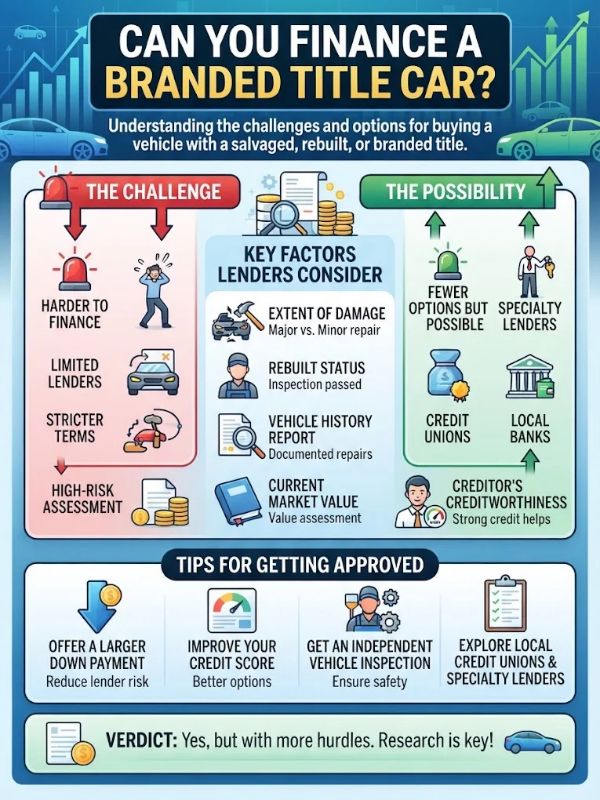
Some lenders will lend only a small share of the car’s value. Because of this, many branded car buyers pay in cash. If you plan to finance, talk to the lender before you shop. Ask about their branded title policy. Save yourself the stress of a deal that falls apart at the last step.
How to Check a Branded Title Before Buying
Checking takes time, but it protects your money. Follow these steps in order.
1. Check the Actual Title
Ask to see the physical title and read every line. Look for words such as salvage, rebuilt, flood, junk, or buyback. Check the seller’s name. Make sure it matches the seller’s ID.
Look at the VIN printed on the title. Compare it with the VIN on the car itself. You can usually find it on the driver side dashboard near the windshield and on the door jamb sticker. Walk away if the numbers do not match. A mismatch can point to fraud or a stolen car.
2. Check the VIN
Run the VIN through trusted tools. The VIN is like a fingerprint for the car. It unlocks the car’s recorded history.
Check that the VIN appears the same in all places. Look for scratches or signs of tampering around the VIN plate. Be careful if the plate looks loose or replaced. Use the VIN to start every report below.
3. Review NMVTIS Information
NMVTIS is the National Motor Vehicle Title Information System, a national database run under the U.S. Department of Justice. It collects title, brand, and total loss data from states, insurers, and salvage yards.
You can get NMVTIS reports through approved data providers. The reports are often low cost. They can show current title state, brand history, and total loss records. NMVTIS is a strong first check for brands. It does not show every repair or every accident, though. Use it together with other tools.
4. Review Vehicle History Reports
Use a vehicle history report from a known service such as CARFAX or AutoCheck. These reports gather data from many sources. They may show accidents, service records, owner changes, and title events.
Read the report slowly. Look for brand notes, total loss entries, odometer issues, and gaps in history. Pay attention to where the car has lived. A car from a flood zone deserves extra care. Do not rely on one report. Reports can miss events that no one reported. Think of them as one part of your checklist.
5. Ask for Repair Documentation
Ask the seller for receipts, photos, and shop invoices. A good seller keeps records. They should show before and after photos of the damage.
Look for the list of parts used. Ask whether the parts were new, used, or aftermarket. Ask who did the repair and whether the shop is licensed. If a seller cannot show any proof, treat that as a red flag. Missing records often mean missing quality.
6. Get an Independent Inspection
Pay a trusted mechanic, who does not work for the seller, to inspect the car. Choose a shop with experience in collision repair or frame checks.
Ask the mechanic to check:
- Frame and body alignment
- Welds and panel gaps
- Airbag and warning lights
- Signs of water or mold
- Wiring and electronics
- Tires and suspension wear
A good inspection costs far less than a bad repair. This step alone can save you thousands.
7. Check Insurance
Call your insurer before you buy. Share the VIN and the brand. Ask about coverage options and prices.
Get the quote in writing when possible. Rules can change after the car is registered. Knowing the answer early helps you avoid an unpleasant surprise. If the insurer says no, think about whether you can drive the car legally. Most states require at least liability insurance.
8. Check Financing
Talk to your lender before you sign. Ask whether they approve loans for branded titles. Ask for the exact terms. If you plan to pay cash, think about your exit plan. Resale will be harder. Make sure you can afford to keep the car for a long time.
Use this checklist as a quick guide:
| Step | What to Do | Why It Matters |
| Title | Read it fully and match the VIN | Confirms the brand and owner |
| VIN | Check all plates and labels | Detects fraud |
| NMVTIS | Run an approved report | Shows brand and total loss records |
| History report | Review CARFAX or AutoCheck | Reveals past events |
| Repair proof | Collect receipts and photos | Shows quality of work |
| Inspection | Hire a trusted mechanic | Finds hidden damage |
| Insurance | Get a written quote | Avoids coverage surprises |
| Financing | Ask the lender first | Avoids loan problems |
Branded Title Salvage Meaning
In simple terms, “branded title salvage” means the car carries a brand that says it was once a total loss. The word “salvage” tells you the car’s value was written off by an insurer or the state. The word comes from the idea of saving something from loss.
In the car world, salvage means the parts or body still have some worth, even if the car as a whole does not. When you hear “salvage” together with “branded,” picture the starting point of a long path. First comes the total loss. Then comes the salvage brand. If the car is repaired and passes inspection, it may become rebuilt.
That is how many branded titles begin. Some buyers use “branded salvage” to mean any car with a bad history. Try to be exact. Ask which brand is on the title, and ask for a copy.
What Does a Branded Title Mean on CARFAX?
On CARFAX, a branded title means the report found a title brand in the car’s recorded history. The report may show words like salvage, rebuilt, flood, fire, or manufacturer buyback. CARFAX collects data from state motor vehicle agencies, insurers, auctions, and repair shops.
It then lists title events in a timeline. You may see a “Branded Title” alert near the top of the report. Read beyond the headline. Click through the details. Look for the date, the state, and the type of brand. Note whether the car moved states after the brand was added.
Keep in mind that no report is perfect. Some damage never gets reported. A clean CARFAX does not prove a car has never been in an accident. A brand on CARFAX does prove a title event was recorded.
Branded Title Meaning in Texas, Colorado, Nebraska, and Utah
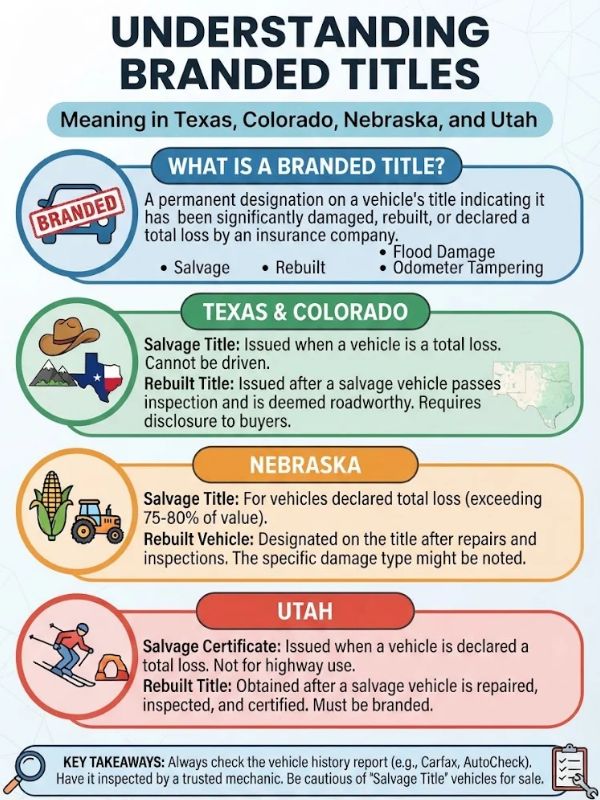
Each state sets its own rules for brands, inspections, and wording. The same car can carry a different label in different states. Here is a general look. Always confirm the current rules with the state motor vehicle office, because laws change.
| State | General Notes |
| Texas | Uses brands such as salvage, rebuilt salvage, and nonrepairable. Salvage vehicles generally cannot be driven on public roads until repaired and retitled. |
| Colorado | Uses terms such as salvage and reconstructed. A repaired car usually needs an inspection before it can be retitled. |
| Nebraska | Has separate brands for salvage and reconstructed vehicles, with rules for inspection before registration. |
| Utah | Uses salvage and rebuilt style brands, and often requires inspection and paperwork before the car returns to the road. |
Why does this matter? A car may move from one state to another. Some states have stricter inspections than others. A brand added in one state usually follows the car to the next. Real life example: A buyer in Colorado finds a truck with a title from Texas.
The Texas title shows “Rebuilt Salvage.” The buyer must check how Colorado treats that brand during registration. The buyer must also confirm that the Texas repair paperwork is complete. Always ask your local DMV for the latest steps before you buy a branded car from another state.
Clean Title Meaning: What Is a Clean Title?
A clean title is a title with no brand. It means the state has not recorded a total loss, flood, fire, buyback, or other major mark on the vehicle. Most cars on the road have clean titles. A clean title is what most buyers, banks, and insurers prefer. It supports a higher value and an easier sale. But a clean title does not mean the car is perfect.
A car can have a clean title and still have hidden damage. A crash may never have been reported. A repair may have been done outside insurance. The owner may have paid out of pocket. Think of a clean title as a good start, not the final answer. You still need a history report and an inspection. Smart buyers check every car the same way.
Branded Title vs. Clean Title
A clean title has no brand and usually brings higher value and easier financing. A branded title has a brand and usually brings lower value and more risk. The gap between the two shows up in many parts of ownership. Here is a side by side look:
| Factor | Clean Title | Branded Title |
| History record | No major brand | Major event recorded |
| Resale value | Higher | Lower |
| Insurance | Easier to get | Often harder or limited |
| Financing | Widely available | Often limited |
| Buyer interest | Wide | Narrow |
| Required checks | Standard | Extra and careful |
The price gap pulls many people toward branded cars. The risk gap should slow them down. Weigh both sides. If two cars look the same and cost the same, pick the clean title. If the branded car costs far less and has full repair records and a clean inspection, it may still make sense for you.
What Is a Bonded Title?
A bonded title is not a brand. It is a title issued when a car’s ownership proof is missing or unclear, and the buyer posts a surety bond to protect others. Here is how it works. Say you buy a car and the seller loses the title. You may apply for a bonded title.
The state asks you to buy a surety bond, often for a value tied to the car’s worth. In many states, that amount is around one and a half times the car’s value. The bond protects any person who may later prove ownership.
The bond stays active for a set number of years, often three to five, depending on the state. After that period, if no claim appears, the state may issue a standard clean title. People often confuse bonded and branded titles because the words look alike.
Common Branded Title Mistakes
Many buyers lose money because of simple errors. Avoid these six.
Mistake 1: Thinking Every Branded Title Is Salvage
Not every branded title is salvage. Salvage is one type. Others include rebuilt, flood, fire, junk, and buyback. Each brand has its own risk. A buyback car may have a minor recurring issue. A flood car may have deep electrical trouble. Read the exact word on the title.
Mistake 2: Assuming Rebuilt Means Perfect
Rebuilt means the car passed a state check. It does not mean the repair was excellent. State inspections often cover basic items, not full structural quality. Always get your own inspection. Ask for photos of the damage before the repair. Ask who did the work.
Mistake 3: Assuming a Clean Title Guarantees a Perfect Car
A clean title shows no recorded brand. It does not show unreported damage. Some owners fix crashes privately and never report them. Run a history report and hire a mechanic. Treat every used car with care, clean title or not.
Mistake 4: Assuming Every State Uses the Same Rules
State rules differ in wording, inspection, and registration. A brand may carry a different name in the next state. Check with your local motor vehicle office. Do not trust a seller’s summary of state law.
Mistake 5: Buying Because the Price Looks Cheap
A low price often reflects real risk. Buyers sometimes focus on the savings and ignore the repair history. Count the full cost. Add inspection fees, higher insurance, higher loan rates, and a lower resale price. The “deal” may shrink fast.
Mistake 6: Skipping an Independent Inspection
Skipping an inspection is the costliest mistake of all. Sellers want to close the sale. Their mechanic may not tell you everything. Hire a neutral expert. The fee is small compared with the cost of hidden frame damage or flood rot.
A Simple Example of a Branded Title
Meet Sara. She wants a three year old compact SUV. A clean title model costs $22,000. She finds a similar one for $14,500. The listing says “rebuilt title.” Sara asks for the paperwork. The seller shows the title, a list of repairs, and photos of the front end damage.
The car once hit a pole. The insurer called it a total loss, and a repair shop rebuilt it. Sara pays $150 for a full inspection. The mechanic finds good welds but spots uneven panel gaps. He also notes that one airbag light flickers. Sara asks the seller to fix the airbag system. The seller refuses.
Sara calls her insurer. They offer liability only. She checks her credit union. They decline the loan. Sara walks away. She saved herself from a car that she could not fully insure or finance, and one that had an unresolved safety problem.
Frequently Asked Questions
What is the simplest branded title meaning?
A branded title is a car title with an official warning about past damage or defects. The state adds it and it usually stays for life.
Is a rebuilt title the same as a branded title?
A rebuilt title is one kind of branded title. It means a salvage car was repaired and passed inspection.
Can I drive a car with a branded title?
Yes, in most cases, if the car is repaired, inspected, registered, and insured. A salvage or nonrepairable car usually cannot be driven.
Can a branded title be removed or cleaned?
No. A true brand stays on the record. Be careful of “title washing,” which is an illegal attempt to hide a brand by moving the car between states.
Is a branded title car worth buying?
It can be, if the price is low enough and the repair proof is strong. Always get a full inspection, an insurance quote, and a loan check first.
How do I find out if a car has a branded title?
Check the paper title, run the VIN through NMVTIS, and review a vehicle history report. Then have a mechanic inspect the car.
Do branded titles hurt resale value?
Yes. Branded cars often sell for much less than clean title cars, and they take longer to sell. Keep repair records to help your case.
Final Thoughts
A branded title is a permanent warning on a car’s record. It points to a major past event such as a total loss, flood, fire, or manufacturer buyback. Salvage is just one type. Rebuilt, flood, fire, junk, and buyback brands also exist.
Branded cars often cost less, but they also bring lower resale value, harder insurance, and tougher loans. A careful buyer can still find a good deal. The key steps are simple. Read the title, check the VIN, run NMVTIS and history reports, collect repair proof, and hire an independent mechanic.