
The word “Zionist” is everywhere today. You see it in news reports, class debates, and social media posts. But many people are not sure what it really means. Some use it with pride. Others use it as a warning or an insult.
This guide gives you the Zionist meaning in plain English. You will learn the definition, the history, and why the word matters in 2026. You will also see how context changes the meaning, and how to use the term with care.
What Does Zionist Mean?
A Zionist is a person who supports Zionism. Zionism is the movement for a Jewish national home in the land of Israel, which many people also call Palestine. Today, most Zionists support the continued existence of Israel as a Jewish homeland.
That is the core dictionary meaning. But the word carries a lot more weight than a dictionary line suggests. People use it as a proud label, a neutral description, and sometimes as an insult. The meaning shifts with who is speaking and why.
What Is the Zionist Meaning in Simple Terms?
A Zionist is someone who believes the Jewish people have a right to a national homeland in Israel.
Here is the same idea in even simpler words:
- Zionism is an idea about a Jewish homeland.
- A Zionist is a person who backs that idea.
- The idea started in Europe in the 1800s.
- Israel was founded in 1948, and many Zionists see it as the goal reached.
Not every Zionist thinks the same way. Some Zionists support the Israeli government. Others criticize it harshly. The label describes a belief about Jewish self rule, not a full set of political opinions.
What Is Zionism?
Zionism is a political and cultural movement that began in the late 1800s. It aims to create and support a Jewish state in the historic homeland of the Jewish people. The name comes from Zion. Zion is a biblical word for Jerusalem and the land of Israel.
Jewish prayers have mentioned Zion for thousands of years. The phrase “next year in Jerusalem” is sung at Passover. The word “Zionism” was popularized by a writer named Nathan Birnbaum in the 1890s. Modern political Zionism then grew under Theodor Herzl, a Jewish journalist from Vienna.
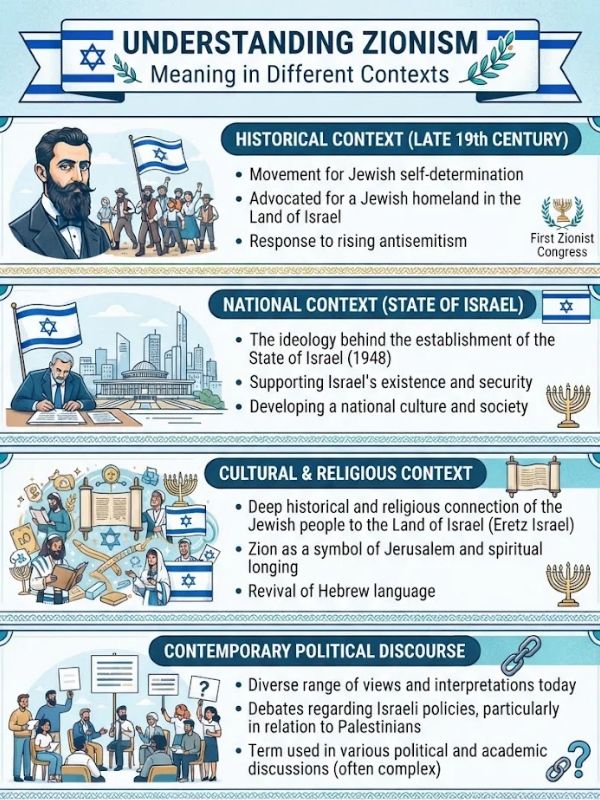
Zionist Meaning in Different Contexts
The word changes shape from room to room. A historian, a politician, a priest, and a social media user may all use it differently. Knowing the context helps you read the word correctly.
Historical Context
In history books, a Zionist usually means a member of the Jewish national movement before or around the time Israel was created. These people raised money, bought land, built towns, and pushed for international support.
Early Zionists were a mixed group. Some were secular socialists. Some were religious. Some wanted a cultural center for Jewish life, not necessarily a state. Historians treat Zionism as a movement with many branches.
Political Context
In politics, a Zionist often means a person who supports Israel’s existence as a Jewish state. Politicians may say “I am a proud Zionist” to show support for Israel. Others may use the word to criticize an opponent.
Politics adds a second layer. People argue over whether Zionism only means support for Israel’s existence, or also support for specific policies. Those policies include settlements in the West Bank, military actions, and the status of Palestinians. This gap causes many arguments.
Social Media Context
On social media, “Zionist” is often used as a short, sharp label. It may appear in bios, comments, and hashtags. Some users wear it with pride. Others use it as an accusation or an insult.
Posts are short, so nuance gets lost. One user may mean “supporter of Israel’s right to exist.” Another may mean “supporter of everything the Israeli government does.” These two meanings are very different, and the confusion fuels online fights.
Religious Context
In Jewish religious life, views on Zionism vary. Religious Zionists see the return to the land as a spiritual goal. They often link it to biblical promises. Some ultra Orthodox groups, however, have opposed political Zionism. They believe a Jewish state should wait for the arrival of the Messiah.
How Context Changes the Meaning
The same word can carry very different messages. Look at the speaker, the audience, and the tone. A quick table helps.
| Context | Typical Meaning | Usual Tone |
| History | Member of the early Jewish national movement | Neutral |
| Politics | Supporter of Israel as a Jewish state | Mixed |
| Social media | Pro Israel label or accusation | Often heated |
| Jewish religion | Spiritual tie to the land of Israel | Varies by group |
| Christian faith | Biblical support for Israel | Often positive |
When in doubt, ask what the speaker means. That one question prevents many misunderstandings.
Is Zionist the Same as Jewish or Israeli?
No. Zionist, Jewish, and Israeli are three different words with three different meanings. “Jewish” describes a religion, a culture, and an ethnic heritage. “Israeli” describes a citizen of the State of Israel. “Zionist” describes a political belief. These groups overlap, but they are not the same.
Here are some simple facts:
- Many Jewish people are Zionists, but not all of them.
- Some Jewish people are critical of Zionism or reject it.
- Many Israelis are Zionists, but not all of them.
- About one in five Israeli citizens is Arab, and many of them do not identify as Zionist.
- Many Zionists are not Jewish. Christian Zionists are one example.
Treating all Jewish people as Zionists is a mistake. It also becomes a form of prejudice when it blames Jewish people everywhere for the actions of a government. Many people who study antisemitism warn about this point.
| Term | What It Describes | Example |
| Jewish | Religion, culture, or heritage | A person who attends synagogue |
| Israeli | Citizenship of Israel | A person with an Israeli passport |
| Zionist | Political belief about a Jewish homeland | A person who supports Israel’s existence |
Real Conversation Examples
Examples show how the word works in daily life. Here are three short scenes.
1: Historical Discussion
- Student: Who were the first Zionists?
- Teacher: They were Jewish activists in the late 1800s. Many lived in Russia and Central Europe. They faced harsh discrimination, and they wanted a safe homeland.
- Student: So Zionist was a movement label then?
- Teacher: Yes. It described people who joined that movement.
In this scene, the word is a historical label. It carries little emotion.
2: Political Conversation
- Person A: I support Israel’s right to exist. I guess that makes me a Zionist.
- Person B: I support that too. But I disagree with the government’s current policies.
- Person A: That is fair. Zionism does not mean agreeing with every policy.
Here, two people separate the idea of a homeland from the actions of a government. This is a common view.
3: Social Media Argument
- User 1: All Zionists are evil.
- User 2: What do you mean by Zionist? Do you mean every Jewish person who supports Israel?
- User 1: I mean people who support the war.
- User 2: Then say that. Those are different groups.
This scene shows why clarity matters. A broad word used as an insult can hit many people who do not fit the speaker’s meaning.
Why Is Being a Zionist Controversial?
Being a Zionist is controversial because the creation of Israel brought both safety for Jewish people and displacement for Palestinians. People judge Zionism differently based on which side of that history they focus on.
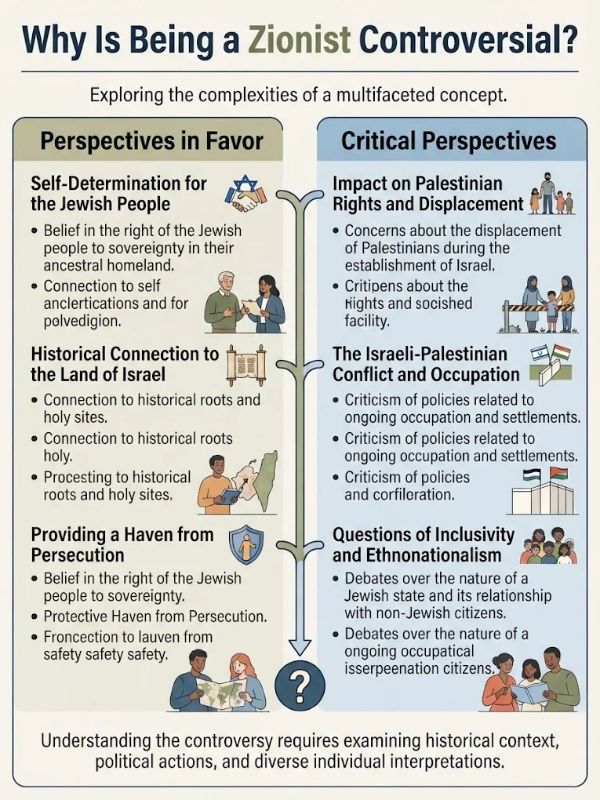
Supporters point to centuries of persecution. They mention pogroms in Europe and the Holocaust, where six million Jews were murdered. For them, Zionism is a right to self determination and a safe place to live.
Critics point to the 1948 war. About 700,000 Palestinians fled or were expelled during that war. Palestinians call this the Nakba, which means “catastrophe.” Critics also point to the military occupation of the West Bank, which began in 1967, and to settlement growth. For them, Zionism is tied to dispossession.
Both views are held sincerely by many people. Here are the main points of debate:
- Land: Who has rights to live in and govern the land?
- Refugees: What should happen to Palestinian refugees and their families?
- Occupation: Is the control of the West Bank justified, or unjust?
- Identity: Is Zionism about Jewish self rule, or does it exclude others?
- Antisemitism: When does criticism of Zionism cross into hatred of Jewish people?
That last point is debated too. Some groups use a definition of antisemitism from the International Holocaust Remembrance Alliance. Others prefer the Jerusalem Declaration. Scholars and activists disagree about where to draw the line.
Christian Zionist Meaning
Christian Zionism has roots in Protestant thinking from the 1600s and 1800s. Some Christian teachers read biblical prophecy as saying that Jewish people would return to the land before the end times. This belief grew strongly in the United States, partly through a teaching called dispensationalism.
Today, many evangelical churches support Israel. Groups like Christians United for Israel, founded in 2006 by Pastor John Hagee, are large examples. Supporters see it as a moral and spiritual duty.
Critics, including many Christians, disagree. Palestinian Christians have often said that this view ignores their own community and the suffering of Palestinians. Some Christian leaders also say that linking foreign policy to end times prophecy is risky.
Key points about Christian Zionism:
- It is based on faith, not Jewish identity.
- It is strongest among evangelical Protestants.
- It influences politics in the United States.
- Many other Christians reject or question it.
Zionist Meaning: Is It Good or Bad?
The word itself is neither good nor bad. Its meaning depends on how people understand Zionism and how the speaker uses the word. Many Jewish people see the word as positive. To them, it means pride, survival, and connection to their ancestral homeland.
A person may describe themselves as a Zionist with warmth. Many Palestinians and others see the word as negative. To them, it points to a movement tied to loss, war, and occupation. They may use it as criticism.
A fair answer avoids a one word verdict. Ask these questions instead:
- What does the speaker mean by the word?
- Is the word used about a belief or about a whole group of people?
- Is the tone respectful or hateful?
Honest discussion starts with these questions. Shouting a label rarely helps anyone learn.
Zionist Meaning in Arabic
In Arabic, the word is صهيوني (pronounced Sahyuni). Zionism is الصهيونية (as Sahyuniyya). The word comes from Sahyun, the Arabic form of Zion. In Arabic media, the word is often used in political speech. It is commonly tied to criticism of Israel and its policies. In many Arabic news reports, “Zionist” is used where English reports might say “Israeli.”
This is one reason the word feels sharper in Arabic news than in English news. Arabic speakers may also use the word differently in daily talk. Some use it as a political term. Others use it as an insult. Context, again, decides the meaning.
Zionist Meaning in Chinese
In Chinese, a Zionist is 犹太复国主义者 (Yóutài fùguó zhǔyì zhě). It literally means “a person who supports the restoration of the Jewish state.” Zionism is 犹太复国主义 (Yóutài fùguó zhǔyì). Another form, 锡安主义, uses a sound based translation of Zion. It appears in some texts but is less common.
Chinese media usually uses the word in a formal and descriptive way. It is mostly found in history lessons, news about the Middle East, and academic writing. It carries less of the heated feeling found in English social media.
Is Zionist a Neutral or Offensive Word?
The word can be neutral, proud, or offensive. Tone and intent decide which one it is. Used in a classroom or news report, the word is usually neutral. Used by a person proud of the label, it is positive. Used as a slur, it becomes offensive. Some Jewish groups say the word is sometimes used as a stand in for “Jewish” in hateful speech.
For example, a person may say “Zionists control the banks.” That sentence repeats an old antisemitic myth about Jewish power. It is not a fair political criticism. On the other side, some people feel that any criticism of Zionism is labeled antisemitic. They say this silences honest debate about Israeli policy.
A simple test can help:
| Sentence Type | Example | Likely Reading |
| Descriptive | “He was a Zionist leader in the 1920s.” | Neutral |
| Self label | “I am a Zionist and I care about Israel.” | Neutral or proud |
| Policy critique | “I disagree with Zionist settlement policy.” | Political criticism |
| Group blame | “Zionists are behind everything bad.” | Likely hateful |
Is Zionist the Same as Supporting the Israeli Government?
No. Supporting Zionism does not mean supporting the current Israeli government or its decisions. Governments change. Zionism, as an idea, is older than any single government. A person can back the idea of a Jewish homeland and still protest against leaders or policies. Israel has a large and noisy political debate. Many Israelis, who often identify as Zionists, march against their own government.
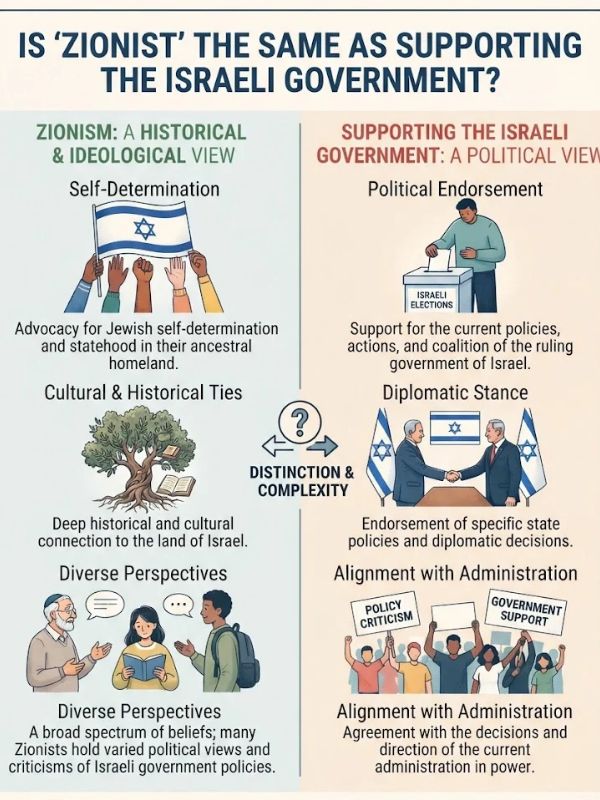
Some want peace talks. Others want stronger security. Some want a two state solution. Others reject it. In the same way, a person can criticize Israeli policy without opposing Israel’s existence. Many people hold that view. It is wise not to assume. Ask the person what they believe.
How to Respond When Someone Uses “Zionist”
You may hear the word at school, at work, or online. A calm reply works better than an angry one. Think first about what the speaker means. Then choose your tone.
Polite Clarification
If you are unsure, ask a short question. This keeps the talk friendly.
- “What do you mean by that word?”
- “Are you talking about the movement, or about a specific policy?”
- “Can you explain more about what you mean?”
Clarifying shows respect. It also stops you from arguing about words that mean different things to each person.
If You Agree With the Label
If someone calls you a Zionist and you accept it, you can explain what it means to you. Be specific. Say what you support and what you do not.
For example: “Yes, I support Israel’s right to exist. That does not mean I agree with every policy.” This invites a real conversation. It also blocks the assumption that all Zionists think alike.
If You Disagree
If you reject the label, you can say so in a calm way. You do not need to attack the other person.
For example: “I do not call myself a Zionist. I see it differently, and here is why.” Explain your view with facts and respect. If the speaker becomes hateful, you can end the talk. You do not owe anyone a debate.
When to Use the Term
Use the word when it fits the meaning. Good places include:
- History lessons: to describe the movement and its leaders.
- Academic writing: to name a school of thought.
- Self description: when a person chooses the label for themselves.
- News analysis: when describing a group that uses the term for itself.
In these cases, define the word first. A short definition keeps your reader on the same page.
When to Avoid the Term
Avoid the word when it may cause harm or confusion. Poor uses include:
- As an insult: it turns the word into a weapon.
- As a stand in for Jewish people: this creates prejudice.
- To describe a whole country: Israelis and Zionists are not identical groups.
- When you do not know the person’s view: do not label others without asking.
If you want to criticize a government, name the government and the policy. Precise words lead to better debate and fewer false claims.
Common Mistakes About the Word Zionist
Many errors come from rushing. Here are the most common ones.
- Thinking Zionist means Jewish. It does not. Zionism is a political belief.
- Thinking all Jewish people are Zionists. Jewish views vary widely.
- Thinking all Zionists support the government. Many Zionists oppose current leaders.
- Thinking Zionism is only one idea. It has several branches, from cultural to religious.
- Thinking the word has only one tone. It can be proud, neutral, or hostile.
- Thinking Zionism began in 1948. The movement started decades earlier.
- Ignoring Palestinian views. Any fair talk should include the people who feel its impact.
Avoiding these mistakes makes you a more careful reader and speaker.
Similar Terms and Their Differences
Several words sit close to “Zionist.” They are often mixed up. This table clears things up.
| Term | Meaning | Key Difference |
| Zionist | Supporter of a Jewish homeland in Israel | A political belief |
| Anti Zionist | Opponent of Zionism as a political idea | Rejects the idea of a Jewish state |
| Non Zionist | Person who does not take a side | Neutral or uninterested |
| Post Zionist | Person who thinks Zionism has finished its goals or needs rethinking | Common in Israeli academia |
| Pro Israel | Supporter of Israel as a country | Can include non Zionists |
| Antisemite | Person who hates or discriminates against Jewish people | A form of prejudice, not a political view |
| Christian Zionist | Christian who supports Israel for biblical reasons | Based on faith |
| Pro Palestinian | Supporter of Palestinian rights | Can include Zionists or non Zionists |
Some terms overlap. A person may be pro Palestinian and also support a Jewish state. A person may be pro Israel and still criticize the government. Labels are only starting points.
Origin and Historical Background
The story of Zionism starts long before the modern era. Jewish communities lived in the land of Israel for thousands of years. After the Roman period, many were scattered around the world. This is called the diaspora. Through prayer and tradition, they kept a spiritual tie to Zion.
In the 1800s, nationalism grew across Europe. Jewish people faced attacks, such as pogroms in the Russian Empire. Antisemitism also rose in Western Europe. The Dreyfus Affair in France in the 1890s shocked Theodor Herzl. He wrote The Jewish State in 1896.
In 1897, Herzl organized the First Zionist Congress in Basel, Switzerland. Delegates agreed to seek a home for the Jewish people in Palestine, secured by public law. This is seen as the start of organized political Zionism.
Key Dates in Zionist History
| Year | Event |
| 1890s | The term “Zionism” spreads |
| 1896 | Herzl publishes The Jewish State |
| 1897 | First Zionist Congress in Basel |
| 1917 | Balfour Declaration supports a Jewish national home in Palestine |
| 1920s to 1930s | Jewish immigration grows under British rule |
| 1939 to 1945 | The Holocaust |
| 1947 | United Nations proposes a plan to divide Palestine |
| 1948 | Israel declares independence; the first Arab Israeli war begins |
| 1967 | Six Day War; Israel takes control of the West Bank, Gaza, and East Jerusalem |
| Today | Debates continue over borders, security, and rights |
Main Branches of Zionism
- Political Zionism: Led by Herzl, it focused on winning international support for a state.
- Cultural Zionism: Led by thinkers like Ahad Ha’am, it focused on reviving Jewish culture and the Hebrew language.
- Labor Zionism: It mixed Zionism with socialist ideas and built farming communities called kibbutzim.
- Revisionist Zionism: Led by Ze’ev Jabotinsky, it favored a stronger and more nationalist approach.
- Religious Zionism: It sees the return to the land as a religious duty.
These branches still shape Israeli politics today. Each has its own view on borders, religion, and peace.
Frequently Asked Questions
What does Zionist mean in simple words?
A Zionist is a person who supports a Jewish homeland in Israel. The word describes a political belief, not a religion.
Is every Jewish person a Zionist?
No. Jewish people hold many different views. Some support Zionism, some criticize it, and some reject it.
Is Zionist an insult?
It depends on the speaker. The word can be neutral or proud, but it becomes an insult when used with hatred.
What is a Christian Zionist?
A Christian Zionist is a Christian who supports Israel based on biblical beliefs. Many are evangelical Protestants.
Does being a Zionist mean supporting the Israeli government?
No. A person can support the idea of a Jewish homeland and still oppose government policies.
When did Zionism begin?
Modern political Zionism began in the late 1800s. The First Zionist Congress met in 1897.
What is the difference between Zionist and Israeli?
Israeli describes citizenship in Israel. Zionist describes a belief about a Jewish homeland, and anyone can hold it.
Conclusion
The word “Zionist” has a simple core meaning. It describes a supporter of a Jewish homeland in Israel. Yet the word carries history, pain, pride, and anger for many people. Its tone changes with the speaker and the setting.
Remember the main points. Zionist is not the same as Jewish or Israeli. Zionism has several branches. Supporting it does not mean backing every government policy. And criticism of a policy is different from hatred of a people.