

You see “DNI” in a bio, a comment, or a chat message. You pause and wonder what it means. Is it a rule, a warning, or just slang? This guide gives you the full DNI meaning explained in simple words.Online, DNI usually stands for “Do Not Interact.”
It sets a clear boundary on social media and in texts. But the same three letters also appear in hospitals, at the Olympics, and in government news. Here, you will learn what DNI stands for online, medically, and beyond, with easy examples to help you understand each one.
What Does DNI Mean? (Quick Overview)
DNI most often stands for “Do Not Interact.” People use it online to tell others not to follow, reply to, tag, or message them unless they meet certain conditions.
The same three letters carry other meanings outside social media. Context tells you which one applies. Here are the main ones:
- Do Not Interact: social media, texting, and online communities
- Do Not Intubate: a medical order in healthcare
- Did Not Improve: a scoring note in Olympic big air events
- Director of National Intelligence: a United States government role
DNI Meaning Explained: The Short Version
If you only need a fast answer, this table covers it.
| Where You See DNI | What It Means | Who Uses It |
| Social media bio | Do Not Interact | Creators, fans, regular users |
| Text or chat | Do Not Interact | Group chat members, online friends |
| Hospital chart | Do Not Intubate | Doctors, nurses, patients |
| Olympic scoreboard | Did Not Improve | Judges, broadcasters |
| Government news | Director of National Intelligence | Officials, journalists |
The social media meaning is by far the most common one people search for. The rest of this guide spends most of its time there.
DNI Meaning Explained: Internet Slang (Do Not Interact)
As internet slang, DNI is a polite or blunt “stay away” sign. A person puts it in a profile, a pinned post, or a message. It tells visitors to keep their distance if they fit certain descriptions.
Most DNI notes come with conditions. The person might write “DNI if you are rude” or “DNI if you hate this fandom.” The list of conditions matters more than the three letters. It tells you exactly who should not interact.
People often write DNI in capital letters. Some write “dni” in lowercase for a softer feel. The meaning stays the same. Think of it like a sign on a private garden gate. It does not lock the gate. It simply states who is welcome and who is not.
What Does DNI Mean in Text?
In text and chat, DNI means “Do Not Interact.” It asks a person or group to avoid engaging with you, your posts, or your messages. You will not see DNI much in private texts between close friends.
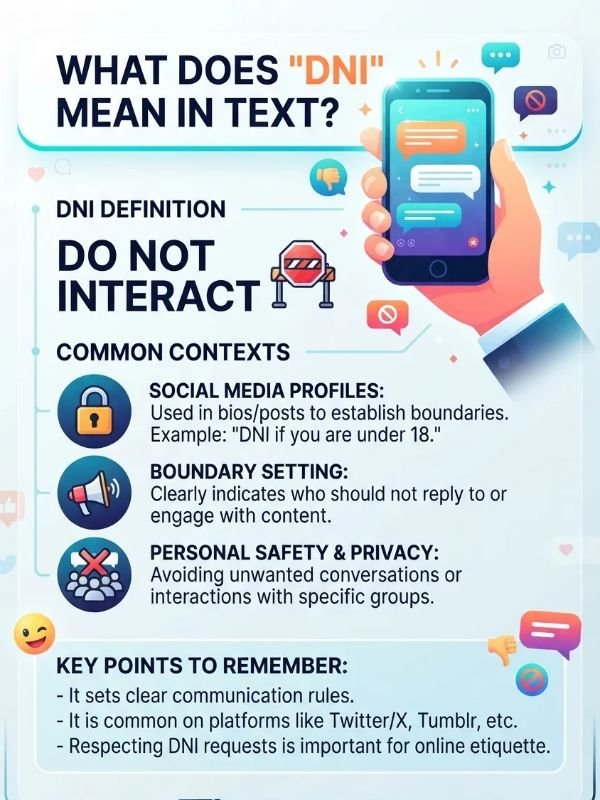
It shows up more in group chats, community servers, and direct messages on social apps. Someone might send it after a bad experience. They might also use it to set rules for a new group.
Here are the common reasons it appears in chat:
- A person wants to set a boundary before a conversation starts
- A group wants to protect its space from trolls
- A user wants to avoid people who share a certain opinion
- A creator wants to filter out unwanted attention
In texting, DNI works as a short rule. It saves time because the writer does not need to explain every detail. The reader gets the message fast.
DNI List Meaning
A DNI list is a set of conditions that tells people who should not interact. It usually sits in a bio or a pinned post. The list can be short or long.
Common items on a DNI list include:
- People who send hateful comments
- People who argue about topics the user finds upsetting
- People who share a specific fandom conflict
- People below a certain age, for creators who post adult themes
- People who copy or steal art and content
- People who ignore posted rules
Some lists are serious. Others are playful or silly. A user might write “DNI if you put pineapple on pizza.” Read the tone to see which kind you have found.
Where Is DNI Commonly Used?
DNI is a social media habit more than a texting habit. Each platform shapes how people use it. This table gives you a quick map.
| Platform | Typical DNI Use | Common Placement |
| TikTok | Filters viewers and commenters | Bio and pinned comment |
| X (Twitter) | Sets boundaries for debates and fandoms | Bio and profile header |
| Sets rules for threads and communities | Post text and user flair | |
| Discord | Protects servers and private spaces | Server rules and profile about me |
| Guides followers and message requests | Bio and story highlights | |
| Tumblr | Defines blog rules and fandom limits | About page and pinned post |
What Does DNI Mean on TikTok?
On TikTok, DNI means “Do Not Interact.” Creators put it in their bio or pin it as a comment. It tells viewers which kinds of reactions are not welcome. Many TikTok users pair DNI with a short list. A creator might say “DNI if you are here to hate.” Others use it to limit adult themes to adults only.
What Does DNI Mean on Twitter (X)?
On X, DNI is very common in bios. Fan accounts, artists, and writers use it most. The platform moves fast and debates get loud, so people set rules early.
An X user might write “DNI if you disagree with my ship.” This means they do not want reply arguments about their fandom choices. The line is not a legal rule. It is a request.
DNI Meaning Explained: Reddit
On Reddit, DNI appears less often in profiles and more often in posts or comments. A user might write it when they want only certain people to reply. Some communities also use DNI in their own rules.
Reddit has moderators who enforce subreddit rules. A personal DNI note has no such backing. It remains a polite request unless the community rules say the same thing.
DNI Meaning Discord, Instagram & Tumblr
On Discord, DNI appears in server rules and user profiles. Servers often use it to keep out members who broke rules before. Users also add it to the “about me” section to filter who sends friend requests.
On Instagram, people put DNI in bios and story highlights. It guides who follows, who comments, and who sends message requests. Instagram also gives users tools like block and restrict, so DNI works as a soft first step.
On Tumblr, DNI is a long running habit. Bloggers add it to their about page with a full list of conditions. Tumblr fandom culture helped spread the term across the wider internet.
DNI in Real Conversations
Real examples make the meaning clear. DNI changes shape depending on who writes it and why. Here are typical situations. A creator posts a drawing and adds a rule in the caption. A gamer sets up a profile for a new server. A friend warns a group that one person caused problems before. In each case, DNI works as a boundary marker.
DNI Examples in Text Messages
These samples show how DNI might look in real chat messages.
- “Quick heads up. DNI if you plan to argue about the finale.”
- “New account. DNI unless you follow the group rules.”
- “Please DNI that user. They keep stirring up drama.”
- “My bio says DNI, so please do not tag me in those posts.”
- “DNI if you are under 18. This page has adult jokes.”
Each message gives a clear instruction. Each one also gives a reason or a condition. That detail helps the reader decide what to do. A good DNI message stays short. It states who should stay away and why. It avoids insults.
Why Do People Use DNI?
People use DNI to protect their time, comfort, and online space. It is a fast way to say “this is what I welcome and what I do not.” Most users do not want a fight. They want peace.
Here are the top reasons:
- Mental comfort: They want to avoid upsetting topics
- Safety: They want to keep certain groups or ages away from adult content
- Fandom rules: They want to avoid long arguments about favorites
- Time: They do not want to explain themselves again and again
- Community care: They want a friendly space for followers
DNI also saves effort. Instead of replying to every unwanted message, the user points to the note in their bio. It acts as a standing answer.
Some users also like it because it filters in advance. If someone ignores a clear DNI, the user can block them without guilt. The rule was visible from the start.
Is DNI Slang or an Acronym?
DNI is slang in how it is used and an initialism in how it is built. Both labels are close to correct, and most people use “acronym” for everything.
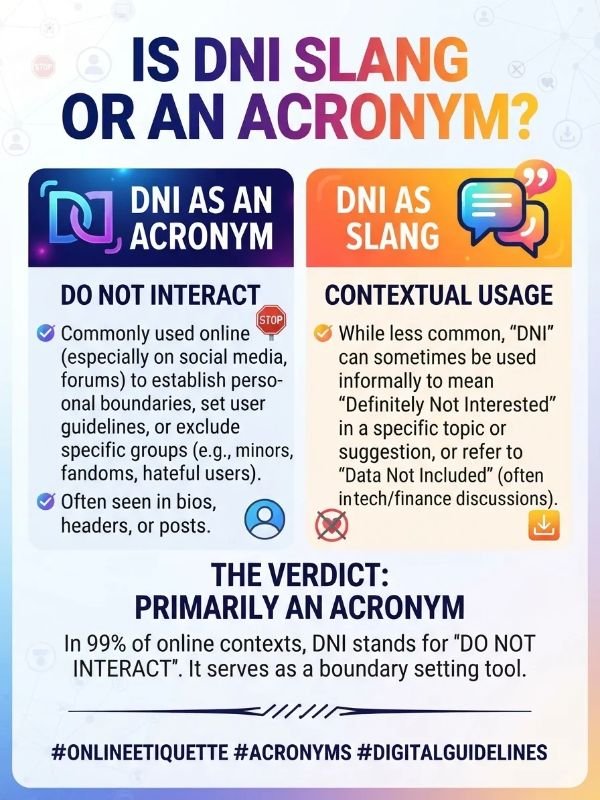
Here is the difference in simple terms:
| Type | How You Say It | Example |
| Acronym | You say it as a word | NASA, NATO |
| Initialism | You say each letter | FBI, DNI |
People say DNI as three letters: D, N, I. So it is an initialism. Online writers still call it an acronym, and nobody minds. The term works the same either way.
As slang, DNI belongs to internet language, along with terms like BRB and IDK. It spread through fandoms and creator spaces. Now it appears across most major platforms.
DNI vs. Similar Terms (BYI, DND, Block)
DNI sits next to several other terms. Some look alike. Others do a different job. This table shows the differences.
| Term | Full Form | Main Purpose | Does It Stop Contact? |
| DNI | Do Not Interact | States who should stay away | No, it is a request |
| BYI | Before You Interact | Asks people to read rules first | No, it is a notice |
| BYF | Before You Follow | Asks people to read rules first | No, it is a notice |
| DND | Do Not Disturb | Pauses notifications or contact | Only mutes alerts |
| MDNI | Minors Do Not Interact | Asks people under 18 to stay away | No, it is a request |
| Block | Platform tool | Cuts off contact | Yes, enforced by the app |
The biggest gap is between DNI and a block. DNI asks. A block enforces. One depends on goodwill, and the other depends on software. BYI is gentler than DNI. It says “read this first.” DNI says “do not engage if this applies to you.” DND is a phone or app setting for quiet time, and it has nothing to do with boundaries on social media.
What Does DNI Actually Do?
DNI does very little on its own. It does not stop anyone from viewing your page. It does not hide your posts. It does not report anyone. What it does is set a public expectation. Anyone who reads it knows your wishes. If they ignore it, they cannot say they did not know.
That clear signal helps in three ways:
- It filters out many unwanted visitors before they speak
- It gives you a reason to block or mute people who cross the line
- It tells your followers what kind of space you run
DNI is a soft tool. It works best with real tools like blocking, muting, and reporting.
Can You Use DNI in a Text Message?
Yes, you can use DNI in a text message. It works best in group chats or community chats where others understand the term. In a private chat with one person, a full sentence is clearer.
For example, “Please do not interact with me about that topic” is easy for anyone to understand. If your friend knows internet slang, “DNI about that topic, please” also works. Choose the version your reader will understand without a guess.
Avoid using DNI with older relatives or coworkers who may not know it. They may read it as a typo or an odd code. Clear words keep the message friendly.
Common Mistakes When Interpreting DNI
Many people misread DNI because the term is short and the tone is missing. A few simple errors cause most of the confusion. Knowing them saves awkward moments.
Here are the common mistakes:
- Thinking DNI means block. It does not. It is a request, not a tool.
- Assuming it is about you. Most DNI notes target a type of behavior, not a named person.
- Ignoring the conditions. The list after DNI tells you who it applies to.
- Mixing it up with DND. One is a boundary. The other is a notification setting.
- Reading it as hostile. Many users write it politely and mean no harm.
If you are unsure, read the full bio or post. The conditions usually explain everything. If they do not, you can skip interacting and lose nothing.
Tone Changes Everything: How DNI Can Read Differently
The same three letters can feel gentle, funny, firm, or harsh. The words around them set the tone. A friendly version might read, “DNI if you hate cats, sorry!” That feels light. A firm version might read, “DNI. No exceptions.”
That feels serious. A harsh version might read, “DNI if you are annoying.” That feels sharp and may upset readers. Emojis, punctuation, and extra words all shift the mood. A smiley face softens the message. A period after DNI makes it sound strict. When you read a DNI note, look at the whole message before you decide how the writer feels.
DNI Is a Boundary, Not a Guarantee
A DNI note shows what someone wants. It does not guarantee anyone will follow it. Some users will ignore it, either by accident or on purpose. That is why DNI works best as a first layer of protection. If someone crosses the line, the next step is a tool. You can mute, block, restrict, or report the account.
Respect also plays a part. When you see a DNI that applies to you, the kind choice is to step back. You lose nothing, and the other person gets the space they asked for.
DNI Meaning Explained: Olympics
At the Winter Olympics, DNI is a scoring note. It stands for Did Not Improve and appears when a competition has several runs but not every score counts. You will mostly see it in snowboard and ski events.
The term confuses many viewers because it looks like a social media tag. In sports, it has nothing to do with boundaries. It simply tells you that an athlete’s latest run did not change their total.
Fans see it on scoreboards during big air and similar events. Commentators also say it out loud. Once you know the meaning, the screen makes more sense.
DNI Meaning Explained: Snowboard
In snowboard and ski big air, each athlete gets three runs. Only the best two scores count toward the final total. A DNI shows up when a new run scores lower than what the athlete already has, so their overall tally does not improve.
Here is a simple example. An athlete scores 85 on run one and 90 on run two. On run three, they score 80. The 80 will not replace the 85 or the 90, so the scoreboard marks the run as DNI.
This is not a failure label. Many athletes land a DNI after already securing a great score. Sometimes they take a bigger risk on the last run and fall short.
DNI Meaning Explained: Medical
In medicine, DNI means “Do Not Intubate.” It is a doctor’s order that tells the care team not to place a breathing tube in a patient’s airway. Intubation means putting a tube through the mouth or nose into the windpipe.
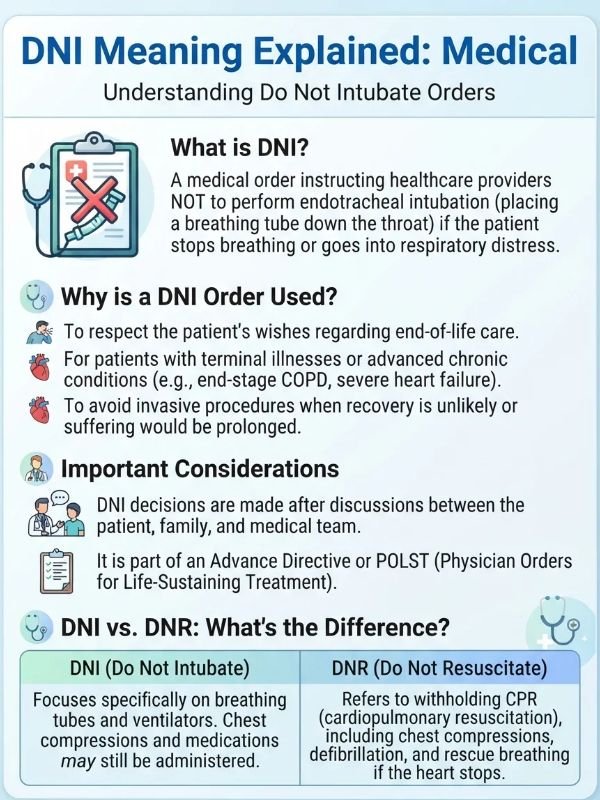
The tube connects the patient to a machine that helps with breathing. Some patients choose not to receive this treatment, often after talking with their doctors and families.
A DNI order is part of a patient’s care plan. It is written in the medical chart so every team member can see it. It is a serious legal and medical instruction, and it has no connection to the social media term.
DNR vs DNI
DNR means “Do Not Resuscitate.” DNI means “Do Not Intubate.” They are separate orders, and a patient can have one, both, or neither.
| Order | Full Form | What It Covers |
| DNR | Do Not Resuscitate | No CPR or chest compressions if the heart stops |
| DNI | Do Not Intubate | No breathing tube or ventilator placement |
These choices are personal and deeply tied to a patient’s wishes. Anyone facing this decision should speak with their doctor or care team. This article gives general information and cannot replace medical advice.
DNI Meaning Explained: Military / Federal Government
In United States government news, DNI stands for Director of National Intelligence. This person leads the country’s intelligence community and acts as the main intelligence adviser to the President.
Congress created the role in 2004, after the 9/11 attacks, to help agencies share information better. The DNI oversees many intelligence agencies, including those linked to the military. The office brings their work together into one picture for top leaders.
It also helps shape budgets and priorities across the community. News stories often use “the DNI” as a short title. If you read about a DNI briefing or a DNI report, it points to the Director of National Intelligence office.
DNI vs. the CIA Director
The DNI and the CIA Director are different jobs. The CIA Director runs one agency, the Central Intelligence Agency. The DNI oversees the whole intelligence community, which includes the CIA and many other groups.
Think of it like a coach and a team captain. The captain leads one team. The coach looks at the full group and plans how the pieces fit together.
Is DNI Rude? When to Use (and Avoid) It
DNI is not automatically rude. It is a boundary statement, and setting a boundary is a normal act. The rudeness comes from how someone words it. A clear and calm DNI is fine. A DNI full of insults or personal attacks is not. “DNI if you are mean to others” sounds firm and fair. “DNI if you are stupid” sounds hostile.
Use DNI when:
- You run a creator page and want to protect your space
- You manage a group that has clear rules
- You want to avoid repeated arguments on a topic
- You need to keep adult content away from younger users
Avoid DNI when:
- You are talking to someone who does not know the term
- You are writing to coworkers, teachers, or clients
- A full sentence would be clearer and kinder
- You want to start a fight and are using DNI as a weapon
How to Write Your Own DNI
A good DNI is short, clear, and fair. It tells readers exactly who should stay away. It does not insult anyone.
Follow these steps:
- Pick your conditions. Decide who or what you want to avoid.
- Write them as a list. Short lines are easy to scan.
- Keep the tone calm. A polite tone gets more respect.
- Place it where people look. Use your bio, pinned post, or profile page.
- Review it often. Update the list when your needs change.
Here are two sample versions you can adapt:
- “DNI if you send hate or start arguments. I am here for fun posts.”
- “DNI if you are under 18. This account shares adult humor.”
Keep your list focused. Ten rules are harder to follow than three.
How to Respond When Someone Says DNI
If a DNI note applies to you, the best response is to step back. Do not reply, tag, or message the person. A quiet exit is the most respectful answer. If the note does not apply to you, you can interact as normal. Just stay kind. Read the full list and make sure you fit the welcome group.
If someone sends you a DNI message in a chat, you can reply in a simple way:
- “Got it. I will stay out of your posts.”
- “Understood. Thanks for telling me.”
- “No problem. Take care.”
Avoid arguing or asking for reasons. People owe no long explanation for a boundary. A short and polite reply keeps things calm.
Frequently Asked Questions
What does DNI mean on social media?
DNI means “Do Not Interact” on social media. It asks certain people to avoid following, replying to, or messaging the account owner.
Is DNI the same as MDNI?
Not quite. MDNI means “Minors Do Not Interact” and asks people under 18 to stay away. DNI covers any group the writer lists.
What does DNI mean on a medical chart?
It means “Do Not Intubate.” The order tells the care team not to place a breathing tube in the patient.
What does DNI mean in ski and snowboard scoring?
It means “Did Not Improve.” A run scored lower than the athlete’s earlier scores, so the total stayed the same.
Who is the Director of National Intelligence?
The DNI is the senior official who leads the United States intelligence community. The role advises the President on intelligence matters.
How do you reply when someone writes DNI?
Step back and do not engage if the note applies to you. A short, polite reply like “Understood” is enough if you must answer.
Can you write DNI in a message to a friend?
Yes, if your friend knows internet slang. If not, a full sentence like “Please do not interact with me about that” is clearer.
Final Thoughts
DNI looks like a tiny term, but it carries a lot of weight. Online, it protects comfort and sets a boundary. In medicine, it records a patient’s choice. In sports and government, it follows rules of its own. Reading the context always shows which meaning fits.
When you meet a DNI online, treat it as a polite request. Step back if it applies to you, and write your own note with a calm tone if you need one. A short, kind boundary helps everyone enjoy the internet a little more.