

Cara mia is an Italian phrase that means “my dear” or “my darling.” It is a warm term of endearment. People use it for a woman or girl they love or feel close to. You may have heard it in songs, movies, or old romantic scenes.
So what does cara mia really mean? How do you say it the right way? And when should you use it? This guide answers all three questions in simple words. You will learn the meaning, pronunciation, and real examples. You will also see how to use this Italian phrase with confidence.
What Does Cara Mia Actually Mean?
Cara mia means “my dear” in Italian. It is a warm term of endearment. People use it for a woman or a girl they love, respect, or feel close to. The phrase has two words. Cara is an adjective. It means dear, beloved, or precious.
Mia is a possessive adjective. It means my. Put them together and you get “my dear.” The meaning is simple. The feeling behind it is what makes the phrase special.
Word by Word Breakdown
Each word does a clear job. The table below shows how the phrase works.
| Word | Part of Speech | Meaning | Extra Note |
| Cara | Feminine adjective | Dear, beloved, precious | Comes from the Latin word carus |
| Mia | Feminine possessive adjective | My, mine | Matches the feminine form |
| Cara mia | Phrase | My dear, my darling, my beloved | Works as a direct address |
Both words end in a. That is not an accident. Italian adjectives match the gender of the person they describe. Cara and mia are both feminine singular forms.
Cara has a second meaning in Italian. It can also mean expensive. Context tells you which one the speaker means. “Questa borsa è cara” means “This bag is expensive.” In cara mia, the meaning is always dear.
Literal Meaning vs. Emotional Meaning
The literal meaning is “my dear.” The emotional meaning goes deeper. It says, “You matter to me.” A grandmother may say it to her granddaughter. A husband may say it to his wife. A friend may say it during a warm chat. The same two words can feel tender, playful, or even firm.
Tone changes everything. Here are the common moods behind the phrase:
- Tender: said softly to someone you love
- Playful: said with a smile during a joke
- Teasing: said with a raised eyebrow
- Firm: said when you want someone to listen
Masculine and Plural Forms
Italian changes the phrase to match the person. You must pick the right form. The table makes it easy.
| Form | Who You Speak To | English Meaning |
| Cara mia | One woman or girl | My dear |
| Caro mio | One man or boy | My dear |
| Care mie | A group of women or girls | My dears |
| Cari miei | A group of men or a mixed group | My dears |
Saying cara mia to a man sounds wrong to Italian ears. Use caro mio instead. This small change shows respect for the language.
The Cara Mia vs. Mia Cara Thing
Cara mia and mia cara both mean “my dear.” Cara mia puts the stress on the endearment and sounds more spoken and emotional. Mia cara is the more neutral order and often appears in letters and messages.
Many learners feel confused here. Both phrases look almost the same. Both are correct Italian. The difference is small, but it is real. Italian grammar usually puts the possessive word before the noun. You say “la mia casa” for “my house.” Mia cara follows that normal pattern.
Cara mia flips the order. This flip is common in Italian when people speak to someone directly. Think of “amico mio” (my friend) or “figlia mia” (my daughter). The possessive comes last and adds warmth.
| Feature | Cara Mia | Mia Cara |
| Literal meaning | My dear | My dear |
| Word order | Adjective first | Possessive first |
| Feeling | Spoken, warm, emotional | Neutral, a little more polished |
| Common use | Talking to someone face to face | Letters, cards, written greetings |
| Example | “Cara mia, siediti.” | “Mia cara Anna, ti scrivo oggi.” |
When to Choose Each One
Use these simple rules and you will rarely go wrong:
- Choose cara mia when you speak to someone and want to sound warm.
- Choose mia cara when you open a letter, card, or message.
- Choose cara alone when you want a lighter, everyday greeting.
That last point matters. In Italian, “Dear Anna” is simply “Cara Anna.” Italians open many letters and emails this way. The word mia is optional, and it adds extra closeness.
Does the Meaning Change?
No. The meaning stays the same. Only the rhythm and the feeling change. Cara mia sounds a bit more dramatic. Mia cara sounds a bit more calm. Both tell the listener that you hold them dear.
How Italians Use Cara Mia in Real Life
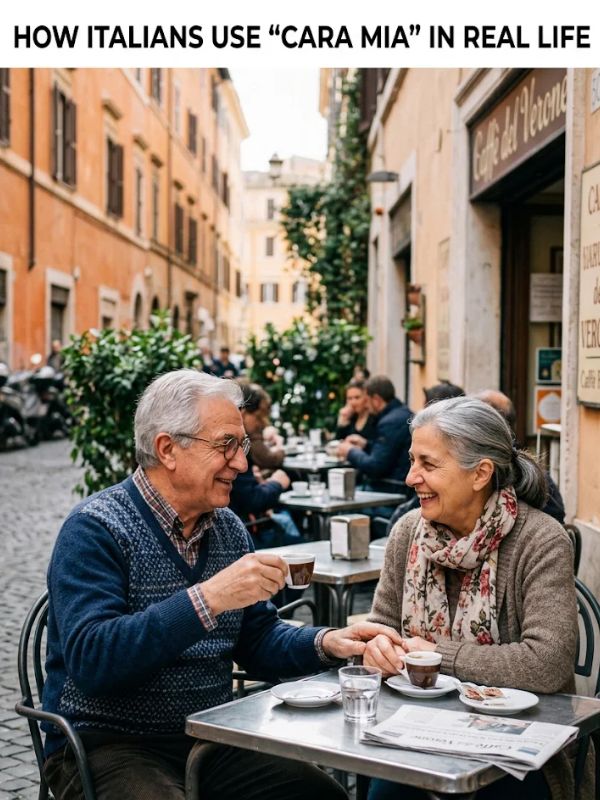
Italian speakers use cara mia in warm, personal moments. The phrase fits family, close friends, and partners. It also appears in teasing and in gentle advice. The phrase is not a business greeting. You would not use it with a stranger at a shop. It belongs in relationships where people already feel close.
Tender and Loving Moments
Here, cara mia works as a soft term of endearment. It expresses care, comfort, and love.
- A parent comforts a daughter after a hard day.
- A grandmother welcomes a granddaughter at the door.
- A partner whispers it during a quiet moment.
In these moments, the phrase feels like a hug in word form.
Teasing, Advice, and Scolding
Cara mia can also carry an edge. A speaker may use it when they want to make a point. The warm words soften the message, but the message still lands.
Imagine a friend who says, “Senti, cara mia, ora basta!” That means, “Listen, my dear, that’s enough now!” The tone is firm but still caring. Tone makes the difference. A smile makes it playful. A sharp voice makes it a gentle warning.
Real Life Examples With Translations
Study these short examples. They show how the phrase sits inside normal sentences.
| Situation | Italian | English |
| Greeting a loved one | Come stai, cara mia? | How are you, my dear? |
| Saying thanks | Grazie, cara mia. | Thank you, my dear. |
| Offering comfort | Non preoccuparti, cara mia. | Don’t worry, my dear. |
| Inviting someone closer | Vieni qui, cara mia. | Come here, my dear. |
| Showing love | Ti voglio bene, cara mia. | I care about you deeply, my dear. |
| Giving a firm warning | Attenta, cara mia! | Careful, my dear! |
| Opening a letter | Mia cara Giulia, | My dear Giulia, |
Notice the comma. Italians place a comma before or after cara mia when they address someone. This works like English “my dear.”
Who Can Use It?
Most native speakers use the phrase with people they know well. Family and close friends top the list. Romantic partners follow. You can use it as a learner too. Just keep it for warm situations. If you are unsure, a simple “cara” works well and carries less risk.
Pronunciation: How to Say Cara Mia Right
Say it as CAH rah MEE ah. Stress the first syllable in each word. Keep every vowel clear and open. Italian is a very regular language. You say each letter the way it looks. That makes cara mia easy once you learn a few sounds.
Sound by Sound Guide
| Part | How to Say It | Sounds Like |
| Ca | CAH | The “a” in “father” |
| ra | rah | A quick tap of the tongue for r |
| Mi | MEE | The “ee” in “see” |
| a | ah | The “a” in “father” again |
Written in phonetic form, the phrase looks like this: CAH rah MEE ah. Linguists often show it as [ˈkaːra ˈmiːa].
The Italian r is not like the English r. Tap the tip of your tongue once behind your upper teeth. Think of the quick “d” sound in the English word “butter.”
Common Pronunciation Mistakes
Many English speakers know the name Cara. They often say KAIR uh. That is a fine way to say the English name. It is not the Italian way.
Here are the usual slips:
- Saying KAIR uh: Use CAH rah instead.
- Squashing mia into one beat: Say MEE ah with two clear syllables.
- Stressing the wrong part: Put stress on CA and MI.
- Using a hard English r: Use a light tap.
Practice Tips
Say the phrase slowly. Then say it three times faster. Record yourself and compare your voice with an Italian song or movie clip. Short daily practice works better than one long session. Two minutes each day builds a natural sound.
What Language Is Cara Mia?
Cara mia is Italian. Italian is a Romance language that grew out of Latin. The word cara comes from the Latin word carus, which meant dear. Italian is the official language of Italy, Switzerland, San Marino, and Vatican City. Italian communities also live in the United States, Argentina, Brazil, Australia, and many other countries. Cara mia travels with them.
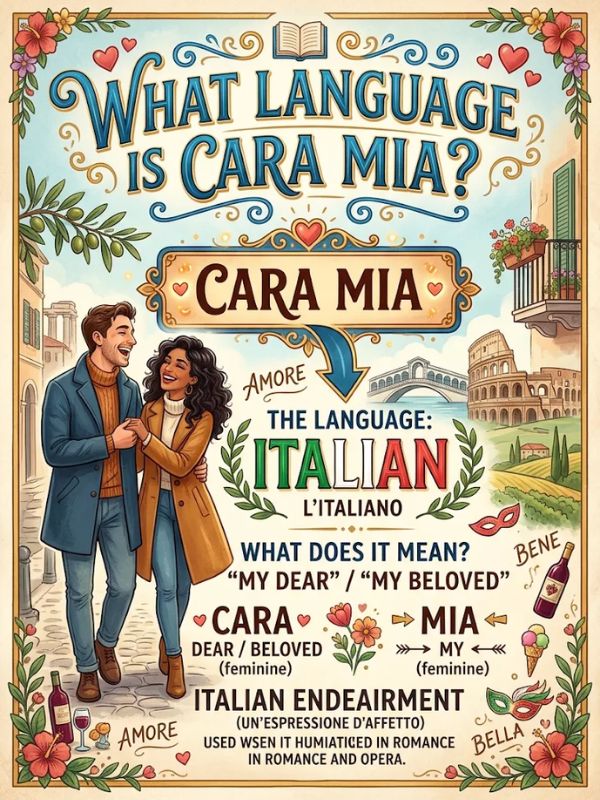
The word carus gave Italian its words caro and cara. Latin carus also meant costly. That explains why Italian cara can mean both dear and expensive. The two ideas grew from the same root.
Is Cara Mia Spanish or Portuguese?
No. This is a common mix up. Spanish and Portuguese are close cousins of Italian, but the phrase does not work the same way there. In Spanish, cara means face.
So “cara mía” in Spanish would mean “my face.” In Portuguese, cara also means face, and in Brazilian slang it can mean “guy.” That is why context matters. The phrase you see in songs and films is Italian.
The Latin Root in Short
- Carus (Latin): dear, beloved, costly
- Caro (Italian, masculine): dear, expensive
- Cara (Italian, feminine): dear, expensive
- Cara mia: my dear
Is Cara Mia Slang?
No. Cara mia is not slang. It is standard Italian. It is informal and affectionate, but it follows normal grammar and has existed for a long time. Slang means casual words that live inside a certain group or time. Think of short, trendy words that change every few years.
Cara mia does not fit that pattern. It is better to call cara mia a term of endearment. These are loving names people use for each other. English has “darling,” “sweetheart,” and “my dear.”
Slang vs. Standard Language
| Type | Example | Does Cara Mia Fit? |
| Slang | Casual trendy words | No |
| Abbreviation | Short forms in texting | No |
| Standard word or phrase | Words in a dictionary | Yes |
| Term of endearment | A loving nickname | Yes |
| Formal business language | Words for official use | No |
So cara mia sits in the middle. It is not formal. It is not slang. It is warm, everyday Italian for people who are close.
Register Matters
Linguists use the word register for the level of formality in speech. Cara mia has a relaxed, personal register. That is why it feels odd in a work email. Use it with people who feel like family. Skip it in contracts, interviews, and first meetings.
Cara Mia in Songs, Movies, and Pop Culture

Many English speakers meet the phrase through music and film. Pop culture gave cara mia a romantic, old world feel. Singer David Whitfield recorded a song called “Cara Mia” in 1954, and it topped the UK chart. Jay and the Americans released their own version in 1965, and it became a hit in the United States. These songs helped the phrase spread across English speaking countries.
The Addams Family Connection
Another famous use comes from The Addams Family. In the classic TV series and later films, Gomez Addams greets Morticia with the phrase. His dramatic, loving tone made the words famous to a whole new audience. That example shows the theatrical side of cara mia. It sounds passionate, playful, and a little bit grand.
Why Pop Culture Matters
Pop culture shapes how people hear a phrase. English speakers often link cara mia with romance, candlelight, and old songs. That image is charming, but real conversation in Italy can feel simpler and more casual. Knowing both sides helps you use the phrase with taste.
Other Italian Terms of Endearment You Can Use
Cara mia is lovely, but Italian has many other warm phrases. Some are more common in daily life. Here are the favorites.
| Phrase | Meaning | Feeling |
| Amore mio | My love | Romantic |
| Tesoro | Treasure, darling | Very common, family and partners |
| Tesoro mio | My treasure | Soft and loving |
| Cuore mio | My heart | Deep affection |
| Vita mia | My life | Strong love |
| Anima mia | My soul | Very romantic |
| Piccola mia | My little one (to a girl or woman) | Gentle, protective |
| Piccolo mio | My little one (to a boy or man) | Gentle, protective |
| Bella | Beautiful | Friendly compliment |
Which One Should You Pick?
Choose tesoro for general warmth. It works with children, partners, and close friends. Choose amore mio for romance. Choose cara mia when you want a classic, slightly poetic touch. Match the phrase to the person and the moment. That is how Italians choose too.
Gender Rules Apply
Most of these phrases change with gender. Piccola becomes piccolo for a male. Cara becomes caro. Check the ending every time.
Common Mistakes to Avoid When Using Cara Mia
A few small errors can spoil the phrase. Avoid these and you will sound natural.
- Writing “mi cara mia.” This form is not correct Italian. Mi means “me” or “to me.” It does not mean “my.” Say cara mia or mia cara.
- Using it for a man. Switch to caro mio.
- Using it with strangers or bosses. The phrase is personal. Save it for close relationships.
- Pronouncing it like the English name Cara. Say CAH rah, not KAIR uh.
- Ignoring tone. The same words can feel sweet or sharp. Watch your voice.
- Overusing it. Constant repetition can sound fake or theatrical.
Quick Fix Checklist
- Check the gender of the person.
- Check how close you are.
- Check your tone.
- Check your pronunciation.
Four quick checks keep you safe in almost every situation.
One Honest Observation
While checking sources for this guide, I noticed a pattern. Many pages on this topic copy each other. They repeat the same sentences, the same stock phrases, and the same mistakes.
Some pages teach “mi cara mia” as if it were correct. It is not. A few pages claim cara means “face” in Italian, which is true in Spanish but not in Italian. Others list regional versions of the phrase without any clear source. Treat those claims with caution.
Here is a second honest point. Cara mia is real Italian, but it can sound dramatic to many Italian ears. In everyday talk, people often reach for tesoro, amore, or a simple cara. English speakers love the phrase more because songs and films made it famous.
Frequently Asked Questions
What does cara mia mean in English?
Cara mia means “my dear” or “my darling.” It is an Italian term of endearment for a woman or girl.
How do you pronounce cara mia?
Say CAH rah MEE ah. Stress the first syllable of each word and keep the vowels open.
Is cara mia romantic?
It can be romantic, but it is not only romantic. Family members and close friends use it too.
Can you say cara mia to a man?
No. Use caro mio for a man or a boy. Cara mia is for a woman or a girl.
Is cara mia the same as mia cara?
Yes. Both mean “my dear.” Cara mia sounds more spoken, while mia cara is common in letters.
Is cara mia Italian or Spanish?
It is Italian. In Spanish, cara means “face,” so “cara mía” would mean “my face.”
How do you reply to cara mia?
There is no fixed reply. You can say “Grazie” or answer with a warm phrase like caro mio.
Final Thoughts
Language carries feeling as well as meaning. Cara mia proves it. Two short words can turn a plain sentence into a warm gesture. Use the phrase with care, a gentle tone, and the right person in mind. When you do, it will sound natural, and it will mean what it should: you matter to me.