


You see “NTR” in a chat, a comment, or an anime thread. Now you wonder what it means. The answer depends on where you see it. In anime and slang, NTR usually stands for Netorare, a Japanese term about a partner being taken by someone else. In texts and work chats, NTR often means “Nothing To Report.”
This guide explains the NTR meaning in text, slang, and anime in simple words. You will learn the full form, the origin, and real chat examples. You will also see how to tell which meaning a person uses. Read on to use NTR with confidence and avoid awkward mistakes.
What Does NTR Mean?
NTR is an abbreviation with more than one meaning. The right meaning depends on where you see it and who writes it.
Here is the short list:
- Netorare: A Japanese fandom term about betrayal and a partner being stolen.
- Nothing To Report: A plain status update used at work, in logs, and in quick texts.
- Need To Respond: A rare reminder, mostly used by people who write it to themselves.
- NTR as a name: In South Asia, many people link it to the Telugu film star N. T. Rama Rao and his grandson, known as Jr NTR.
Anime and gaming spaces use the first meaning. Office and professional chats use the second.
NTR Meaning in Text
In a text message, NTR is short for a phrase. The sender wants to save time or add a joke. The meaning changes with the person, the topic, and the app.
If a coworker texts “NTR from my side,” they mean “Nothing To Report.” If a friend in an anime Discord server types “that plot is so NTR,” they mean the betrayal trope.
NTR Full Meaning (What NTR Stands For)
NTR stands for:
| Full Form | Where You See It | Tone |
| Netorare | Anime, manga, visual novels, fandom chats | Dramatic, adult, controversial |
| Nothing To Report | Work, logs, quick updates | Neutral, professional |
| Need To Respond | Personal notes, busy chats | Casual, rare |
Netorare is the most searched meaning. It is also the one people feel unsure about, so this article spends the most time on it.
What Is the Meaning of NTR in English
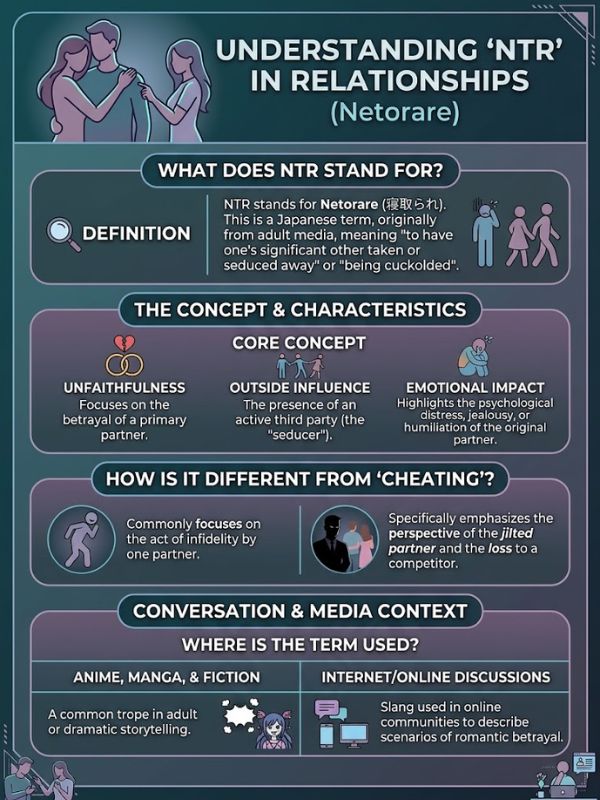
There is no single English word for Netorare. The closest idea is “having your partner stolen from you.” Some fans also use the English word “cuckolding” to describe a similar theme, though the two terms are not identical.
In plain English, NTR means a story or situation built around betrayal in a romantic relationship. The focus is the pain, shock, and jealousy of the person who loses their partner.
NTR Japanese Origin Explained
Netorare comes from the Japanese verb netoru, which means “to steal someone’s partner.” The form netorareru is passive. It means “to have your partner stolen.” Fans shortened it to NTR when they typed it in Latin letters.
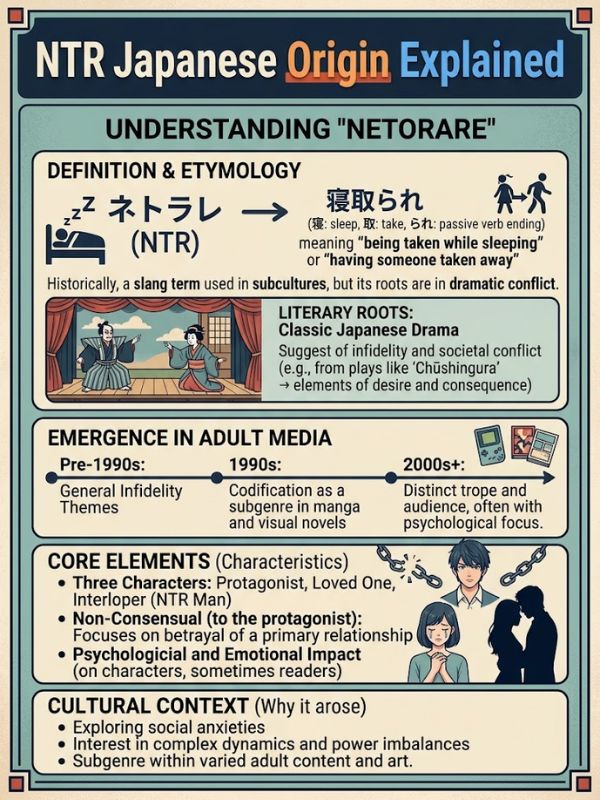
That detail matters. The word does not describe the person who steals. It describes the person who suffers the loss. This is why the genre centers on the hurt character.
Japanese forums and fan communities began using the short form NTR as the trope grew popular in adult comics and games. English speaking fans later picked it up from translated works and online boards.
Two related terms also exist:
- Netori: The act of taking someone else’s partner, told from the other side.
- Netorase: A situation where one partner arranges or allows it. This is a different theme.
Most people online use plain “NTR” for all of them.
NTR Meaning in Anime
In anime and manga fandoms, NTR is a label for a story type. Fans use it to warn others about plot content. A good warning saves readers from surprise.
The label usually points to adult oriented works. Many NTR stories are rated for mature audiences only. If you are under 18, treat the term as something to understand, not something to search for.
NTR in Anime Chats and Fandom Use
Fans use NTR in three common ways:
- As a warning: “Heads up, this volume has NTR.”
- As a joke: “My favorite ship got NTR’d in the latest episode.”
- As a complaint: “I dropped the series after the NTR twist.”
The word also works as a verb. Fans write “NTR’d” or “got NTR’d” to say a character lost their partner in the story. Some fans use it for any love triangle that ends badly, even when the story is mild.
NTR as a Story Genre
As a genre, NTR follows a simple pattern. A character has a partner. A third person enters the picture. The partner is taken or pulled away. The story then focuses on the emotional fallout.
Writers use this pattern to create tension, jealousy, and regret. Some stories aim to shock. Others explore trust and loss.
Fans often split the genre by who suffers and how the story ends. That is why you will see tags in fan databases such as “NTR warning” or “no NTR.” Readers use them to pick stories that fit their taste.
Why It’s a Controversial Trope Among Fans
Many fans dislike NTR. They read romance to feel joy, and the trope delivers hurt instead. Some viewers feel upset when a favorite character gets betrayed.
Critics also say the trope can treat relationships in an unhealthy way. Defenders say fiction lets people explore dark feelings without real harm. Both sides argue loudly on forums.
Because of this, fans treat the tag as a spoiler warning. Posting NTR content without a label often starts fights. Good community manners say: tag it and let people choose.
Does NTR Mean Anything Else?
Yes. NTR has everyday meanings that have nothing to do with anime. Many people use these meanings every day without any link to fandom. If you skip this section, you may misread a harmless message. A simple “NTR” from your manager does not mean what a fan means.
NTR as “Nothing To Report” or “Need To Respond”
Nothing To Report is the older and safer meaning. People use it in shift notes, security logs, hospital handovers, and team updates. It tells the reader that nothing important happened.
Example: “Night shift update: NTR.”
Need To Respond is rare. People use it as a quick reminder in notes or to flag messages they must answer later. It is not a common standard abbreviation, so always check with the sender if it is unclear.
Example: “Mom’s message, NTR tonight.”
How to Tell Which Meaning Is Being Used
Look at the clues around the word. A few seconds of checking prevents most mix ups.
Use this checklist:
- Platform: Work apps like Slack or email lean toward “Nothing To Report.” Anime servers lean toward Netorare.
- Topic: Reports and updates point to “Nothing To Report.” Romance plots point to Netorare.
- Sender: A coworker and an anime fan use the word differently.
- Punctuation and tone: Jokes, emojis, and “NTR’d” point to the anime meaning.
- Position: A stand alone “NTR” at the end of an update usually means “Nothing To Report.”
When you still feel unsure, ask: “Do you mean Nothing To Report?” It is a polite and quick question.
Origin and Evolution of NTR
NTR began as a niche label in Japanese fan circles. It helped readers sort stories by theme. Over time, translated manga and visual novels carried it overseas.
Then social media did the rest. Short posts, memes, and reaction clips pushed the term outside fandom. People who never read the original works started to repeat it.
The meaning also stretched. Today, some users apply NTR to any situation where someone loses something to a rival. A gamer might say “my teammate NTR’d my loot.” That use is a joke, and it is far from the original meaning.
Here is a simple timeline:
| Stage | What Happened |
| Early use | Japanese fans tag stories about stolen partners |
| Spread | Translated works and forums introduce the short form NTR |
| Meme era | Clips and jokes carry the term to wider audiences |
| Today | Used as a genre label, a joke, and a general slang word |
Psychological and Emotional Meaning of NTR
NTR stories work on strong feelings. The main ones are jealousy, insecurity, loss, and fear of being replaced. These feelings are common in real life, which is why the theme hits hard.
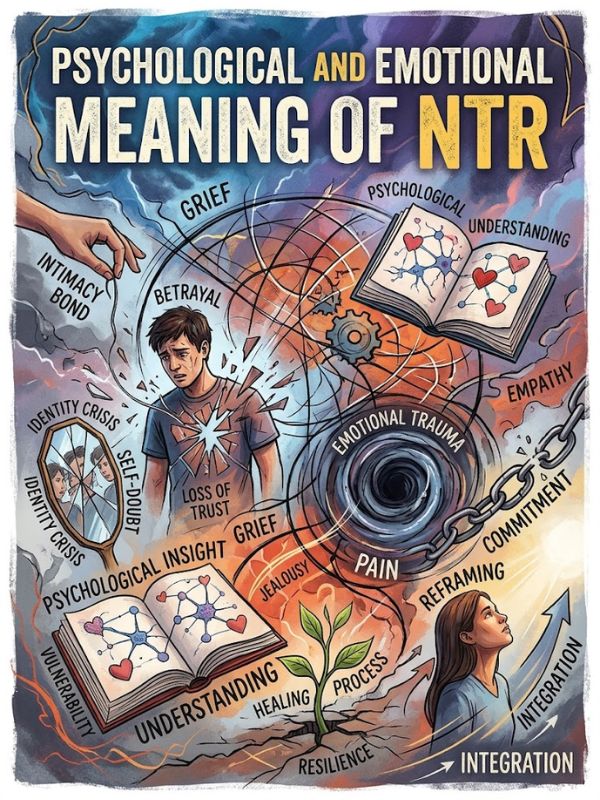
Some readers say they feel drawn to the tension, even when it hurts. Others feel pure discomfort and leave. Neither reaction is wrong. People enjoy fiction for very different reasons.
Psychologists often note that people use stories to safely explore emotions they fear. Fiction gives distance. A reader can feel the fear of betrayal without facing it in real life. This is a general idea about storytelling, not a claim about any one fan.
Communication Function of NTR
Slang does a job. It saves time, sets a tone, and signals who belongs to a group. NTR does all three. In a work chat, NTR keeps updates short. Two letters replace three words. In a fan chat, NTR works as a tag, a joke, or a warning in one word.
Slang also builds trust within groups. When you use the term correctly, others see you as someone who understands the space. When you use it wrongly, people may find it awkward or confusing.
That is why context matters more than the letters themselves. The same word can be polite in one group and edgy in another.
Cultural and Generational Context of NTR
Different groups know NTR differently. Anime fans know Netorare. Office workers and healthcare staff know “Nothing To Report.” Fans of Telugu cinema may think of the actor first. Culture shapes the first guess. A teen in a gaming community and a nurse on a night shift will read the same three letters in two different ways. Neither is wrong.
Older people tend to know the “Nothing To Report” use. Younger people online tend to meet the anime use first. This gap causes many funny and awkward misunderstandings.
Why NTR Became Popular
Several things pushed NTR into wide use. None of them came from a single event.
- Short form appeal: Three letters are easy to type.
- Fandom growth: Anime and manga reached more countries every year.
- Meme culture: Clips, edits, and reaction posts spread the word.
- Shock value: Controversial terms attract clicks and search traffic.
- Curiosity: People search for what they do not understand.
Search interest also grows because the term is confusing. When a word has several meanings, people look it up to avoid mistakes. This article exists for that reason.
Semantic Core Meaning of NTR
Strip away every context, and one idea stays at the center. NTR is about loss to another party. In anime, the loss is a partner. In casual joking, the loss is an item, a spot, or a win. In reports, the idea flips: nothing was lost, nothing happened.
Related terms people link to NTR include betrayal, infidelity, love triangle, cheating trope, jealousy, rival, and fan warning tag. Knowing these related words helps you read a thread faster.
A simple way to remember it:
- Anime meaning: A partner is taken.
- Work meaning: Nothing to say.
- Joke meaning: Something got stolen.
Most Common NTR Meaning in Text (Deep Dive)
In casual online chats, the most common meaning of NTR is Netorare. In professional chats, the most common meaning is “Nothing To Report.”
Why the split? Platform culture decides. Fan communities on Discord, Reddit, and X talk about stories all day, so Netorare dominates there. Workplace tools reward brief updates, so “Nothing To Report” dominates there.
If you see NTR in a private text from a friend, think about what you two usually talk about. If you share an interest in anime, the odds favor Netorare. If the message is a status update, the odds favor “Nothing To Report.”
Never assume. One quick question clears the confusion.
Meaning Based on Context
Use this table as a fast decoder.
| Where You See It | Likely Meaning | Example |
| Anime Discord server | Netorare | “Skip that manga, it has NTR.” |
| Work chat or email | Nothing To Report | “Status: NTR.” |
| Hospital or security log | Nothing To Report | “Shift summary: NTR.” |
| Gaming voice or text chat | Joke use of “stolen” | “He NTR’d my kill.” |
| Personal reminder note | Need To Respond | “Landlord text, NTR.” |
| South Asian film fan page | The actor N. T. Rama Rao or Jr NTR | “Jr NTR’s new film trailer.” |
When two meanings could fit, pick the one that matches the group and the topic. That rule works almost every time.
NTR Meaning in Urdu
Urdu speakers meet NTR in anime, gaming, and social media spaces, often through English chats. The word does not have a direct Urdu equivalent.
In Urdu terms, the anime meaning is close to شریکِ حیات کا کسی اور کے ہاتھوں چھن جانا, which means a partner being taken away by someone else. A simple way to say it is محبت میں دھوکہ, meaning betrayal in love.
For “Nothing To Report,” Urdu speakers can say رپورٹ کرنے کے لیے کچھ نہیں. In South Asia, people also see NTR as the name of the famous Telugu actor, so context matters here too. Check the topic before you decide.
NTR Meaning in Relationship
In a relationship chat, NTR almost always connects to the anime idea of betrayal. People use it as a joke, a tease, or a serious worry. The tone decides everything. Tone clues matter more than the word.
A laughing emoji points to humor. A cold, short message points to real concern. Read the whole conversation, not just the letters. If you are not sure, ask directly. A calm question protects trust better than a guess.
Romantic Betrayal Context
Some people use NTR to describe real life betrayal, such as a partner leaving for someone else. Using the term this way can feel flippant to the hurt person. Real pain deserves plain words.
If someone shares a painful breakup, do not answer with the slang term. Say something kind and clear instead, like “I’m sorry that happened to you.” Slang works for jokes about fiction. It works poorly for real heartbreak.
How Couples Use NTR in Chat
Couples who both know the anime meaning often use it as a tease. One partner may send a meme about a love triangle and add “NTR.” The other partner laughs and replies with a joke.
Here is how tone changes the meaning:
| Style | Example | What It Means |
| Joking | “If you watch that show without me, it’s NTR 😂” | Playful teasing |
| Teasing | “Don’t NTR me for that new game” | Light rivalry |
| Serious | “Be honest, is this NTR?” | Real worry about loyalty |
If a joke makes your partner uneasy, stop. Jokes about betrayal can sting, even when you mean no harm.
NTR Meaning in Social Media
Each app has its own flavor. The word moves around, but the main meanings stay the same. Here is what to expect on the big platforms.
NTR on Snapchat
On Snapchat, people use NTR in short, fast chats. It may mean “Nothing To Report” in a casual reply, such as when a friend asks “anything new?” and you say “NTR.” Anime fans may also use it in jokes and captions.
NTR on TikTok
TikTok is where many young users first meet the term. Creators use it in meme edits, reaction clips, and fandom videos. Most posts refer to the anime trope or joke about someone losing a rival contest.
Always check the caption and comments. They usually show which meaning the creator intends.
NTR on Instagram and WhatsApp
On Instagram, NTR shows up in comments, story replies, and fan pages. On WhatsApp, it appears more in private and group chats. Both apps see the “Nothing To Report” use in work groups and the anime use in friend groups.
South Asian users may also see it tied to film star fan pages. If you see a movie poster, the actor meaning is likely.
NTR on Discord and Reddit
Discord and Reddit hold the deepest NTR talk. Anime servers and manga subreddits use it as a content tag. Moderators often ask users to mark such posts clearly or hide them behind spoiler tags. Gaming servers use it in jokes. Always read the channel rules before you post.
Real Chat Examples of NTR in Use
Real examples make the word easier to spot. Here are common patterns, split by meaning.
Anime and fandom use
- “Does this manga have NTR? I want to avoid it.”
- “That plot twist was pure NTR. I’m done.”
- “Please tag NTR spoilers.”
Nothing To Report use
- “Morning check: NTR overnight.”
- “Any issues on the line? NTR.”
- “Weekly update from me: NTR.”
Gaming and joke use
- “You NTR’d my loot again!”
- “He walked in and NTR’d our whole team’s spot.”
Need To Respond use
- “Client email, NTR by 5 pm.”
- “Sister’s call, NTR later.”
Notice the pattern. Topics and tone reveal the meaning almost every time.
NTR vs Similar Slang Terms
NTR sits beside several other short terms. People often mix them up. This table separates them.
| Term | Meaning | How It Differs From NTR |
| NTR | Netorare, or Nothing To Report | Depends on context |
| NR | No reply, or no response | Shorter and less specific |
| NTM | Nothing much | Casual reply to “what’s up?” |
| NVM | Never mind | Dismisses a topic |
| NSFW | Not safe for work | Content warning, not a plot type |
| NTA | Not the a**hole | Reddit judgment term |
| Cuckold | A man whose partner cheats | English word, related but not identical to NTR |
The closest “everyday” match to the work meaning is NTM, but NTM answers “what’s up?” while NTR reports on status.
Is NTR Appropriate to Use?
It depends on who is listening. The anime meaning belongs in fan spaces. The work meaning fits professional notes. Mixing them up causes trouble. Use this rule: if you would not explain the meaning to a stranger, do not use the term in a mixed group.
Is NTR Rude or Offensive?
The word itself is not a swear word. The anime meaning, though, connects to adult themes and betrayal. Some people find it uncomfortable or inappropriate.
The “Nothing To Report” meaning is perfectly polite. Problems appear only when someone reads the anime meaning into a harmless message, or when you use the anime meaning around people who do not want it.
When in doubt, spell it out.
Should You Use It at School or Work?
At work, use NTR only for “Nothing To Report,” and only when your team already uses it. Write the full phrase the first time so everyone understands.
At school, avoid the anime meaning. It links to adult content, and many schools restrict it. Choose clear words over slang when teachers or staff might read your message.
Who Uses NTR and Why It Went Mainstream
Three groups use NTR most often: anime fans, gamers, and busy workers. Each group needs short, clear shorthand. NTR gives them that. The term went mainstream because platforms reward short, shareable words. Memes and clips took a niche label and gave it to millions of users.
Gen Z vs Millennial Usage
Gen Z users meet NTR mostly through anime, TikTok, and gaming. They often use it as a joke or a fandom tag. Millennials meet it in work chats, shift notes, and older internet forums, so they lean toward “Nothing To Report.”
This split creates fun confusion. A millennial manager writes “NTR” and a Gen Z intern wonders if something is wrong. A quick clarification fixes it.
How TikTok Popularized the Term
TikTok spreads terms fast. A single viral clip can introduce thousands of users to a word they never saw before. Creators remix the idea, add captions, and pass it along.
As more people watched these clips, more people searched “NTR meaning.” That wave of curiosity helped the term spread far beyond fan communities.
How to Reply When Someone Says NTR
Your reply depends on the meaning. First, check the context. Then choose a response that fits.
If it means Nothing To Report:
- “Thanks for the update.”
- “Got it. Let me know if that changes.”
If it means Need To Respond:
- “No rush. Reply when you can.”
- “Want me to remind you later?”
If it means the anime term:
- “Thanks for the warning.”
- “Not my favorite genre either.”
- “Is it tagged? I’d like to skip it.”
If you do not know:
- “Quick question: what does NTR mean here?”
Asking is never rude. It shows you care about getting the message right.
Frequently Asked Questions
What does NTR mean in text?
NTR in text most often means Netorare in fan chats and “Nothing To Report” in work or status messages. Context tells you which one.
What does NTR mean in slang?
In slang, NTR usually refers to the Japanese betrayal trope Netorare. Some people also use it jokingly when someone “steals” something.
What is full form NTR?
The common full forms are Netorare and Nothing To Report. Need To Respond is a rare third use.
Is NTR the same as “Need To Respond”?
No. Need To Respond is a separate and much less common meaning. Check the context before you assume.
Is NTR always about anime?
No. It also appears in work logs, quick chats, and as the name of a famous Telugu actor.
Is it okay to use NTR casually?
Yes, as “Nothing To Report” with people who know it. Avoid the anime meaning around people who may not want that topic.
Why do gamers say NTR?
Gamers often borrow the anime term for jokes about losing a rival contest or having something taken. They also sometimes use it to mean “Nothing To Report” during team updates.
Final Thoughts
NTR is a small word with several big meanings. Anime fans use it for stories about stolen partners. Workers use it for “Nothing To Report.” Others use it as a joke or as a name. The best way to decode it is to read the context, the platform, and the tone.
When you feel unsure, ask a quick question or use the full phrase. Clear words keep chats friendly, avoid awkward moments, and help you use slang with confidence.